The decision seems straightforward. A patch of mold appears on food, and the instinct is to act on what is visible — cut around it, or throw the whole thing away. Most people have a rule they follow, even if they couldn’t explain where it came from.
The problem is that the rule is usually based on the wrong model. Mold contamination is not a surface event. It is a structural process, and the visible patch — the fuzzy growth, the discoloration — is not the contamination itself. It is the signal that contamination is already established, and has been for some time.
What Mold Actually Is Inside Food
Mold grows as a network, not a spot. The organism extends through food via hyphae — microscopic filaments that penetrate the food matrix, drawing nutrients from the interior while the visible reproductive structures form at the surface. What you see when mold becomes visible is the part built to release spores. The part doing the actual work has been growing beneath it.
This distinction matters because it reframes what cutting away the visible growth actually accomplishes. In a soft, high-moisture food, the hyphal network has typically extended well beyond the visible boundary by the time surface growth appears. Removing the surface leaves the network intact and embedded in the food.
In denser foods, the physics are different. Compact cell structure slows hyphal movement, and contamination is more likely to remain localized — which is why different foods genuinely require different decisions.
Four Variables That Determine Actual Risk
Rather than applying a single rule to all moldy food, the more useful framework involves four variables that interact to determine how mold behaves in a specific situation.
Moisture is the primary driver. High water content accelerates both growth rate and penetration depth. Soft, wet foods create environments where hyphae travel quickly and deeply; dry, low-moisture foods slow this process significantly.
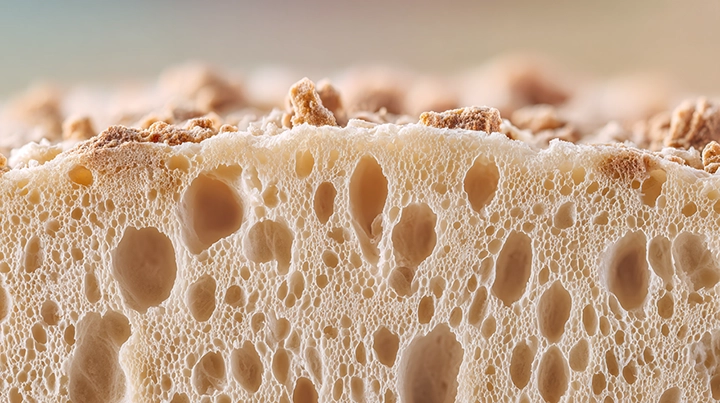
Structure determines resistance. Porous foods — bread, cooked grains, soft fruit — offer almost no physical barrier to hyphal movement. Dense foods — hard cheeses, firm root vegetables, whole produce — present structural resistance that limits how far contamination can travel before the food’s integrity breaks down.
Time governs extent. The longer mold has been growing before it becomes visible, the further the network has extended. A small visible spot that developed overnight represents less internal spread than a small visible spot that developed over a week.
Visibility reliability varies by food type. In soft materials, surface appearance is a poor proxy for internal contamination — the actual extent is almost always greater than what is visible. In dense materials, the relationship between visible and actual contamination is tighter, which makes the cutting approach more defensible.
These four variables together explain why “cut it off” works sometimes and fails other times. The answer depends on the food, not the size of the spot.

High-Moisture Foods: Why the Rule Is Always Discard
Bread, cooked leftovers, soft fruit, yogurt, jam, deli meat, and similar products share two characteristics that make them categorically different from dense foods: high water content and open structure. Both accelerate hyphal penetration, and both reduce the reliability of visual inspection as a guide to contamination extent.
In these foods, by the time a visible patch appears, the hyphal network has typically distributed through a significant portion of the surrounding material. Bacteria often develop alongside mold in these environments, adding a secondary contamination layer that is independent of the fungal growth.
Surface removal in these cases is not partial decontamination. It is removal of the visible indicator while leaving the underlying system intact.
Dense Foods: Where Structure Creates a Different Calculation
Hard cheeses, firm carrots, apples, cabbage, and similar products behave differently. Their compact structure slows hyphal movement, and contamination in these foods is genuinely more likely to remain localized near the visible growth.
The USDA guidance for these foods — cutting at least 2 to 3 centimeters around and below the visible mold, using a clean knife, keeping the cut surface away from the remaining food — reflects this structural reality. The margin accounts for the possibility that hyphae have extended beyond the visible boundary; the distance is intended to clear that extension with room to spare.
This approach is only appropriate when the surrounding food is intact: firm texture, normal smell, no signs of softening or internal discoloration. Once those signs are present, the contamination has likely extended beyond what the cutting margin can address, and disposal is the appropriate response.
When Mold Is Intentional
A separate category exists for foods where mold is not contamination but process. Blue cheeses rely on Penicillium roqueforti; brie and camembert develop their rinds through Penicillium camemberti. These organisms are part of controlled fermentation — selected strains, managed inoculation, defined environmental conditions, monitored outcomes.
The safety of these products comes from the control, not from the organism itself. The same genus that produces the veining in Roquefort also produces common food spoilage molds. What differs is the context: known strain, controlled conditions, predictable outcome versus unknown environmental contamination with unpredictable behavior.
If unexpected mold appears on these products — different color, unfamiliar growth pattern, surface breakdown beyond the rind — the controlled system has been disrupted. At that point, the product should be discarded regardless of the category it normally belongs to.

The Mycotoxin Problem
The most significant risk in moldy food is often not the mold itself but the compounds certain molds produce. Mycotoxinsare chemically stable secondary metabolites — produced by certain fungal species under specific conditions — that persist in food after the organism that made them is gone. They are not destroyed by cooking. They produce no smell or visible indicator. They can be distributed through food independently of any visible growth.
Not all molds produce mycotoxins, and not all conditions favor their formation. The problem is that none of this is assessable without laboratory testing in a household setting. There is no color, no smell, no texture change that reliably indicates mycotoxin presence or absence.
This is the logic behind conservative food safety guidance on soft foods. The guidance does not assume that every piece of moldy bread contains dangerous mycotoxins. It assumes that the uncertainty is real and unresolvable at home, and that the cost of discarding food is lower than the cost of repeated exposure to compounds that may be present at harmful levels.
What Consumption Actually Risks
For typical household exposure — eating a small amount of mold-contaminated food without realizing it — the immediate outcome is usually mild: nausea, gastrointestinal discomfort, or irritation in sensitive individuals. These effects reflect the body’s response to foreign biological material rather than acute toxicity.
The more significant risk profile is associated with sustained exposure to mycotoxin-contaminated food over time, particularly in agricultural contexts where commodity grain, nuts, or dried fruit may carry contamination at levels that accumulate with repeated consumption. Aflatoxins — produced primarily by Aspergillus flavus and Aspergillus parasiticus in warm, humid storage conditions — are among the most studied, with documented associations with liver damage under prolonged exposure.
For single household incidents, this level of risk is unlikely. The relevant concern is repeated exposure to unknowingly contaminated food over extended periods, which is a different scenario from a single visible mold spot on a piece of bread.
Prevention as the Only Reliable Strategy
Once mold is visible, the contamination has already progressed. The more effective intervention is upstream: conditions that prevent mold from establishing in the first place.
Mold requires moisture, appropriate temperature, and time. Refrigeration slows growth rate across almost all relevant species. Proper sealing reduces the moisture exchange that allows mold to establish on surfaces. Timely consumption reduces the time available for growth to progress from invisible to visible.
These interventions do not guarantee mold-free food indefinitely, but they substantially compress the window in which contamination can develop undetected. Prevention is the only stage where the four risk variables — moisture, structure, time, visibility reliability — can all be managed simultaneously.
FAQ
Can you safely cut mold off food and eat the rest? Only in dense, low-moisture foods where contamination is likely to remain localized — hard cheese, firm vegetables, whole firm fruit. Remove at least 2–3 centimeters beyond the visible growth. Soft foods should always be discarded.
Does cooking kill mold and make food safe? Cooking kills mold organisms but does not reliably eliminate mycotoxins, which are heat-stable. Cooked moldy food is not necessarily safe food.
Why is moldy bread always unsafe to eat? Because its porous structure allows rapid internal spread of the hyphal network, making the visible patch an unreliable indicator of actual contamination extent.
Are all molds dangerous? No — but there is no practical way to distinguish mycotoxin-producing molds from non-producing ones without laboratory testing. Conservative guidance reflects this unresolvable uncertainty.
What is the biggest risk that isn’t visible? Mycotoxins — chemically stable compounds that can be present throughout food independently of visible mold, undetectable by appearance, smell, or taste.
References
- USDA FSIS — Molds on Food: Are They Dangerous?: https://www.fsis.usda.gov/food-safety/safe-food-handling-and-preparation/food-safety-basics/molds-food-are-they-dangerous
- BBC Food — Mold and Fermentation: https://www.bbc.co.uk/food/articles/c309yq16qm6o
- European Environment Agency — Mycotoxin Exposure in a Changing European Climate: https://www.eea.europa.eu/en/analysis/publications/mycotoxin-exposure-in-a-changing-european-climate