According to nature india
I. Transforming Waste with Biology: The Fungal Engineering Breakthrough
Fungi can transform agricultural and paper wastes into biodegradable materials that can be engineered to mimic the properties of plastic foam used for packaging¹.
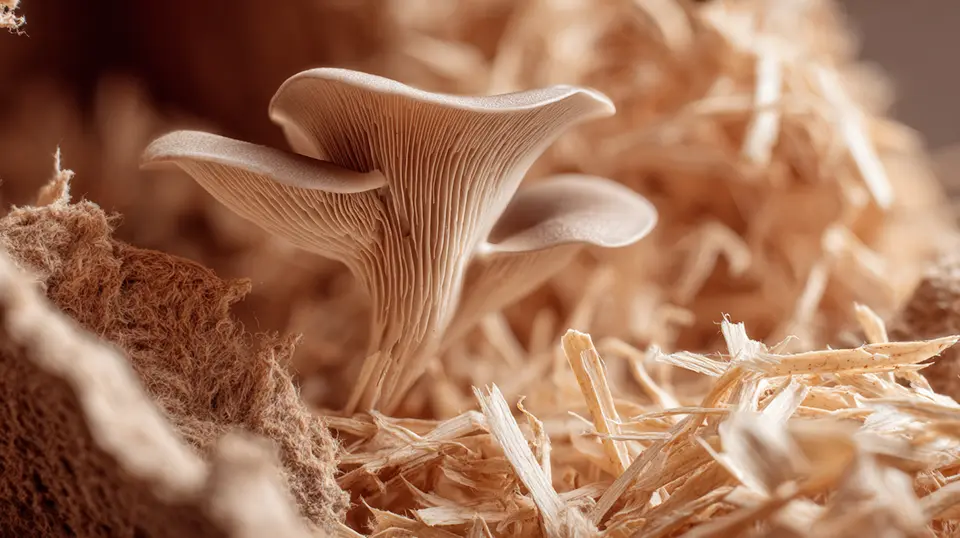
Plastic waste often piles up in landfills or leaks into oceans, harming wildlife and ecosystems. To address this, scientists at the Indian Institute of Technology Madras (IIT Madras) in Chennai allowed two well-known fungi — the oyster mushroom and the reishi mushroom — to grow on sawdust, coconut husk, hay, paper, and shredded cardboard.

Source: Wikimedia Commons, CC BY-SA 4.0
II. Mycelium as Natural Glue: How Fungi Build Foam-Like Materials
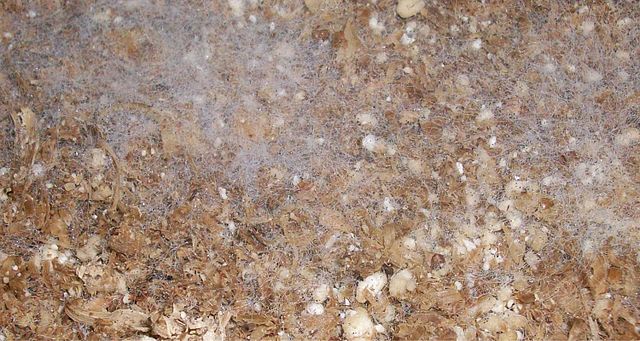
The fungal roots grew through these substrates, weaving them together like natural glue. After about two weeks, the roots completely colonized the material, forming a solid, lightweight, foam-like block that easily breaks down in soil.
After six weeks, some samples — particularly oyster mushroom grown on cardboard — lost up to 80% of their weight. The rest decomposed steadily, returning nutrients to the soil without leaving toxic residue.
Source: Wikimedia Commons, CC BY-SA 4.0
III. Strength, Water Resistance, and Compostability: A Viable Polystyrene Replacement
The reishi mushroom–cardboard composite was the strongest, while the oyster mushroom–sawdust composite also performed well. These composites repelled water, and some samples resisted moisture better than expanded polystyrene.
This means they could tolerate short-term moisture exposure, making them suitable for wrapping electronics or food items, the researchers note.

Source: Wikimedia Commons, CC BY-SA 4.0
References
- UN Environment Programme (UNEP). Plastic Waste Crisis.
- Indian Institute of Technology Madras. Research Division.
- Pleurotus ostreatus – Oyster Mushroom.
According to nature india
Key Takeaways
- Agricultural and forestry waste streams (straw, hemp hurds, sawdust, corn stover) combined with fast-growing fungal mycelium can be transformed into compostable packaging foams, replacing expanded polystyrene in protective packaging applications.
- Mycelium foam packaging has been commercially produced by Ecovative Design since 2014 and is used by Dell, IKEA, and other corporations as a biodegradable alternative to EPS in product shipping.
- The production process is energy-efficient: mycelium composites form at ambient temperature and pressure within 5–7 days, compared to the energy-intensive petroleum cracking and blowing agent injection required for EPS.
- Mycelium packaging fully biodegrades in home compost within 45 days, compared to 500+ years for EPS (which never fully degrades and generates microplastic particles throughout its long breakdown).
- Cost remains the primary barrier to widespread adoption: mycelium packaging currently costs approximately 2–5× more than equivalent EPS per unit, though costs are declining as production scales.
Frequently Asked Questions
How is mycelium packaging made?
Mycelium packaging production involves several steps. First, an agricultural waste substrate—typically hemp hurds, corn stover, or wood chips—is combined with water and sterilised. The substrate is then inoculated with a selected fungal species (Ganoderma lucidum and Pleurotus ostreatus are commonly used) and packed into moulds in the shape of the desired packaging component. Over 5–7 days at ambient temperature, the fungal mycelium grows through the substrate, binding the particles together into a cohesive composite. The mould is then removed, and the material is heat-treated at approximately 70°C to kill the fungus and stop further growth, stabilising the product. The result is a lightweight, rigid foam-like material that can be produced in virtually any shape.
How does mycelium foam compare structurally to EPS?
Mycelium foam and expanded polystyrene (EPS) serve similar protective packaging functions through different structural means. EPS is a closed-cell petroleum foam with extremely low density (typically 15–30 kg/m³), very high compressive strength for its weight, and excellent thermal insulation. Mycelium foam has slightly higher density (typically 50–100 kg/m³), lower compressive strength than EPS at equivalent density, but comparable or better energy absorption (cushioning) characteristics for fragile item protection in shipping. It has higher water vapour permeability than EPS (which can be advantageous for certain perishable products). For most standard protective packaging applications—protecting electronics, appliances, and fragile goods during shipping—mycelium foam performs comparably to EPS within normal temperature and humidity ranges.
What happens to mycelium packaging when it’s composted?
Dried, heat-killed mycelium packaging breaks down readily in compost and soil environments. The agricultural substrate components (hemp hurds, straw, sawdust) are biodegradable cellulosic materials; the fungal mycelium itself is composed of chitin (cell walls), proteins, lipids, and polysaccharides—all of which are completely biodegradable. In active home compost at 50–65°C, mycelium packaging typically disintegrates within 30–45 days. In garden soil, breakdown takes longer (3–6 months) but the material contributes organic matter and nutrients to the soil. In contrast, EPS never fully biodegrades—it fragments into microplastics that persist indefinitely in soil and water. Mycelium packaging can also be broken apart and added to garden beds as a direct soil amendment.
Which companies use mycelium packaging commercially?
Commercial adoption of mycelium packaging has grown since Ecovative Design (New York, US) began producing it around 2012. Notable corporate adopters include Dell (for laptop packaging), IKEA (for furniture packaging—IKEA committed to eliminating EPS from its packaging globally), Steelcase (office furniture), and various food and cosmetics brands. In Europe, Grown.bio (Netherlands) and Mogu (Italy) produce mycelium packaging and building materials. Loop Industries in Canada has explored mycelium packaging for cosmetics. The adoption has been driven primarily by sustainability commitments and extended producer responsibility regulations in the EU that increase the cost of using non-recyclable plastics like EPS in packaging.
Is mycelium packaging suitable for food contact applications?
Most commercially available mycelium packaging is not currently certified for direct food contact applications in major markets, though this is an active area of development. Direct food contact certification requires demonstrating that no harmful compounds leach from the packaging into food under typical use conditions, and that the material is microbiologically stable during use (the heat-killing step during production eliminates viable fungal cells, but residual compounds must be tested). Some indirect food contact applications (such as outer protective packaging around individually packaged food items) may be suitable with existing formulations. Mycelium packaging for fresh produce (where it could serve as both protective packaging and moisture regulation) is an area of research where the biodegradability and moisture-permeable properties could be particularly advantageous.