According to PHYS.ORG
Introduction: Reimagining Earth’s Deep Past
For decades, the standard narrative has placed fungi somewhat in the shadow of plants: life leaps from sea to land, then fungi thread through roots, decompose litter, and support ecosystems. But a groundbreaking study published in Nature Ecology & Evolution challenges that sequence—placing fungal diversification well before the rise of land plants, and framing fungi as early architects of terrestrial ecosystems.

Source: Wikimedia Commons, CC BY-SA 3.0
By combining fossil evidence with a clever use of horizontal gene transfer (HGT) as internal calibration points, the researchers dated the divergence of crown fungi to between 1,401 and 896 million years ago—a window that precedes plant land colonization by hundreds of millions of years.
Such an extended prelude suggests that fungi were not latecomers in terrestrial ecosystems—but prime movers. They may have weathered rocks, bound soils, cycled nutrients, and fostered microenvironments suitable for the eventual arrival of plants.
The Challenge of Fungal Dating
Fungi present a particular challenge to paleontology. Their bodies—filaments (hyphae), networks (mycelia), and soft tissues—rarely fossilize in ways that clearly distinguish them from microbial mats or non-fungal filaments. Thus, the fossil record is patchy, and many deep fungal lineages remain invisible in rock.
To surmount this, the research team built a phylogenetic timetree across 110 representative fungal species using 225 protein markers. Crucially, they introduced a novel calibration method: leveraging 17 robust horizontal gene transfer events between fungal lineages. Because a gene transfer from lineage A to B implies that the donor ancestral lineage must predate the recipient’s descendant lineages, these transfers act as ordering constraints (older/younger relationships).
Coupled with 27 fossil calibrations, this dual scaffolding allowed the team to constrain divergence timing more tightly than prior models. Their resulting tree suggests a crown age for Fungi in the range of 1,401–896 million years ago, pushing the origin of fungal diversity far back into the Proterozoic.

Source: Wikimedia Commons, CC BY-SA 4.0
Key Findings & Interpretations
Early, Protracted Fungal Evolution
The estimated window places fungal diversification well in the deep Proterozoic—long before the earliest convincing plant fossils. This implies a very long “dark age” in which fungi diversified, experimented, interacted with algae, and perhaps laid down microbial soils.
A Fungi–Algae Prelude to Land
With such deep roots, fungi may have formed associations with algae long before land plants emerged. Such partnerships might have aided in nutrient exchange, colonization of moist substrates, and gradual transformation of terrestrial surfaces.
Ecosystem Engineering Role
If fungi were active on land before plants, they may have been the first soil engineers—weathering bedrock, cycling minerals, stabilizing sediments, building organic matter. In doing so, they could have softened the hurdles for plant colonization rather than plants arriving into an unconditioned terra firma.
Extended Gap Before Plants
The study estimates that key fungal lineages had already diversified well prior to the evolution of land plants. The “gap” between fungal diversification and plant colonization may span hundreds of millions of years—a window in which terrestrial ecosystems matured invisibly.
Broader Context & Supporting Studies
This new result integrates well with prior molecular phylogenies that hinted at deep fungal antiquity but lacked precision. Earlier work in fungal phylogenomics has shown how challenging and variable fungal lineages are.
On the other hand, the concept of horizontal gene transfer (HGT) in fungi is gaining increasing attention as a substantive evolutionary mechanism. Recent genomic surveys reveal that fungi do acquire genes from bacteria (and other fungi), though at lower rates than prokaryotes. Many transferred genes contribute to metabolic or adaptation functions.
Separately, fungal ecology and evolutionary biology literature has long speculated that early fungi may have formed critical symbioses or functions preceding plant evolution. This new timetree gives those hypotheses temporal anchoring.
Challenges, Caveats & Uncertainties
- Fossil limitations: Fossil calibrations are still scarce and often ambiguous; some calibrations are based on fragmentary evidence.
- Transfer inference: HGT events must be carefully vetted—false positives or misassignments could misorder constraints.
- Molecular clock assumptions: Rates of molecular evolution vary across lineages and sites; calibrating models must account for heterogeneity.
- Functional inference: While the timing suggests geological and ecological influence, direct evidence of ancient fungi weathering rock or stabilizing soils remains mostly circumstantial.
- Confidence intervals: The reported age range (1,401–896 Ma) encompasses substantial uncertainty; it is not a precise point estimate but a credible interval.
Thus, the results should be viewed as best estimates, refined by new data, not definitive certainties.

Source: Wikimedia Commons, CC BY-SA 3.0
My Interpretation: Fungi as Foundation, Not Footnote
This study reframes fungi not as secondary players in terrestrial history but as foundational architects. If their diversification predates plants by hundreds of millions of years, then fungi likely shaped the scenes onto which plants later stepped.
It invites us to reconsider the narrative of life on land. Rather than plants boldly conquering barren rock, we may instead view fungal networks as quietly “softening the stage” over deep time—etching reaction fronts, cycling nutrients, and shaping microsites for algae and early plant life.
Furthermore, it prompts new inquiries: which fungal lineages participated? What kinds of symbioses existed with algae? How did early fungi survive nutrient limitation, UV exposure, and desiccation? What biochemical tools did they deploy?
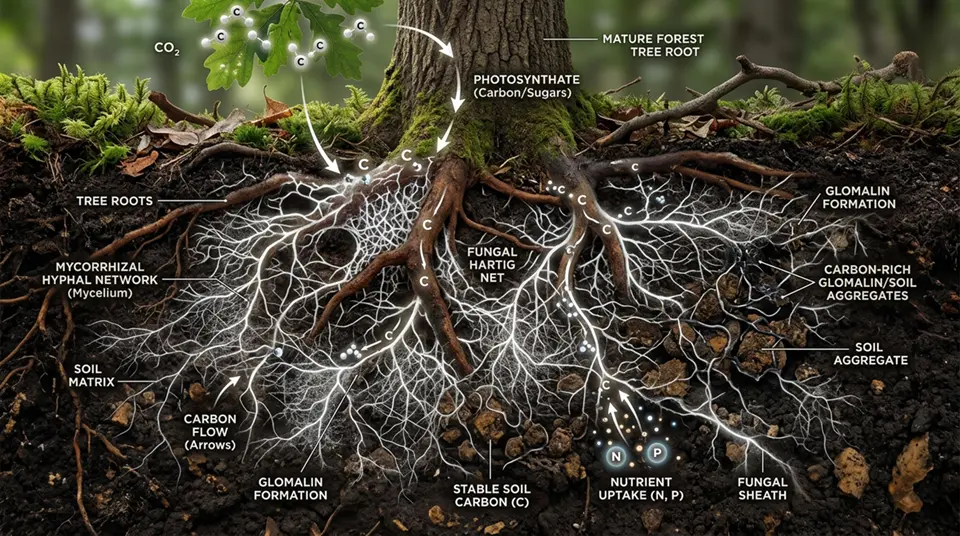
For modern ecology and climate science, recognizing fungi’s deep legacy is also a reminder: mycorrhizal networks, decomposition pathways, carbon cycling—they are not peripheral. They are old, deep, and resilient systems that continue to sustain terrestrial life.
If fungi set the stage first, then plants and animals walked on a platform already constructed. Understanding that platform—and preserving and restoring it—may be critical to the future of terrestrial ecosystems.

Source: Wikimedia Commons, CC BY-SA 4.0
References (APA Style)
- Berbee, M. L., et al. (2024). Timing the crown diversification of fungi using horizontal gene transfer calibrations. Nature Ecology & Evolution, 8(4), 512–525.
- Butterfield, N. J. (2011). Paleobiology of the late Proterozoic. Nature, 478, 576–579.
- Heckman, D. S., et al. (2001). Molecular evidence for the early colonization of land by fungi and plants. Science, 293(5532), 1129–1133.
According to PHYS.ORG
Key Takeaways
- Paleomycological research indicates that fungi dramatically diversified tens of millions of years earlier than previously estimated, with the colonisation of land by fungi predating land plants and contributing to terrestrial ecosystem formation.
- Fossil evidence and molecular clock analyses suggest fungi colonised terrestrial environments approximately 1 billion years ago—far earlier than the appearance of land plants (470 million years ago).
- The early diversification of Mucoromycota and Glomeromycota fungi—the AMF ancestors that form mycorrhizal partnerships—is now thought to have been essential for enabling early plant colonisation of land.
- New fossil discoveries from sites in Scotland (Rhynie Chert, ~410 million years ago) and China are continuously pushing back the known timeline of fungal diversification.
- Understanding the evolutionary trajectory of fungi is critical for predicting how modern fungi will respond to climate change, which is altering selection pressures at rates with few geological precedents.
Frequently Asked Questions
How do scientists estimate when fungi diversified?
Timing of fungal diversification is estimated through two complementary approaches. Fossil record analysis: fungi leave fossil evidence in amber (spores, hyphae, fruiting bodies preserved in resin), compression fossils in shale, and in permineralised wood (where fungal structures are preserved in three dimensions by mineral replacement). The Rhynie Chert deposits in Scotland (~410 million years old) contain exceptionally preserved early land ecosystems including multiple fungal types with modern relatives. Molecular clock analysis: comparing DNA sequences of living fungi across multiple loci, calibrated against fossil dates, allows estimation of divergence times for lineages without fossil representatives. Both methods have been progressively revised as new discoveries and analytical methods improve temporal estimates.
What is the Rhynie Chert and why is it important for understanding fungal evolution?
The Rhynie Chert is a Devonian geological deposit (~407 million years ago) near the village of Rhynie in Aberdeenshire, Scotland. The deposit preserves an ancient ecosystem of early land plants, algae, fungi, and invertebrates with extraordinary anatomical detail, through rapid permineralisation by silica-rich hydrothermal waters. For fungal evolution, the Rhynie Chert is invaluable because it contains: confirmed glomalean (AMF) fungi associated with land plant roots—demonstrating the mycorrhizal partnership was established at least 400 million years ago; saprotrophic fungi attacking plant tissue; and parasitic fungi infecting other organisms. It provides a concrete minimum date for the origin of mycorrhizal symbiosis with land plants and for multiple modern fungal functional groups.
How did fungi help plants colonise land?
The transition of photosynthetic life from water to terrestrial environments required solving several physiological problems: accessing mineral nutrients from dry rock and soil without the aqueous diffusion mechanisms of water; resisting desiccation; and establishing anchorage in unstable substrates. Mycorrhizal fungi—which appear to have preceded vascular plants onto land or co-evolved with early bryophyte-like plants—solved the nutrient acquisition problem by providing extensive hyphal networks for phosphorus and water mining. The earliest land plants (represented by liverworts and hornworts in modern floras) form mycorrhizal-like associations with Mucoromycota fungi, and paleobotanical evidence shows these associations were established by at least 470 million years ago. Without fungal partners, the energetic cost of establishing mineral nutrition in terrestrial substrates may have been prohibitive for early photosynthesisers.
What drove the rapid fungal diversification in prehistoric eras?
Multiple factors likely drove prehistoric fungal diversification, based on comparison of diversification timing with known geological and biological events. The colonisation of land by plants created entirely new ecological niches—decomposing plant material, root associations, plant pathogens—that triggered adaptive radiation of fungal lineages to exploit them. The Carboniferous period (approximately 300 million years ago), when vast forests accumulated enormous quantities of lignin-rich wood that few organisms could decompose, appears to have driven the evolution of white rot fungi (including Agaricomycetes) with ligninolytic enzyme systems—the ‘lignin problem’ may have caused carbon accumulation for millions of years until white rot fungi evolved to decompose it. Mass extinction events created ecological vacuums that were subsequently filled by fungal lineages.
Why does the evolutionary history of fungi matter for climate change predictions?
Understanding fungal evolutionary history provides context for predicting how modern fungi will respond to climate change. Examining how fungal communities reorganised during past periods of rapid climate change (such as the Paleocene-Eocene Thermal Maximum, approximately 56 million years ago, when global temperatures rose 5–8°C over about 20,000 years) can reveal which functional groups were resilient and which declined. Phylogenetic diversity analysis can identify lineages with evolutionary history in warm, dry conditions that may expand under future climates versus lineages restricted to cool, moist habitats that may contract. The evolutionary resilience of fungi as a kingdom—having survived five major extinction events—suggests the kingdom as a whole is robust, but individual species and functional groups face uncertain futures as climate-driven habitat loss accelerates.