The Living Soil Beneath Our Feet
The soil is too often misunderstood as a static medium, a passive bed for roots and seeds. But anyone who pays attention—who treats the earth as a living, conductive matrix—knows better. Beneath the surface lies a realm of extraordinary activity, where fungi weave themselves into the architecture of plant life. Their networks function like subterranean circuits, channeling information, nutrients, and adaptive instructions. They shape the survival of crops not through brute force, but through subtle, continuous exchanges.
A recent comprehensive review, built upon 733 scientific articles, attempts to map this otherwise invisible landscape. It reveals how agriculture is moving beyond its long-standing suspicion of fungi and beginning to embrace them as critical partners in building climate-resilient farming systems.
From Crop Killers to Crop Guardians
Historically, fungal research in agriculture has been synonymous with crisis. From the late blight that pushed communities into famine to the rust fungi that still threaten wheat and maize, pathogenic fungi have earned their reputation as silent destroyers. In monoculture systems—vast fields of genetically identical crops—these pathogens spread with the precision of an ungrounded surge, overwhelming everything in their path.
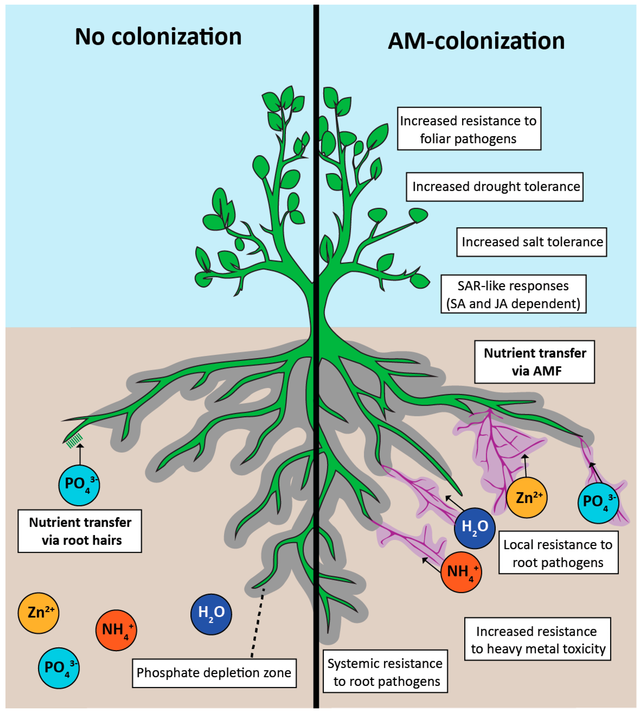
Yet the review documents a profound shift: fungi are no longer viewed solely as saboteurs. Many are now seen as quietly benevolent engineers. Mycorrhizal fungi extend the reach of plant roots into soil they could never penetrate alone. Endophytic fungi live within stems and leaves, lending their hosts heightened resistance to drought, heat, and heavy metals. These allies operate through biological relationships so intimate that a plant’s resilience becomes inseparable from the fungal networks supporting it.
This new understanding reframes fungi as tools—living instruments capable of reinforcing crops against the very stresses reshaping global agriculture.

A Field of Research Entering a New Phase
The review highlights a remarkable acceleration in fungal research, driven by advances in genome sequencing, molecular imaging, and ecological modeling. Over the last decade, scientists have begun mapping fungal genetics and behavior with a precision that would have seemed speculative just years ago. It is as though the scientific community has finally developed the sensors needed to detect the subtle currents flowing between fungi and plants.
A particularly striking trend is the surge in agriculture-focused fungal research emerging from China. The country’s investment in biotechnology and soil–microbe systems appears to be reshaping global leadership in this domain. Its laboratories are producing genomic libraries, functional gene analyses, and large-scale field studies at a rate that suggests a long-term commitment to fungal-based agricultural solutions.
The research priorities themselves are revealing. Scientists are increasingly focused on how fungi enable plants to withstand heatwaves, droughts, nutrient-poor soils, and fluctuating carbon and water cycles. These are not minor scientific curiosities—they are the fault lines along which modern agriculture is beginning to crack. Fungi may be poised to stabilize those fractures.

The Hidden Gaps in Our Understanding
1. The Missing Multi-Omics View
Genomics can show a fungal species’ potential, but without transcriptomics and metabolomics, the real-time orchestration of plant–fungal activity remains concealed. Only multi-omics integration will reveal the full circuitry—what genes fire during stress, what compounds flow between partners, and how these exchanges shift under climate pressure.
2. Networks Without Maps
Plant roots interact with fungi, bacteria, archaea, and the soil’s chemical gradients in a dynamic web. Yet we still lack comprehensive maps showing which fungal species serve as keystone connectors or which microbial hubs stabilize entire crop systems. It is as though the orchestra is playing, but we still cannot identify the conductor.
3. Untapped Power of Indigenous Fungi
Native fungal species, shaped over millennia by local climates and soils, are likely among the most powerful platforms for region-specific resilience. Yet they remain largely unstudied—biological technologies waiting for recognition.
These gaps are not evidence of neglect but of the vast complexity of the underground world. Only by filling them can agriculture fully harness the power of fungal partnerships.

Why This Matters in a Warming World
Agriculture is entering a period of heightened instability. Pesticide resistance is rising. Weather extremes are intensifying. Arable land is shrinking. And the global food system, stretched across geopolitical and ecological tension, is showing its vulnerabilities.
Traditional tools—fertilizers, pesticides, irrigation—no longer offer sufficient protection. They function like outdated machinery, overburdened and prone to failure.
Fungi, however, offer a different kind of solution. They operate through relationships, not domination. They enhance nutrient flow without chemical intervention. They improve stress tolerance without massive energy inputs. They help plants adapt at the very edge of survival.
Their intelligence is not mechanical but evolutionary—refined through hundreds of millions of years of crisis and adaptation.
If agriculture is to endure, it will need to align itself with these fungal systems rather than work against them. The future belongs not to fields sterilized of fungi, but to fields illuminated by a deeper understanding of fungal networks and their power.
Fungi are the hidden wiring of the natural world.
They move signals through soil, orchestrate survival strategies for plants, and build resilience quietly, persistently, and often invisibly. The review’s findings affirm what many in the microbial sciences have whispered for years: fungi are not simply present in agriculture—they are essential to its future.
To ignore them is to ignore the circuitry beneath our entire food system. To understand them is to gain access to one of the most sophisticated biological technologies on Earth.
References
Academic
- Genre, A. & Bonfante, P. (2020). “Plant–fungus interactions and sustainable agriculture.” Annual Review of Plant Biology. DOI: 10.1146/annurev-arplant-081519
- Singh, P. et al. (2023). “Fungal biodiversity and agricultural resilience: A synthesis of 700+ studies.” Frontiers in Microbiology. DOI: 10.3389/fmicb.2023.1134451
- Zhang, X. et al. (2022). “Microbial networks in soil ecosystems under climate stress.” Soil Biology & Biochemistry. DOI: 10.1016/j.soilbio.2022.108515
Official Sources
- FAO — Fungi and soil health: https://www.fao.org
- IPCC — Climate impacts on agriculture: https://www.ipcc.ch
Key Takeaways
- Fungal networks in agricultural soil—both mycorrhizal and free-living species—function as invisible architects of soil structure, fertility, and plant community dynamics in ways that profoundly influence crop productivity.
- Arbuscular mycorrhizal fungi (AMF) colonise the roots of most agricultural crops and are the primary biological mechanism for transferring phosphorus from mineral soil to plant roots.
- Saprotrophic fungi decompose crop residues into humus, releasing stored nutrients and building soil organic matter that improves water retention, aeration, and cation exchange capacity.
- Modern intensive farming practices—tillage, fungicide use, synthetic fertilisers—have collectively reduced fungal diversity and biomass in agricultural soils by an estimated 60–80% compared to natural grassland baseline.
- Regenerative agriculture practices that prioritise soil fungal health—no-till, diverse cover crops, reduced fungicides and synthetic fertilisers—can significantly restore fungal communities within 3–5 years of management change.
Frequently Asked Questions
How do fungal networks affect soil structure in agricultural fields?
Soil structure—the arrangement of mineral particles into aggregates with pores for air and water—is fundamentally a biological product maintained by living organisms. Fungi contribute to soil structure in two main ways. First, hyphal strands physically bind soil particles together: a single teaspoon of healthy agricultural soil contains several kilometres of fungal hyphae that weave through and around soil particles, creating bonds that stabilise aggregates against breakdown by raindrops and erosion. Second, glomalin—a glycoprotein produced by AMF hyphae—is a biological ‘soil glue’ that coats particle surfaces and aggregate interfaces, with a persistence of 7–42 years in soil. Glomalin content is now used as a proxy indicator of mycorrhizal activity and soil structural health in research and some agricultural monitoring systems.
Which agricultural crops benefit most from mycorrhizal fungi?
Almost all major agricultural crops form mycorrhizal associations, but benefit from AMF varies significantly by crop and soil condition. Crops that typically show the greatest yield response to AMF under low-to-medium fertility conditions include: maize (corn); wheat, barley, and other small grains; cassava; sweet potato; onion and garlic (extremely dependent on AMF for phosphorus due to their limited root hair development); most legumes (though they fix nitrogen, AMF still significantly improve phosphorus and zinc nutrition); and most fruit and vegetable crops. Notable non-mycorrhizal crops include brassicas (cabbage, broccoli, canola/rapeseed) and beetroot, which do not form AMF associations—planning rotations around these non-hosts must account for their potential to reduce AMF populations.
How do synthetic fertilisers suppress mycorrhizal fungi?
Mycorrhizal symbiosis is a carbon-for-nutrient trade: the plant provides the fungus with photosynthesis-derived sugars (5–20% of total plant carbon production) in exchange for nutrients, primarily phosphorus. When synthetic phosphorus fertilisers supply phosphorus abundantly at the root surface, the plant ‘switches off’ mycorrhizal investment—it no longer needs to pay the carbon cost of maintaining an extensive fungal network. Research consistently shows that high soil phosphate levels reduce AMF colonisation rates, hyphal density, and functional activity. After decades of synthetic fertiliser application in intensive farming, soils may have greatly depleted AMF communities that recover slowly even when fertiliser inputs are reduced—creating an ‘AMF debt’ that limits the speed of transition to lower-input farming systems.
What does fungal diversity in soil tell us about farm health?
Fungal diversity in agricultural soil serves as a sensitive indicator of soil biological health and management quality. High fungal diversity generally correlates with: more complete decomposition of organic matter across different particle sizes and chemical types; greater resilience of soil nutrient cycling to climate variability; higher aggregate stability and better water infiltration; lower pathogen disease pressure (diverse fungal communities provide better competitive exclusion of specific pathogens); and more efficient plant nutrition. Metabarcoding-based soil fungal assessments are increasingly available to farmers through commercial services, providing species-level diversity indices, functional group ratios (pathotrophs vs. symbiotrophs vs. saprotrophs), and comparisons against reference soils under similar management.
How quickly can fungal communities recover with regenerative practices?
Fungal community recovery timelines after shifting to regenerative management vary considerably by initial soil condition, management change intensity, and local climate. Research from farms transitioning from conventional to organic or regenerative management finds: AMF biomass can increase measurably within 1–2 years of eliminating deep tillage and synthetic fertiliser; species richness increases more gradually, with significant gains visible in 3–5 years; ectomycorrhizal communities in agroforestry systems take 5–20 years to approach natural woodland complexity; and highly degraded soils with very low initial fungal activity may require longer recovery periods or active inoculation. The presence of adjacent natural habitat (hedgerows, woodland edges) accelerates recovery by providing spore and mycelial inoculum source populations.