According to GULF NEWS
I. The Search for Sustainable Silicon Alternatives
As the computing world hits the physical and environmental limits of traditional silicon microchips—facing issues of material scarcity, high energy consumption, and burgeoning electronic waste (e-waste)—researchers are seeking radical, sustainable alternatives.
The solution may lie in an unexpected biological source: the common mushroom.
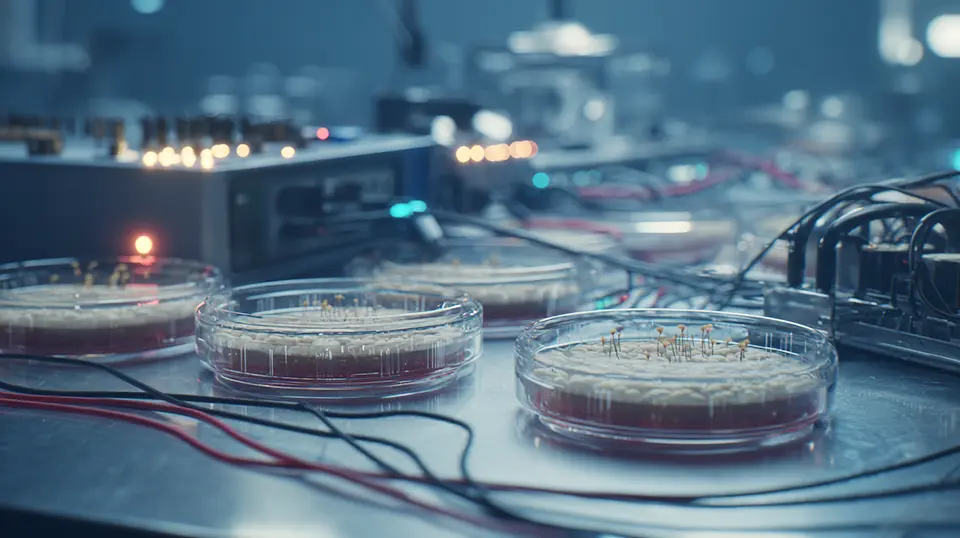
A groundbreaking study led by The Ohio State University has successfully demonstrated that dehydrated edible fungi, particularly shiitake mushrooms (Lentinula edodes), can be grown and trained to function as organic memristors.

Source: Wikimedia Commons, CC BY-SA 3.0
II. Mushrooms as Organic Memory Devices
Memristors are specialized circuit components capable of remembering past electrical states, akin to the memory chips found in smartphones and computers. This ability is crucial for neuromorphic computing, a field dedicated to creating hardware that mimics the brain’s highly efficient, neural-like operations.
Mimicking the Brain
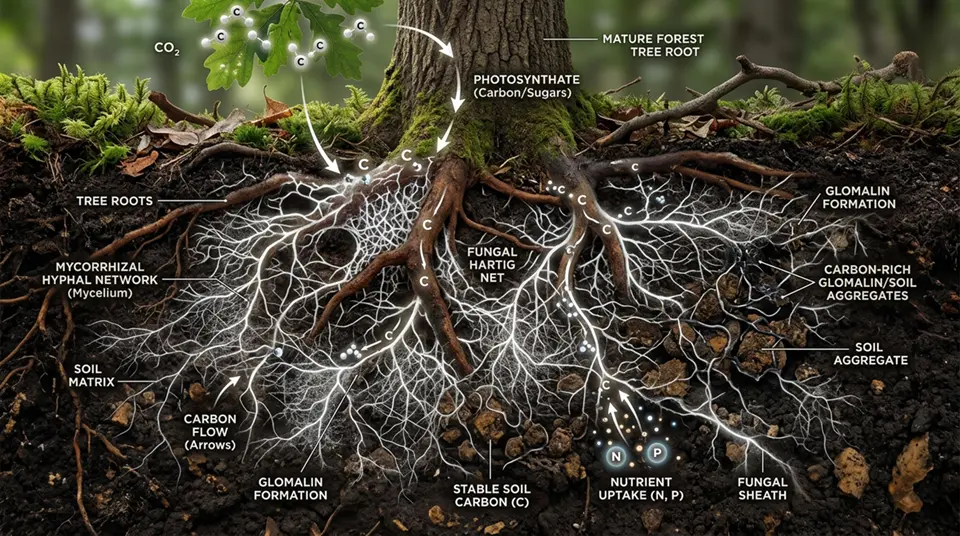
The mushroom’s natural, dense, thread-like network, called mycelium, provides a living structure that is resilient and capable of conducting and storing electrical signals. This neural-like network allows the fungal devices to store data and process information together.

Source: Wikimedia Commons, CC BY-SA 4.0
Performance
In laboratory tests, the mushroom-based memristors (sometimes playfully called “mushristors”) demonstrated remarkable capabilities:
- They were able to switch between electrical states up to 5,850 times per second.
- They achieved a signal retention accuracy of approximately 90% when used as temporary computer memory (RAM).
Durability
The research indicated that dehydrated fungal circuits, which can be revived by simple hydration, showed resilience — even demonstrating an advantage in aerospace applications due to their potential radiation resistance.

Source: Wikimedia Commons, CC BY-SA 4.0
III. The Environmental and Economic Advantage Over Silicon
The fungal approach offers a compelling path toward addressing the environmental cost of modern technology by dramatically contrasting with traditional semiconductor manufacturing.
| Aspect | Fungal Memristors | Conventional Silicon Chips |
|---|---|---|
| Material Sourcing | Grown from organic substrate and edible fungi; minimal resource extraction. | Requires rare earth mining and silica purification. |
| Manufacturing | Low-cost, low-energy cultivation; simple dehydration process. | High-energy, complex cleanroom fabrication. |
| End-of-Life | Fully biodegradable and compostable. | Persistent e-waste pollution. |
| Energy Use | Neural-like efficiency; low standby power. | Constant high energy draw, even when idle. |
IV. Paving the Way for a Fungal Future
While the mushroom memory devices are still in the early stages—with current lab versions being relatively bulky and their speed lagging behind the peak performance of silicon chips—researchers believe the technology is highly scalable.
Diverse Applications
The low power consumption, light weight, and unique resilience of fungal electronics make them promising candidates for:
- Edge Computing: Processing data closer to the source (e.g., smart sensors).
- Wearable Devices: Flexible and biodegradable electronic components.
- Aerospace Exploration: Lightweight and radiation-resistant systems for harsh environments.
Accessibility
Lead author John LaRocco suggested that the resources needed for fungal computing could range from “as small as a compost heap and some homemade electronics” to large industrial biofabrication factories, making the technology highly accessible for future innovation.
This research marks a significant shift toward bioelectronics, where living, adaptive, and sustainable materials could form the foundation of next-generation, brain-inspired computing.
References
- Nature Electronics (2023). Edge and Wearable Biocomputing Applications.
- FAO (2022). Biodegradable Material Innovation for Circular Economies.
According to GULF NEWS
Key Takeaways
- Edible mushroom species—including oyster mushrooms and Schizophyllum commune—are being explored as biological substrates for next-generation computing, drawing on their electrical signalling capabilities in mycelial networks.
- Fungal mycelium generates and propagates action-potential-like electrical spikes that can respond to stimuli, with computed ‘word lengths’ of up to 21 binary symbols identified by Prof. Andrew Adamatzky’s research group.
- The appeal of mycelium computing lies in its potential for massively parallel distributed processing without a central processing unit, at room temperature, using biodegradable hardware.
- Practical challenges are enormous: the signal speed, reliability, and density of fungal electrical processing is currently many orders of magnitude below silicon electronics.
- Mycelium computing research is at the ‘proof of biological concept’ stage comparable to early vacuum tube computing in the 1940s—demonstrating that biological computation is possible, not yet useful.
Frequently Asked Questions
What electrical phenomena in mushrooms are researchers trying to exploit for computing?
Prof. Andrew Adamatzky at the University of the West of England has published extensively on electrical activity in mycelium networks. Using fine iridium electrodes implanted in growing ghost fungi (Omphalotus nidiformis) and king oyster mushrooms (Pleurotus eryngii), his group detected trains of electrical spikes (action potential-like events) propagating through hyphae at varying rates. The frequency and patterns of these spikes changed in response to external stimuli including chemical compounds and light. Computational analysis of these spike trains identified statistical patterns analogous to language-like structures (discrete ‘words’ with different bit lengths). The research frames mycelium as a distributed, self-organised information-processing system.
Are mushrooms actually ‘thinking’ or computing anything?
This is the central philosophical question in mycelium computing research, and the honest answer is: not in any conventional computing sense. The electrical spikes observed are real biological signals—they are action potentials similar to those in neurons and plant vascular tissue, not artefacts. However, calling this ‘computing’ requires substantial interpretive leaps. The spikes serve clear biological functions (transmitting information about chemical gradients, physical damage, and nutrient availability within the organism); whether they can be harnessed to perform useful computation in a human-defined sense is a very different question from whether they constitute information processing in a biological sense.
What would ‘useful’ mycelium computing actually look like?
For mycelium computing to be practically useful, researchers would need to: reliably interface with the fungal electrical signalling system (write inputs and read outputs without disrupting the biological system); achieve stable and reproducible logical operations (the same input reliably producing the same output); scale the system to perform computations beyond what can be done on paper or in a conventional processor; and do so at speeds and reliability levels competitive with existing approaches for at least some task category. Current demonstrations show stimulus-response relationships that could theoretically encode binary states, but creating a programmable logical circuit—the minimum threshold for ‘computing’—has not yet been demonstrated in any peer-reviewed publication.
Why are researchers interested in biological computing alternatives?
The interest in biological computing stems from fundamental limitations of silicon-based electronics. Moore’s Law—the prediction that transistor density would double approximately every two years—is approaching physical limits as transistors approach atomic scale. Silicon chip manufacturing also requires rare earth materials, extreme processing conditions (clean rooms, exotic chemicals), and produces significant e-waste. Biological systems perform extraordinary information processing (the human brain runs on 20 watts while outperforming any current AI on many tasks) using only carbon, nitrogen, and water at room temperature. The hope is that biological computing could offer pathways to computation that bypass the physical and materials limits of silicon—though this remains highly speculative.
What other biological computing approaches are being researched alongside mycelium?
Multiple biological computing paradigms are being explored in parallel. DNA computing uses the combinatorial chemistry of DNA hybridisation to solve specific computational problems (particularly those involving massive parallelism like NP-hard combinatorial optimisation). Synthetic biology approaches engineer bacteria or yeast to perform logic gate operations using gene regulatory circuits—’bacterial computers’ have been demonstrated performing basic logical operations. Neuromorphic computing uses electronic circuits that mimic the topology and dynamics of neural networks, bridging biological and silicon approaches. Organoid computing—using lab-grown human brain tissue—has raised profound ethical questions. Of these, synthetic biology and DNA computing are currently most advanced in terms of demonstrated capability, while mycelium computing remains the most conceptual.