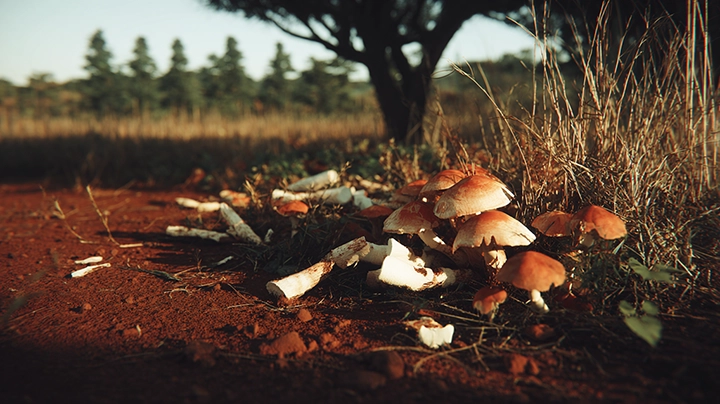
Beneath the Surface: The Oldest Alliance in Nature
Hidden beneath forests, prairies, and croplands, a living web pulses with ancient energy. Mycorrhizal fungi—microscopic filaments branching from plant roots—extend the reach of nearly every terrestrial plant, scavenging water and nutrients from soil volumes roots alone cannot access. In return, plants allocate a portion of their photosynthetically fixed carbon to their fungal partners. This mutualistic exchange has shaped terrestrial ecosystems for more than 400 million years, underpinning the rise of forests, grasslands, and global food systems.
Yet this ancient alliance is not immutable. A recent modeling analysis highlighted by Phys.org, drawing on ecosystem-scale data, suggests that climate change—specifically warming soils and rising atmospheric carbon dioxide (CO₂)—is quietly renegotiating the terms of this underground contract.

— Source: Wikimedia Commons
When Soils Warm, the Economy Changes
As soils warm, biological processes accelerate. Microbial communities decompose organic matter more rapidly, increasing the availability of mineral nitrogen and other nutrients in forms plants can directly absorb. Under these conditions, the comparative advantage of mycorrhizal fungi—nutrient acquisition—diminishes.
Model simulations show that when nutrients become readily available, plants reduce carbon allocation to fungal partners. This shift effectively lowers the “carbon price” plants are willing to pay for mycorrhizal services. For fungi, the consequences are significant: reduced carbon income constrains growth, limits reproduction, and reshapes competitive dynamics within fungal communities.
Over time, such changes could drive community turnover, favoring fungal species that require less carbon or specialize in rapid exploitation, while disadvantaging those adapted to nutrient-poor soils.
CO₂ Complicates the Equation
Rising atmospheric CO₂ introduces a countervailing force. Elevated CO₂ enhances photosynthesis, increasing plant biomass and overall carbon availability. As plants grow faster, their demand for nitrogen and phosphorus often rises beyond what mineralized pools can supply.
In these scenarios, mycorrhizal fungi regain their value—particularly species capable of mobilizing nutrients from complex organic matter. Plants respond by redirecting carbon back belowground, restoring investment in fungal partnerships. The result is a dynamic feedback loop: soil warming may weaken fungal alliances, while CO₂-driven growth can revive them.
Which force dominates depends on local context—soil chemistry, plant functional types, and the metabolic strategies of resident fungi.
No One-Size-Fits-All: The Diversity of Fungal Alliances
Mycorrhizal fungi are not a monolith. Arbuscular mycorrhizal (AM) fungi, common in grasslands and agricultural systems, tend to thrive in nutrient-rich soils and operate with relatively low carbon costs. Ectomycorrhizal (ECM) fungi, dominant in many forest ecosystems, are specialists capable of decomposing complex organic substrates—but they demand higher carbon investment.
Ecosystems hosting diverse mycorrhizal strategies gain functional resilience. This diversity acts as a biological portfolio, buffering systems against environmental volatility. As climate pressures intensify, such flexibility may determine whether ecosystems adapt smoothly or cross destabilizing thresholds.
From Hidden Networks to Global Impact
While MoldNewsHub often addresses fungi as risks—indoor molds, crop pathogens—mycorrhizal fungi represent the opposite pole: stabilizers of ecosystems. These partnerships influence forest productivity, drought resistance, and long-term soil carbon storage.
Modeling results suggest that reductions in plant carbon allocation to fungi could weaken soil carbon sinks, allowing more CO₂ to remain in the atmosphere. In this way, underground negotiations may shape aboveground climate trajectories, reinforcing or dampening feedback loops in the Earth system.

— Source: Wikimedia Commons
The Dynamic Heartbeat of Underground Alliances
The central insight from this research is that fungal–plant partnerships are not fixed agreements, but living economic systems—continuously renegotiated in response to temperature, nutrient availability, and atmospheric change. As climate variability increases, these hidden alliances may prove as critical to monitor as surface temperatures or emission curves.
Food security, forest resilience, and the global carbon cycle may all hinge on how plants and fungi adjust their mutual investments in a warming, CO₂-rich world. In an era focused on what is visible—canopies, yields, emissions—it is the invisible negotiations beneath our feet that may ultimately determine ecological stability.
MoldNewsHub will continue to follow these subterranean shifts, because the future of climate resilience is being decided not only in the sky or the soil surface, but in the microscopic corridors where roots and fungi exchange carbon, nutrients, and trust.
References
Academic
- Treseder, K. K. (2004). A meta-analysis of mycorrhizal responses to nitrogen, phosphorus, and atmospheric CO₂. New Phytologist, 164(2), 347–355.
DOI: https://doi.org/10.1111/j.1469-8137.2004.01159.x - Terrer, C., et al. (2021). A trade-off between plant and soil carbon storage under elevated CO₂. Nature, 591, 599–603.
DOI: https://doi.org/10.1038/s41586-021-03306-8
Official / Authoritative
- Phys.org — Climate change and mycorrhizal modeling
https://phys.org/ - IPCC AR6 — Climate change and terrestrial carbon feedbacks
https://www.ipcc.ch/report/ar6/wg1/
Key Takeaways
- Climate warming and soil pressure changes in terrestrial ecosystems are reshaping fungal community composition, with heat-tolerant and drought-adapted species gaining dominance at the expense of temperature-sensitive ectomycorrhizal fungi.
- Increased soil compaction (from drought-shrinkage followed by re-wetting events) physically damages fungal hyphal networks, reducing mycorrhizal functional connectivity between plants.
- Warming-driven shifts in plant phenology—earlier bud break, later senescence—alter the seasonal availability of plant carbon to mycorrhizal fungi, potentially disadvantaging species adapted to historical seasonal patterns.
- High-elevation and high-latitude forests that are warming rapidly may lose their characteristic ectomycorrhizal fungal communities faster than tree communities can migrate or adapt, creating ‘fungal debt’ scenarios.
- Long-term forest ecosystem monitoring programmes are documenting these fungal community shifts, providing early warning of ecosystem stress before above-ground symptoms become apparent.
Frequently Asked Questions
How does warming change which fungi live in forest soils?
Warming shifts fungal communities through several intersecting mechanisms. Directly, temperature increases favour thermophilic (warm-loving) fungi over psychrophilic and mesophilic species that have historically dominated cool forest soils—particularly many ectomycorrhizal species adapted to cold temperate or boreal conditions. Indirectly, warming reduces soil moisture through increased evapotranspiration, favouring xerophilic fungi that tolerate desiccation. Changes in plant community composition triggered by warming (different tree species becoming dominant as climates shift) also bring different mycorrhizal associates. Long-term monitoring studies in European forests have documented significant declines in above-ground sporocarp (mushroom) production and species richness over 20–30 years correlated with temperature increases.
What is ‘fungal debt’ and why does it matter?
‘Fungal debt’ refers to the concept that fungal community composition may lag behind changing climate conditions—so a forest may have warming-stressed ectomycorrhizal fungi that are no longer well-matched to current or future environmental conditions, even if the tree community appears intact. This matters because the trees themselves may appear healthy in the short term (drawing on stored carbon and residual mycorrhizal function) while their fungal support network is progressively degrading. Only when the mycorrhizal community becomes too impaired to support normal water and nutrient supply do above-ground symptoms (reduced growth, increased mortality) appear—potentially years after the fungal debt has accumulated. This makes soil fungal monitoring an important early warning tool.
Which fungi are winners and which are losers under climate change?
Evidence from long-term monitoring and experimental warming plots identifies general patterns. Losers under warming include: many ectomycorrhizal species (particularly those associated with boreal and montane conifers); fruiting body production of many classic forest mushrooms; and specialists of cold, moist soil microhabitats. Winners include: thermophilic saprotrophic species; some arbuscular mycorrhizal species with broader thermal tolerance; and early-successional and disturbance-adapted species. However, there is enormous variation between species and sites, and the ‘winning’ community under any particular warming scenario is difficult to predict from current knowledge because species interactions and competitive dynamics in soil are complex.
How does soil compaction affect fungal networks?
Soil compaction—whether from heavy rainfall on saturated soils, livestock trampling, machinery traffic, or repeated freeze-thaw cycles—physically damages the pore structure that fungal hyphae inhabit. Compacted soil has reduced macropore volume, lower oxygen diffusion rates, and reduced water infiltration capacity. For fungal hyphae, compaction directly crushes and severs hyphal strands, interrupting hyphal network connectivity. It also reduces the volume of soil accessible to fungal exploration by diminishing pore space available for hyphal growth. Experiments applying soil compaction stress have consistently found significant reductions in mycorrhizal colonisation rates, hyphal length density, and sporocarp production in affected areas compared to controls.
Can monitoring soil fungi provide early warning of forest decline?
Yes—this is an emerging application of forest soil microbiome science. Because fungal communities in soil respond rapidly to environmental change while trees can maintain their outward appearance for years even as their support systems decline, fungal community monitoring can serve as a sensitive early indicator of ecosystem stress. Research has shown that changes in ectomycorrhizal diversity, shifts in community composition toward stress-tolerant species, and declines in mycorrhizal colonisation rates of fine roots can precede measurable reductions in tree growth by years. Some forest management agencies in Central Europe are incorporating soil biological assessments (including fungal community analyses by metabarcoding) into routine forest health monitoring programmes.