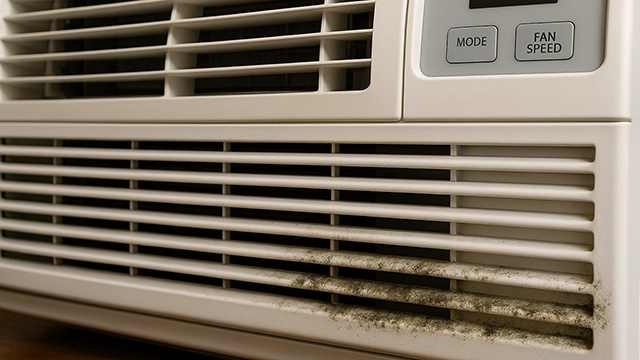
A Headline Recall with Hidden Risks
This summer, global home appliance brand Midea voluntarily recalled more than 1.7 million smart window air conditioners. The reason was not a mechanical defect, but rather the fact that these units could accumulate water, turning into ideal breeding grounds for mold. After the news broke, over a hundred health complaints linked to mold were reported, including more than a dozen cases of respiratory allergies and infections. At first glance, this may look like a simple product flaw. In reality, it reveals a broader issue: why would an everyday appliance like an air conditioner hide mold hazards?
How Air Conditioners Create a Mold Ecosystem
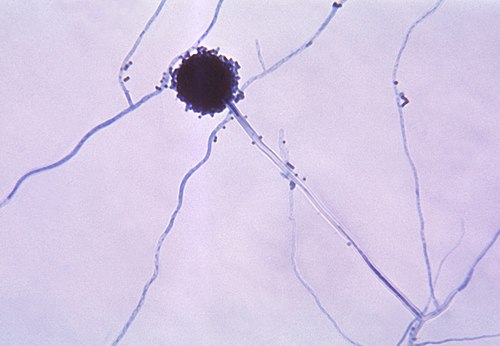
The way air conditioners work naturally creates the kind of environment mold loves. As air passes over the cooling coils, condensation forms. If drainage is poor, water collects inside the unit. These damp corners, combined with warm airflow and fine dust particles, essentially form a miniature petri dish for mold. The most common molds found in air conditioners include Cladosporium, Aspergillus, and Penicillium. These fungi are highly adaptable. Their spores cling to filters or cooling fins and, within days, can grow into visible mold spots.

Mold and Health: More Than Just Allergies
The real problem is that air conditioners don’t just sit quietly in the corner. They actively blow air throughout the room. That means mold spores, once inside the machine, are distributed into the indoor environment with every use. Exposure may begin with mild symptoms like throat irritation or sneezing, but for sensitive groups, the consequences can be much more severe. People with asthma may experience worsened attacks, while those with allergies might develop persistent coughing and congestion. Some molds even produce mycotoxins; although concentrations are usually low, long-term exposure poses chronic risks to individuals with weakened immune systems. This explains why, in the Midea case, seventeen reported incidents were directly tied to health issues.
Design Weaknesses and Everyday Appliances
From a design perspective, mold growth is not purely an “external contamination.” Rather, it exploits weaknesses in the product itself. Poor drainage leads to stagnant water, and certain interior materials hold dust and organic debris that serve as nutrients. In other words, when appliance design fails to address moisture and microbial concerns, it inadvertently provides mold with a comfortable home. Air conditioners are not alone in this—washing machine door gaskets and humidifier tanks have also been criticized for mold problems. These examples remind us that mold is not a random invader; it is a consistent presence in human-made environments, appearing wherever conditions align.
Practical Steps for Everyday Users
So what can everyday users do? The most straightforward step is regular cleaning. Air conditioner filters should be washed every two to four weeks, and drainage pipes must be kept clear to prevent backflow. If a musty odor comes from the vents, or if dark spots appear on the blades, mold is already active and requires deeper cleaning—possibly by a professional. Another often-overlooked factor is indoor humidity. If it regularly exceeds 60%, mold growth inside and outside the air conditioner becomes likely. Using a dehumidifier or ensuring proper ventilation helps protect the entire living environment.

Beyond One Brand: What Mold Teaches Us
Of course, the Midea recall highlights corporate responsibility. Designing products that can harbor mold inevitably undermines consumer trust. Yet beyond the headlines, the larger lesson is our everyday understanding of mold. Many people assume mold only grows on bathroom walls or spoiled food, but it can also thrive inside devices we use daily, like air conditioners and washing machines. These “hidden risks,” if ignored, can escalate into not only personal health issues but also public challenges, such as large-scale product recalls or even building closures.
A Reminder in Every Breath
Mold reminds us that cleanliness and safety are never guaranteed—they require careful design from manufacturers and consistent maintenance from users. The air conditioner is just one example. The next time you switch on your unit and notice an unusual smell, it may not just be stale air. It could be mold already making itself at home in your life.

References
Academic
- Fisk, W. J., Lei-Gomez, Q., & Mendell, M. J. (2007). Meta-analyses of the associations of respiratory health effects with dampness and mold in homes. Indoor Air. Full text
- Mendell, M. J. et al. (2011). Respiratory and allergic health effects of dampness and mold. Environmental Health Perspectives. Full text
Official
Key Takeaways
- Midea voluntarily recalled over 1.7 million smart window air conditioners because design features allowed internal water accumulation, creating ideal mould breeding grounds.
- More than 100 health complaints linked to mould were filed following the recall, including respiratory allergies and infections.
- Air conditioner evaporator coils naturally generate condensation; poor drainage turns units into persistently moist, dark environments where mould can germinate within 24–48 hours.
- Regular cleaning (every 2–4 weeks during heavy use), ensuring proper drainage, and running fan-only mode after cooling significantly reduces mould risk.
- Studies show up to 80% of tested air conditioning filters contain viable mould spores, making the issue far more widespread than this single recall suggests.
Frequently Asked Questions
Why did Midea recall its air conditioners?
Midea issued a voluntary recall of over 1.7 million smart window air conditioners after finding that a design characteristic allowed internal water to accumulate rather than drain effectively. This pooled condensate created persistently moist conditions inside the unit—an ideal environment for mould colonisation—rather than being attributable to a mechanical failure.
How do air conditioners create mould growth conditions?
As warm, humid air passes over an air conditioner’s cold evaporator coils, moisture condenses out of the air—much like water forming on a cold glass. If this condensate doesn’t drain properly, it collects in the drain pan, on coil surfaces, and within air filters. Combined with dust particles that serve as a nutrient source, these surfaces become ideal mould substrates within 24 to 48 hours of moisture accumulation.
What health risks come from mould in air conditioners?
Mould-contaminated air conditioning units disperse spores directly into the airstream circulating through occupied rooms. This can trigger allergic rhinitis, asthma attacks, respiratory infections, and eye irritation. Common species found in AC units—including Aspergillus, Cladosporium, and Penicillium—pose elevated risks to individuals with pre-existing respiratory conditions, the elderly, and the immunocompromised.
How can I prevent mould in my air conditioner?
Key preventive measures include: cleaning or replacing air filters every 2–4 weeks during heavy-use periods; ensuring the drain line is clear and the unit is tilted slightly outward so condensate drains away; running fan-only mode for 15–30 minutes after each cooling cycle to dry internal surfaces; and scheduling annual professional deep-cleaning of evaporator coils and drain pans.
How widespread is mould contamination in air conditioners?
Research indicates the problem is far more common than a single recall suggests. A study published in Applied Microbiology found that up to 80% of tested air conditioning filters contained viable mould spores. Compact window units are particularly vulnerable due to their restricted interior space and limited access for thorough cleaning, making regular maintenance critical for indoor air quality.