
According to NATIONAL GEOGRAPHIC
Beneath forests and grasslands, an invisible economy is at work. Underground fungi trade nutrients with trees, shape ecosystems, and produce one of the world’s most prized foods: truffles. A recent report examines how truffle-hunting dogs have become essential partners in uncovering these hidden fungi, offering insights not only into gastronomy, but also into ecology, evolution, and the complex relationships between animals and fungi.
Truffles are not ordinary mushrooms. Unlike familiar fungi that release spores into the air, truffles grow underground and rely on animals to find them, dig them up, and spread their spores. For centuries, humans have entered this partnership indirectly—first with pigs, and now primarily with dogs—turning animal senses into a scientific and cultural tool.

Source: Wikimedia Commons, CC BY-SA 3.0
Why Truffles Need Animals
Truffles are the fruiting bodies of subterranean fungi that form mycorrhizal relationships with plants, especially trees. In these partnerships, fungi exchange minerals and water for sugars produced by plants through photosynthesis. Because truffles mature below the surface, they cannot disperse spores by wind. Instead, they evolved powerful aromas that attract animals.
These scents are not incidental. They are chemical signals, mimicking pheromones or food cues that animals instinctively recognize. When an animal digs up and eats a truffle, spores pass through its digestive system and are deposited elsewhere, completing the fungal life cycle. Dogs, with their exceptional sense of smell, are particularly sensitive to these compounds—even when truffles lie tens of centimeters underground.
From Pigs to Dogs
Historically, pigs were used to hunt truffles because of their natural attraction to truffle aromas. However, pigs are difficult to control, prone to eating the truffles themselves, and can cause significant damage to soil and roots. Over time, dogs replaced pigs as the preferred truffle hunters.
Dogs offer several advantages: they are easier to train, more responsive to human commands, and less destructive. Importantly, dogs do not have an innate desire to eat truffles. Instead, they can be trained to indicate the location of a truffle in exchange for a reward, allowing harvesters to remove the fungi carefully and sustainably.
Training a Truffle Dog
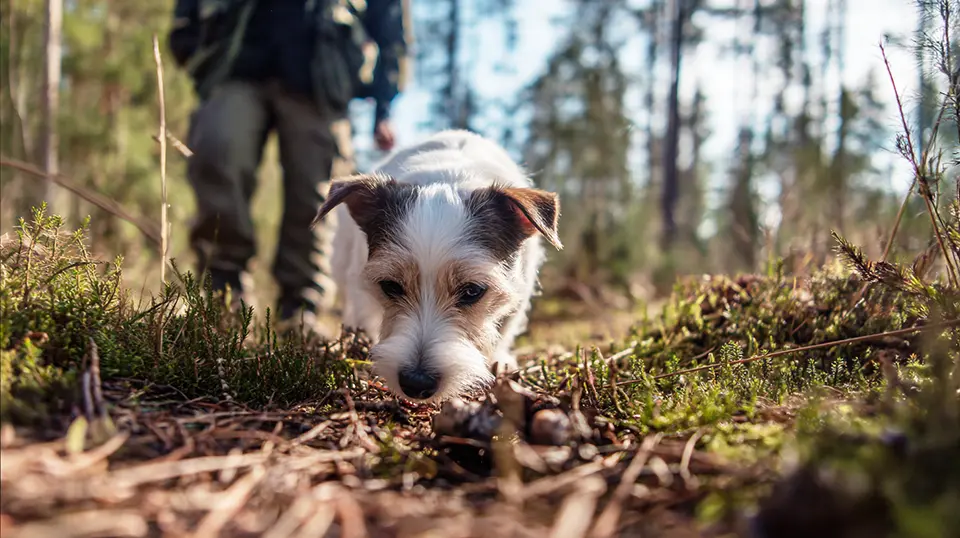
Training begins early, often when dogs are puppies. Rather than relying on instinct alone, trainers introduce dogs to truffle scent through play-based methods. Truffle oil or fragments are hidden in toys, and dogs are rewarded for locating them. Over time, this game evolves into searching natural environments.
The process is less about obedience and more about collaboration. Successful truffle dogs learn to balance curiosity with restraint—alerting their handler without damaging the truffle or surrounding roots. Many breeds can excel at this work, though dogs with strong scent-tracking abilities and calm temperaments are often preferred.

Source: Wikimedia Commons, CC BY-SA 3.0
A Window into Fungal Biodiversity
Truffle hunting does more than supply luxury food markets. Each discovery provides information about fungal distribution, seasonal patterns, and ecosystem health. Scientists increasingly recognize truffles as keystone organisms, influencing plant growth, soil structure, and nutrient cycling.
Different truffle species associate with different tree species and soil conditions. Their presence can indicate long-term ecosystem stability, as many truffles require decades-old forests to thrive. In this sense, truffle dogs are not just culinary assistants; they are field instruments, helping researchers map underground biodiversity that would otherwise remain invisible.

Source: Wikimedia Commons, CC BY-SA 3.0
Climate Change and Truffle Futures
The report also highlights growing concern about how climate change may affect truffle populations. Truffles are sensitive to temperature, soil moisture, and seasonal rhythms. Shifts in rainfall patterns and prolonged droughts can disrupt the delicate balance between fungi and their host plants.
Truffle hunters in Europe and other regions have already reported changes in harvest timing and yield. Dogs, trained to recognize scent rather than visual cues, may detect truffles that humans would otherwise miss, offering early signals of ecological change. In this way, truffle dogs may become unexpected sentinels of environmental transformation.

Source: Wikimedia Commons, CC BY-SA 3.0
Ethics and Sustainability
As demand for truffles grows globally, sustainability has become a central issue. Overharvesting and careless digging can damage fungal networks and reduce future yields. Dog-assisted harvesting supports more selective and less invasive practices, helping preserve underground ecosystems.
Some regions now regulate truffle hunting seasons and methods, recognizing truffles as both economic and ecological resources. Dogs trained to indicate precise locations reduce unnecessary soil disturbance, aligning traditional practices with modern conservation principles.
Cultural and Scientific Convergence
Truffle hunting sits at the intersection of tradition, science, and sensory biology. What began as a rural practice has become a subject of scientific interest, illuminating how animals perceive chemical landscapes humans cannot sense. Dogs, fungi, and humans form a triad of interaction that reveals how deeply interconnected life systems are.
The report underscores that understanding fungi requires moving beyond what is visible. Truffles remind us that much of Earth’s biological activity happens out of sight, mediated by chemical signals and interspecies cooperation. Truffle-hunting dogs, guided by scent and training, make this hidden world accessible.
Conclusion
Truffle-hunting dogs are more than skilled foragers. They are partners in uncovering underground fungal networks that sustain forests, shape ecosystems, and connect species across kingdoms. By following their noses, dogs help humans understand fungi not just as food, but as foundational components of life on Earth.
As scientific interest in fungi continues to expand, the role of animals in revealing these hidden organisms becomes increasingly important. Truffle dogs stand as a living example of how collaboration between species can unlock knowledge buried beneath our feet.
References
FAO. Forests and fungal biodiversity.
According to NATIONAL GEOGRAPHIC
Key Takeaways
- Beneath forests and grasslands, an invisible economy is at work.
- Unlike familiar fungi that release spores into the air, truffles grow underground and rely on animals to find them, dig them up, and spread their spores.
- In these partnerships, fungi exchange minerals and water for sugars produced by plants through photosynthesis.
- They are chemical signals, mimicking pheromones or food cues that animals instinctively recognize.
- Historically, pigs were used to hunt truffles because of their natural attraction to truffle aromas.
Frequently Asked Questions
What should you know about please login to bookmark?
Please login According to NATIONAL GEOGRAPHIC
Why Truffles Need Animals?
Truffles are the fruiting bodies of subterranean fungi that form mycorrhizal relationships with plants, especially trees. In these partnerships, fungi exchange minerals and water for sugars produced by plants through photosynthesis. Because truffles mature below the surface, they cannot disperse spo
What should you know about from Pigs to Dogs?
Historically, pigs were used to hunt truffles because of their natural attraction to truffle aromas. However, pigs are difficult to control, prone to eating the truffles themselves, and can cause significant damage to soil and roots. Over time, dogs replaced pigs as the preferred truffle hunters.
What should you know about training a Truffle Dog?
Training begins early, often when dogs are puppies. Rather than relying on instinct alone, trainers introduce dogs to truffle scent through play-based methods. Truffle oil or fragments are hidden in toys, and dogs are rewarded for locating them. Over time, this game evolves into searching natural en
What should you know about a Window into Fungal Biodiversity?
Truffle hunting does more than supply luxury food markets. Each discovery provides information about fungal distribution, seasonal patterns, and ecosystem health. Scientists increasingly recognize truffles as keystone organisms, influencing plant growth, soil structure, and nutrient cycling.