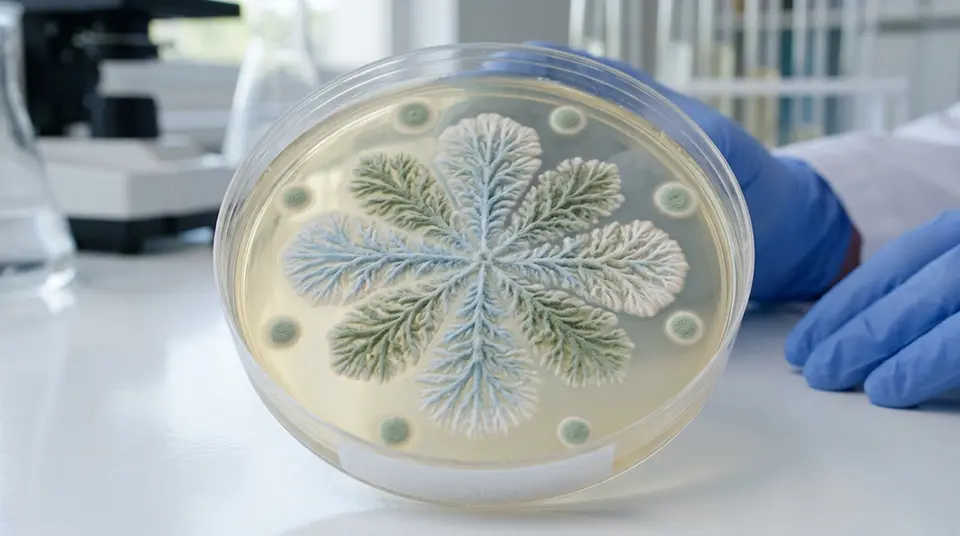
According to HACKADAY
Researchers and makers have demonstrated a novel technique that uses laser light and artificial intelligence to guide fungal growth into precise patterns, transforming living fungi into a programmable artistic medium. The project, known as Funguy, combines computer vision, machine learning, and optical control to direct the natural expansion of fungal mycelium without physically touching the organism. Created by Kexin Wang and built on research published at SIGGRAPH Asia 2024, the project is now available as a hands-on educational kit. While primarily developed as a bio-art and educational platform, the work also illustrates how living fungi can be manipulated with high spatial precision, opening new possibilities for biotechnology, biomaterials, and biofabrication. The project highlights the growing intersection between biology, engineering, and computational design.
The system is based on the observation that certain fungi exhibit photophobic behavior, meaning they avoid growing in areas exposed to light. Researchers developed a computational model capable of predicting fungal growth using two complementary artificial intelligence methods: a temporal convolutional neural network trained on sequential images of fungal development and a neural cellular automaton that simulates colony expansion under changing environmental conditions. By continuously projecting laser light onto selected regions of an agar plate, the system prevents fungal growth only where illumination occurs, allowing the mycelium to expand naturally into predefined shapes. Experimental testing found that a 405-nanometer laser produced the most effective control over fungal boundaries while minimizing unnecessary exposure through real-time growth prediction.

The prototype currently uses fungi belonging to the Mucor genus, although the researchers note that other photophobic microorganisms, including slime molds, may also be compatible with the approach. Unlike conventional 3D printing, the system does not deposit biological material layer by layer. Instead, it continuously guides the natural growth of living organisms by creating invisible optical barriers. The AI model also predicts where nutrients within the agar have already been depleted, allowing the laser to stop illuminating regions where fungal growth would naturally cease. This adaptive strategy reduces energy consumption while improving pattern accuracy. The Funguy kit’s laser system is built with an XY-kinematic system resembling a laser engraver, reportedly constructed from a repurposed DVD drive frame, and the fungal pattern typically fills in within one to two days. Researchers suggest that beyond artistic applications, controlled fungal growth could contribute to future developments in living materials, bioelectronics, sustainable manufacturing, and engineered mycelium-based structures.

Although the technology remains experimental, it demonstrates how computational biology can precisely influence living systems without genetic modification or mechanical manipulation. Scientists emphasize that additional research is needed to evaluate reproducibility across different fungal species, optimize environmental control, and explore practical applications beyond bio-art. The project also reflects a broader trend in synthetic biology and biofabrication, where living organisms are increasingly viewed as programmable materials capable of performing functions that conventional manufacturing cannot easily achieve. As research into fungal behavior, machine learning, and optical control continues to advance, living mycelium may become an increasingly valuable platform for creative design, biological manufacturing, and sustainable material engineering.
References
According to HACKADAY