How Extended Thermophilic Composting Enhances Fungal–Bacterial Cooperation and Improves Compost Quality
Composting as a Controlled Biological System
Composting is far more than organic waste breaking down in a pile. It is a living system—one in which bacteria, fungi, temperature, moisture, and substrate composition interact continuously to transform raw material into something biologically rich.
Central to that transformation is the thermophilic phase, when internal temperatures climb above 50°C and microbial activity reaches its peak. Bacteria have long been considered the dominant players at these temperatures, largely because heat stress pushes many fungal species to the sidelines.
But that picture may be incomplete.
Rethinking the Thermophilic Phase
A new study published in Environmental Research challenges the assumption that fungi step back once temperatures rise. Using a batch-fed composting system—where organic material is added periodically rather than all at once—researchers extended the thermophilic phase to approximately 25 days. Rather than a brief thermal spike, the system sustained elevated temperatures long enough to observe how microbial communities adapted over time.
What they found suggests that the thermophilic phase has been underutilized as a tool for improving compost quality.
Extending Heat Changes System Behavior
Sustaining high temperatures for longer periods kept microbial activity elevated, which accelerated the breakdown of complex organic materials. More importantly, this prolonged activity drove the conversion of raw organic matter into humic substances—the stable, carbon-rich compounds that define mature, high-quality compost.
Rather than acting as a transitional stage, the extended thermophilic phase became the primary engine of biochemical transformation.
Fungi That Survive the Heat
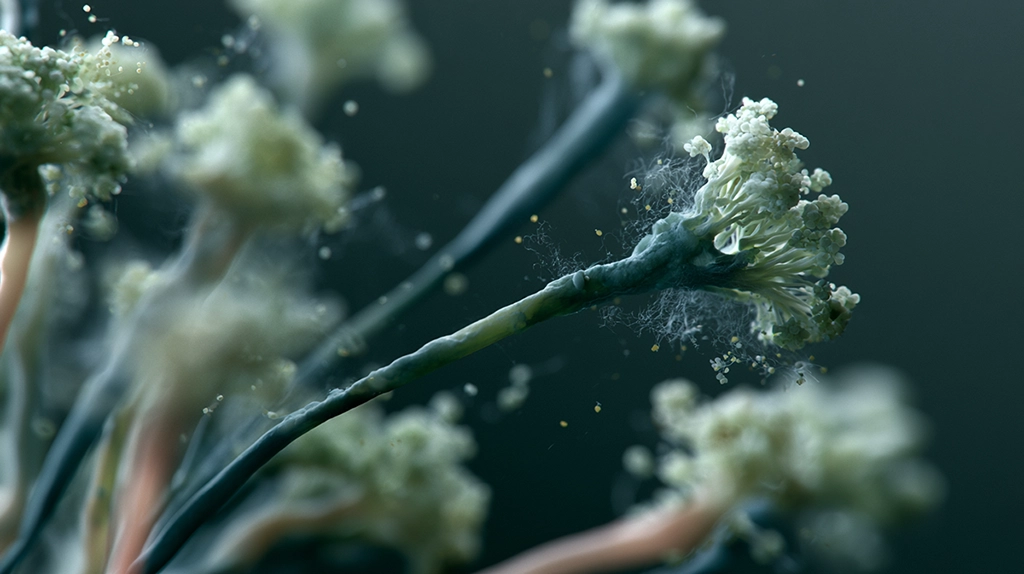
One of the study’s most notable findings is that fungi did not disappear. Certain thermotolerant fungal groups remained metabolically active throughout the high-temperature period, continuing to break down lignocellulosic materials—the lignin and cellulose that form the structural backbone of plant matter.

Aspergillus fumigatus under the microscope — one of the thermotolerant fungi that remain active during extended high-temperature composting.Credit:
Korinna, via Wikimedia Commons, CC BY 4.0This contradicts the standard model in which fungal contributions are confined to cooler composting phases. Under controlled thermophilic conditions, specific fungi remain functionally relevant throughout.
How Fungi and Bacteria Work Together

The study describes a division of labor between fungal and bacterial communities. Fungi initiate the breakdown of complex plant polymers. Bacteria then process the intermediate compounds that fungi release, contributing further to humification. Neither group dominates—they operate in sequence.
Two organisms stood out: Geotrichum (fungus) and Bacillus (bacterium), both strongly associated with lignocellulose degradation and the formation of stable humic compounds. Their complementary activity appears to be a key driver of compost quality.
How Much to Feed the System
The researchers also tested different organic loading rates. Higher feeding volumes produced more humic substances overall—but the highest input level did not yield the best compost. The intermediate feeding rate produced material with stronger maturity indicators: a higher germination index and a more balanced humic composition.
More organic input increases biological activity, but can delay the stabilization needed for compost to reach true maturity.
Why Humification Matters

Mature compost is defined less by what it has eliminated and more by what it has created. Humic substances—stable, carbon-rich compounds formed through microbial transformation—improve soil structure, support nutrient cycling, and enhance water retention.
Composting systems that optimize humification produce more than a waste management outcome. They generate a soil amendment with measurable ecological value.
Composting as Biological Engineering
The findings point toward a more deliberate approach to compost design. Temperature duration, feeding strategy, and microbial community composition all influence the final product. Fungal contributions, previously seen as incidental, may warrant active management.
Biological variability is part of any living system—but these variables can be shaped to improve outcomes consistently.
The Bigger Shift
This research reframes the thermophilic phase as an opportunity rather than a constraint. Extended heat does not suppress the microbial community; under the right conditions, it shapes a more productive one. Fungi and bacteria operating together under sustained high temperatures produce compost that is more mature, more stable, and more valuable.
The goal is not to survive the heat. It is to work with it.
FAQ — Thermophilic Composting and Microbial Interaction
Do fungi survive during thermophilic composting?
Certain thermotolerant species remain active during extended high-temperature phases and continue contributing to organic matter breakdown.
Is composting mainly driven by bacteria?
Bacteria are central, but this research shows fungi play a meaningful parallel role—particularly in lignocellulose degradation—under controlled thermophilic conditions.
Does more organic input always produce better compost?
Not always. Moderate feeding rates produced better maturity indicators than the highest input level in this study.
What is humification in composting?
The microbial conversion of unstable organic compounds into stable humic substances that improve soil structure and fertility.
Can composting be engineered?
Process variables like temperature duration and feeding strategy can be managed to influence outcomes, though biological variability remains part of any living system.
References
Extended thermophilic composting enhances fungal–bacterial cooperation and improves compost quality. Environmental Research. https://doi.org/10.1016/j.envres.2025.125324