
According to NewScientist
When a human catches a severe flu, the biological response is universal and immediate: we shut down. We curl up in bed, cancel our plans, and conserve every ounce of energy to let our immune system wage its internal war. This is known in evolutionary biology as “sickness behavior”—a survival strategy as old as life itself. Lethargy is nature’s quarantine.
But in the damp undergrowth of our world’s rainforests, a terrifying reversal of this logic is taking place.
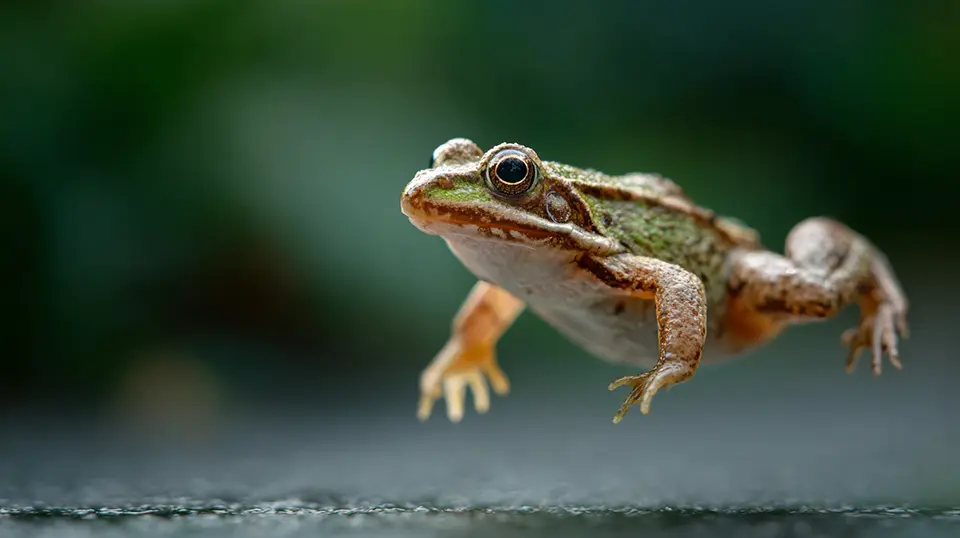
A groundbreaking report from New Scientist has shed light on a phenomenon that reads less like a biological study and more like a psychological horror script. Frogs infected with the devastating chytrid fungus are not curling up to die. Instead, they are becoming hyper‑active, jumping further and moving faster than their healthy counterparts.
This is the story of a “death march” that might just explain why amphibians are facing an apocalypse.
The Anomaly: Running on Empty
The antagonist of this story is Batrachochytrium dendrobatidis (Bd) (often shortened to Bd or the chytrid fungus). For decades, this pathogen has been the “Black Death” of the amphibian world, responsible for the decline or extinction of hundreds of species. It attacks the skin—an organ frogs use to breathe and absorb water—eventually causing cardiac arrest.
Logic dictates that a frog suffocating through its own skin should be lethargic. However, researchers monitoring infection rates and movement patterns discovered a startling correlation: the sicker the frog, the further it jumps.
While healthy frogs remained content within their home territories, those carrying heavy fungal loads were found to be moving significantly greater distances. They were breaking their routine, venturing into the unknown, and expending energy they clearly did not have.

Theory I: The “Terminal Investment” (A Tragic Romance)
Why would a dying creature run a marathon? The scientific community offers two hypotheses, both of which are deeply unsettling.
The first is the theory of terminal investment.
In the cold calculus of evolution, an organism’s primary purpose is not to survive forever, but to pass on its genes. When an animal’s body realizes that recovery is impossible—that the internal systems are failing and death is imminent—it may switch into a desperate override mode.
The increased activity could be the frog’s final, frantic attempt to find a mate. It is a biological “Hail Mary” pass. The frog is essentially burning its remaining life force to secure one last reproductive encounter before the clock runs out.
Viewed through this lens, the frog’s hyperactivity is a tragic act of defiance. It is fighting against the dying of the light, trying to leave a legacy before the fungus stops its heart. It is a romantic, albeit doomed, narrative of life striving to continue at all costs.

Theory II: The Puppet Master (Parasitic Manipulation)
The second hypothesis strips away the romance and replaces it with horror: Host Manipulation.
We are already familiar with the concept of “zombie fungi” (like Ophiocordyceps) that hijack insect brains to steer them to high ground for better spore dispersal. It is entirely possible that Bd is doing something similar, albeit more subtly.
If a frog dies in a secluded burrow, the fungus dies with it. But if the frog moves? If it jumps into a new stream, or crashes into a gathering of other frogs? That is a victory for the parasite.
By altering the host’s behavior—perhaps by messing with neurochemicals or inducing a specific type of discomfort that compels movement—the fungus turns the frog into a vehicle. The frog thinks it is moving of its own volition, or perhaps it is just running from the pain, but in reality, it is being driven by the passenger. The fungus is using the frog’s legs to conquer new territory.

The Consequence: The Super‑Spreader Event
Regardless of whether the cause is the frog’s desperation or the fungus’s manipulation, the ecological result is the same: super‑spreading.
This behavior creates a catastrophic feedback loop. The individuals most capable of spreading the disease (those with the highest fungal load) are also the ones moving the furthest and interacting the most.
The Trojan Horse: a sick frog migrates to a pristine, uninfected pond in search of a mate.
The Interaction: It finds a healthy partner. In the process of mating (or attempting to), it sheds millions of zoospores into the water and onto the partner.
The Collapse: the “patient zero” dies, but the new pond is now doomed.
This explains why containment of chytridiomycosis has been nearly impossible. Our quarantine models often assume sick animals stay put. We didn’t account for the fact that the dying might be the most mobile travelers of all.

The Mold News Perspective: The Cruelty of Nature
As an observer of these biological mechanisms, I am struck by the dark irony of this discovery.
We often personify nature as a benevolent mother, but here we see her as a cold mathematician. The very instinct that drives a species to survive—the drive to mate—is being weaponized against it. The frog’s biological imperative to save its genetic line is exactly what ensures the destruction of its neighbors.
There is a profound lesson here about “intent” versus “outcome.” The frog intends to create life; the outcome is death. The fungus intends nothing but growth; the outcome is silence in the rainforests.
In the end, this news challenges our understanding of “sickness.” We usually associate danger with weakness, with the coughing patient in the hospital bed. But in the wild, and perhaps metaphorically in our own society, the greatest danger sometimes comes from those who are frantically active, moving fast to outrun their own demise, spreading their burdens to everyone they touch.
When you see a frog leaping with unusual vigor through the mist, do not mistake it for vitality. You might be witnessing a funeral procession of one.
References
- Olson, D. H., et al. “Mapping the global emergence of Batrachochytrium dendrobatidis (Bd) and amphibian chytridiomycosis.” PLoS ONE (2013).
- Zipkin, E. F., et al. “Batrachochytrium dendrobatidis influences amphibian population declines across the globe.” PLoS Biology / global amphibian decline assessment (2022).
- Skerratt, L. F., et al. “Spread of chytridiomycosis has caused the rapid global decline and extinction of amphibians.” EcoHealth (2007).
According to NewScientist
Key Takeaways
- When a human catches a severe flu, the biological response is universal and immediate: we shut down.
- This is known in evolutionary biology as “sickness behavior”—a survival strategy as old as life itself.
- Frogs infected with the devastating chytrid fungus are not curling up to die.
- This is the story of a “death march” that might just explain why amphibians are facing an apocalypse.
- It attacks the skin—an organ frogs use to breathe and absorb water—eventually causing cardiac arrest.
Frequently Asked Questions
What should you know about the Anomaly: Running on Empty?
The antagonist of this story is Batrachochytrium dendrobatidis (Bd) (often shortened to Bd or the chytrid fungus). For decades, this pathogen has been the “Black Death” of the amphibian world, responsible for the decline or extinction of hundreds of species. It attacks the skin—an organ
What should you know about theory I: The “Terminal Investment” (A Tragic Romance)?
Why would a dying creature run a marathon? The scientific community offers two hypotheses, both of which are deeply unsettling.
What should you know about theory II: The Puppet Master (Parasitic Manipulation)?
The second hypothesis strips away the romance and replaces it with horror: Host Manipulation.
What should you know about the Consequence: The Super‑Spreader Event?
Regardless of whether the cause is the frog’s desperation or the fungus’s manipulation, the ecological result is the same: super‑spreading.
What should you know about the Mold News Perspective: The Cruelty of Nature?
As an observer of these biological mechanisms, I am struck by the dark irony of this discovery.