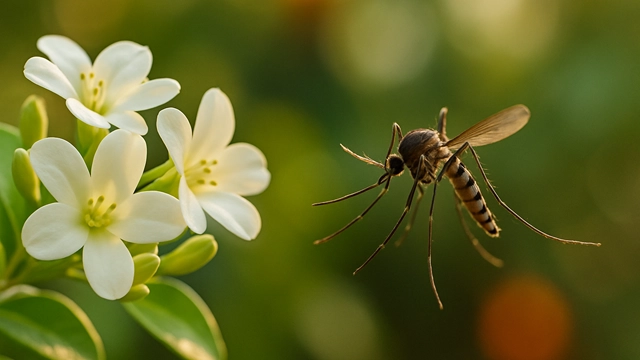
For as long as humans have battled mosquitoes, the strategy has stayed mostly the same: repel them, poison them, or pray they stay away. But now, a team of researchers has taken a strikingly different approach—one that feels almost poetic in its reversal.
Instead of concealing our scent from mosquitoes, what if we lured them in with the promise of sweetness?
And what if the sweetness was a trap?
In a breakthrough from the University of Maryland, scientists have engineered a fungus to release the aroma of flowers—specifically the natural compound longifolene—to draw mosquitoes closer. Once they land, the fungus infects them, spreads through their tissues, and kills them. A simple fragrance becomes a deadly invitation.
This is not chemical warfare.
It is biological choreography.

A Fungus That Smells Like Flowers
The research is built on Metarhizium, a soil fungus long known to attack insects. Normally, these fungi wait passively for an insect to touch their spores—a method effective in nature but too slow for modern mosquito-borne disease control.
The scientists asked a simple but disruptive question:
If insects love floral scents, why not teach the fungus to smell like flowers?
Using genetic engineering, the team rewired the fungus to produce longifolene, a terpene released by various flowers and trees. Mosquitoes are instinctively pulled toward it—they need nectar to survive, long before they go looking for blood.
The result is a fungus that acts like a natural perfume diffuser.
Only this perfume doesn’t attract admirers—it attracts victims.

A Kill Rate That Surprised Even the Researchers
In controlled laboratory settings, the engineered fungus achieved more than 90% mosquito kill rates within a matter of days. Even when the team introduced competing scents—human odor, plant volatiles, ambient lab smells—the insects still favored the longifolene-emitting fungus.
To a mosquito, it simply smelled like dinner.
Once a mosquito lands on the spore-coated surface, the fungus penetrates the exoskeleton, fills the body cavity, and eventually kills the insect. The mechanism isn’t new—but the efficiency is. Instead of waiting for chance contact, the fungus now calls the mosquitoes over.
The strategy flips traditional pest control on its head:
Don’t chase mosquitoes away—draw them toward their own destruction.

Safer, Cheaper, and Harder for Mosquitoes to Outsmart
The implications are significant, especially in regions struggling with dengue, Zika, and malaria.
Chemical insecticides come with a long list of problems:
- mosquitoes evolve resistance
- environmental toxicity builds up
- costs rise with each reformulated chemical
- beneficial insects often get caught in the crossfire
The engineered fungus dodges many of these pitfalls.
Because it relies on infection instead of poisoning, mosquitoes would need to evolve resistance to both the scent and the fungus. And altering metabolically essential scent pathways often comes with biological trade-offs that weaken the mosquito.
In other words:
Evolution might not be able to save them.
The material cost is also low. Fungal spores can be grown in bulk on cheap organic substrates—sawdust, grain waste, agricultural byproducts. In areas without strong infrastructure, an attract-and-infect system could offer a powerful, low-cost alternative to synthetic pesticides.
But Does It Work Outside the Lab?
This is where things get complicated.
Mosquitoes behave differently in the real world.
Wind, humidity, heat gradients, competing scents, vegetation, and local species traits can shift their movement patterns drastically.
A floral-scented fungus in a rainforest might perform very differently than in an urban alleyway.
There is also the ecological question:
What happens when modified fungi spread outdoors?
Although Metarhizium naturally infects insects, adding a scent-diffusion system means its ecological interactions may change. Regulatory agencies will want answers to questions about long-term stability, non-target effects, persistence in soil, and how far its fragrance plume can travel.
The researchers themselves acknowledge that field trials—not lab trials—will determine whether this approach becomes a revolution or a laboratory curiosity.
And then there’s the public perception problem.
People are famously uneasy about “genetically engineered” anything, especially when combined with the words “fungus” and “released into the environment.”
Still, history shows that many life-saving technologies begin exactly this way: bold, slightly uncomfortable, and scientifically sound.

The Future of Mosquito Control May Smell Like a Garden
If the technology scales, entire neighborhoods might one day deploy small, scent-emitting fungal stations—quiet, passive, low-energy devices that mosquitoes mistake for nectar sources. Gardens, forests, and wetlands would no longer be battlegrounds of chemicals, but carefully managed biological systems.
It represents a shift from fighting nature to outsmarting it.
Mosquitoes follow their noses.
And now, their noses may lead them to their end.
References
Academic
- Lovett, B., & St. Leger, R. J. (2017). “Genetically engineering Metarhizium fungi to enhance insect control.” Nature Biotechnology. DOI: 10.1038/nbt.3972
- Fang, W., & St Leger, R. J. (2012). “Enhanced insecticidal activity of fungal pathogens engineered to express scorpion toxins.” PLoS Pathogens. DOI: 10.1371/journal.ppat.1002645
Official Sources
- WHO — Malaria: https://www.who.int/news-room/fact-sheets/detail/malaria
- CDC — Dengue: https://www.cdc.gov/dengue
- CDC — Zika virus: https://www.cdc.gov/zika
Key Takeaways
- Certain floral fragrances—particularly linalool, geraniol, and other monoterpene alcohols—have documented mosquito-killing (larvicidal and adulticidal) properties that are being harnessed for sustainable mosquito control applications.
- The use of floral fragrance compounds against mosquitoes exploits a fundamental vulnerability in mosquito olfactory biology—the same smell receptors that mosquitoes use to detect humans and flowers can be over-stimulated or blocked by concentrated fragrance compounds.
- Linalool, geraniol, and citronellol—common constituents of many floral essential oils—show measurable toxicity against Aedes aegypti (dengue/Zika mosquito), Anopheles gambiae (malaria mosquito), and Culex quinquefasciatus (West Nile mosquito) larvae.
- Fungal production of bioactive fragrance compounds offers a potential biotechnological route to sustainable, scalable production of these compounds without reliance on land-intensive plant cultivation or petroleum-based synthesis.
- Consumer acceptance of floral fragrance-derived mosquito control is potentially higher than for synthetic insecticides, as these compounds have familiar, pleasant associations that contrast with the fear and odor aversion associated with conventional insecticides.
Frequently Asked Questions
Which flowers and essential oils kill mosquitoes?
Several plant-derived essential oils and their constituent compounds have documented mosquito-toxic properties, with a substantial body of laboratory evidence and some field-trial data supporting their use in mosquito control applications. Best-documented mosquitocidal essential oils and compounds: citronella (Cymbopogon nardus and C. winterianus)—the most commercially exploited mosquito repellent essential oil; contains geraniol, citronellol, and citronellal; historically used in candles, coils, and topical repellents; more effective as a repellent than as a toxicant. Lemon eucalyptus (Corymbia citriodora) oil—the natural source of p-menthane-3,8-diol (PMD); PMD is recognised by the US CDC as a biopesticide-based repellent with efficacy comparable to DEET for short-duration use; the plant-derived oil itself has mosquitocidal and repellent properties. Lavender (Lavandula angustifolia)—linalool is the primary active component; documented larvicidal and adulticidal activity against Aedes and Culex species. Geranium (Pelargonium graveolens)—geraniol-rich oil; documented mosquito repellent and some larvicidal activity. Peppermint (Mentha piperita)—pulegone and menthol components show larvicidal activity; peppermint oil has been tested as a larvicide in water bodies. Clove (Syzygium aromaticum)—eugenol shows strong larvicidal activity against multiple mosquito species. Thyme (Thymus vulgaris)—thymol and carvacrol show mosquitocidal activity. Neem (Azadirachta indica)—though not a fragrant flower, neem is the most extensively studied botanical mosquito control; azadirachtin disrupts mosquito development.
How do fragrance compounds kill mosquitoes?
Fragrance compounds (terpenes, phenylpropanoids, and related small molecules) kill or repel mosquitoes through several distinct mechanisms that vary by compound, target mosquito species, and concentration. Primary mechanisms: respiratory disruption—many volatile terpenoids are fumigants; inhaled as vapours at sufficient concentrations, they disrupt insect respiratory metabolism; mosquitoes, like all insects, breathe through spiracles (openings along the body) and tracheae; terpenoid vapours interfere with oxygen delivery and metabolic enzyme systems. Neurological effects—several terpenoids affect insect nervous system function; linalool has been shown to interact with insect GABAergic receptors and acetylcholinesterase; these interactions can cause paralysis and death at sufficient concentrations. Cell membrane disruption—lipophilic terpenoids dissolve in insect cuticle lipids and cell membranes, disrupting insect surface waterproofing and cellular membranes. Olfactory disruption—at sublethal concentrations, fragrance compounds can temporarily block or overstimulate mosquito olfactory receptors, impairing the mosquito’s ability to locate hosts; this repellent mechanism is distinct from the toxic mechanism that operates at higher concentrations. Enzyme inhibition—some compounds inhibit key mosquito enzymes including acetylcholinesterase (the target of organophosphate insecticides), monoamine oxidase, and detoxification enzymes. Species-specific sensitivity: the sensitivity of different mosquito species to specific compounds varies substantially due to differences in metabolic detoxification enzymes and receptor sensitivities; this means that a compound highly toxic to Aedes aegypti may be less effective against Anopheles gambiae.
Are mosquito-killing fragrance compounds safe for humans and pets?
The safety of fragrance compounds used in mosquito control depends on concentration, route of exposure, and the specific compound—with important distinctions between the levels needed for repellency (generally safe) and those needed for insect killing (requiring more caution). Safety profile by compound: linalool—GRAS as a food ingredient; well-tolerated as a fragrance; skin sensitisation is possible with repeated exposure; respiratory irritation can occur at high vapour concentrations in enclosed spaces; very low acute toxicity in mammals compared to conventional insecticides. Geraniol—similar safety profile to linalool; skin sensitisation more common; recognised as a fragrance allergen in the EU; generally safe at repellent concentrations. Citronellol—similar to geraniol; skin sensitisation potential. Eugenol (clove)—moderately higher toxicity than linalool; can cause skin sensitisation and oral mucosa irritation; vapour at high concentrations is irritating; dental use is well-established at low concentrations. p-Menthane-3,8-diol (PMD from lemon eucalyptus)—effective repellent at concentrations considered safe for human use; NOT recommended for children under 3 years (unlike linalool-based products, which have fewer restrictions). Pet safety: cats lack certain drug-metabolising enzymes (particularly glucuronyl transferases) and are more sensitive to many essential oil compounds, including linalool, than dogs or humans; concentrated essential oils should not be applied to cats or used in diffusers in areas where cats cannot escape; dogs are generally more tolerant but are also more sensitive than humans. Environmental safety: terpenoids are biodegradable and do not persist in the environment as organochlorine or organophosphate insecticides do; this is a significant safety advantage.
Is there a connection between fungal production and mosquito-killing fragrances?
The link between fungi and mosquito-killing floral fragrances has two distinct dimensions: fungi as biological producers of mosquitocidal compounds, and fungi as biotechnological platforms for sustainable production of floral fragrance chemicals. Entomopathogenic fungi as direct mosquito killers: several fungi in the family Cordycipitaceae are natural mosquito pathogens; Metarhizium anisopliae—infects and kills larvae of several mosquito species including Anopheles gambiae; field trials in Africa have demonstrated Metarhizium-infected bed net fabrics or surfaces significantly reducing Anopheles populations; Beauveria bassiana—produces beauvericin and other cyclic depsipeptides with insecticidal activity; has been formulated as a biopesticide for mosquito control. Fungal production of fragrance compounds: biotechnology route—the terpenoid pathway genes responsible for producing linalool, geraniol, and related compounds in plants can be engineered into fungal production hosts (typically Saccharomyces cerevisiae or Aspergillus niger) for fermentation-based production; yeast cell factories producing geraniol, linalool, and other fragrances via engineered mevalonate pathway have been demonstrated in research; compared to plant extraction, fermentation-based production can be: more sustainable (no agricultural land required); more scalable; potentially cheaper at large scale; more consistent in product quality. Industrial fermentation of fragrance compounds: several fragrance and flavor chemicals are already produced commercially by fermentation; the concept of replacing petroleum-derived or plant-extracted linalool with fermentation-produced linalool for both fragrance and mosquito control applications is technically feasible and commercially promising.
How does floral fragrance mosquito control compare to DEET and chemical insecticides?
Botanical and fragrance-based mosquito control represents a distinct approach from conventional synthetic insecticides and repellents, with genuine advantages and real limitations that determine their appropriate application context. Comparison with DEET (N,N-Diethyl-meta-toluamide): DEET efficacy—DEET is the gold standard repellent with decades of safety and efficacy data; it provides reliable protection (90%+ repellency) for 2–10 hours at typical concentrations (10–30%); it is effective against most mosquito species globally; US CDC recommends DEET for mosquito-borne disease prevention. DEET limitations—chemical odor that many users find unpleasant; can damage plastics and synthetic fabrics; some users prefer to avoid synthetic chemicals; not ideal for children (recommended < 30% for adults; lower concentrations for children; avoid for infants < 2 months). Natural repellent alternatives—lemon eucalyptus/PMD: US CDC-recommended biopesticide repellent with efficacy approaching DEET for shorter durations (2–4 hours); one of the few natural alternatives with strong evidence base. Picaridin: not a natural compound but well-tolerated; considered comparably effective to DEET with better odor profile. Straight essential oils: lavender, citronella, lemongrass—repellent activity for 30–120 minutes; significantly less efficacious and shorter duration than DEET; appropriate for low-risk situations (backyard, outdoor events in low disease-risk regions). Comparison with chemical insecticides (pyrethroids, organophosphates): fragrance compounds for direct mosquito killing (larviciding, adulticiding) are significantly less potent per unit concentration than synthetic insecticides; they are more expensive to apply at equivalent mosquitocidal doses; their biodegradability is an advantage for environmental safety but limits residual efficacy. Conclusion: fragrance compounds are appropriate for low-risk personal protection, complementary use in integrated vector management, or applications where chemical avoidance is prioritised; they are not a replacement for evidence-based tools (DEET, treated bed nets, IRS) in high malaria/dengue-risk settings.