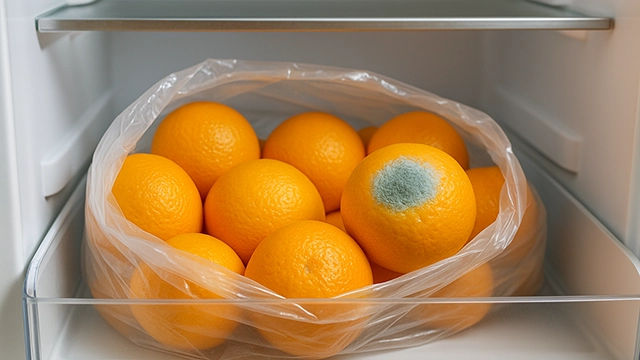
The refrigerator is the go-to place for keeping fruit fresh. We put oranges inside, believing they will stay safe. But soon enough, a familiar blue-green mold spot appears. How can mold grow in such a cold environment?
The truth is simple: refrigeration slows down decay, but it does not stop it. Mold is tougher than we think. It can tolerate cold, grow slowly, and wait patiently until the right moment to spread.
The hidden enemies: blue mold and green mold
Two fungi dominate the spoilage of oranges: Penicillium digitatum (green mold) and Penicillium italicum (blue mold). They are the major postharvest pathogens of citrus fruit worldwide.
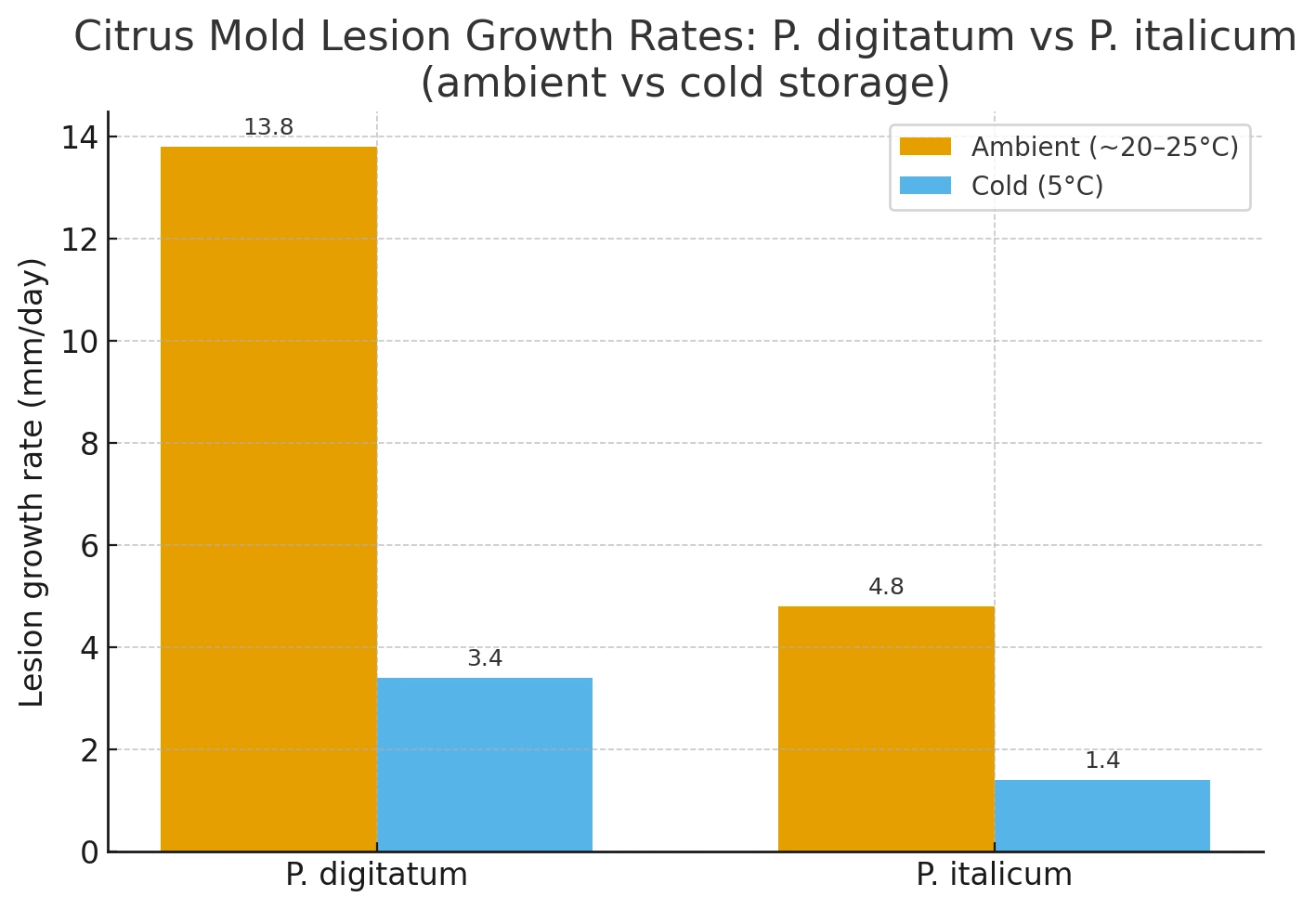
- Green mold (P. digitatum) prefers warmer and more humid conditions, so it grows fast at room temperature.
- Blue mold (P. italicum) adapts better to lower temperatures, which makes it more common in refrigerators.
Both fungi are responsible for huge economic losses. Every year, millions of tons of citrus fruit are wasted after harvest due to infections from these molds. For farmers and distributors, this means significant financial damage, while for consumers it shows up as spoiled fruit in the kitchen.
Another important fact: both are wound pathogens. This means they cannot invade through intact skin. They need an injury, scratch, or stem-end cut to infect the fruit. Even the tiniest bruise can open the door.

Can mold really grow at low temperatures?
Refrigeration does not kill spores. It only slows them down. Laboratory studies confirm this:
- P. italicum: Can germinate and grow slowly at 0–5 °C. On orange juice or moist fruit surfaces, it continues developing even in the cold.
- P. digitatum: Becomes almost inactive below 6–7 °C, but under high humidity and long storage, it can still germinate at 4 °C.
This explains why blue mold often appears first in the fridge, while green mold is more aggressive at room temperature. Cold storage is not a “mold killer.” It is only a “speed reducer.”
Why does mold still win in the fridge?
If refrigeration slows mold down, why do oranges still spoil? The answer lies in a combination of hidden factors:
- Wounds are entry points: Cuts from harvest, bruises from transport, or friction between fruits during storage all create small openings where spores can enter.
- Microclimates inside the fridge: Conditions are not uniform. Drawers trap humidity, door shelves fluctuate in temperature, and the cold-air vent can cause localized condensation. These variations provide niches where mold can thrive.
- Cross-contamination: A single infected orange can release millions of spores, which quickly spread to neighboring fruits.
- Time: Refrigeration slows the process, but after weeks spores eventually overcome the cold barrier.
In short, mold succeeds not because the fridge is “weak,” but because it exploits wounds, moisture, and time.

How to slow down mold growth
We cannot stop mold completely, but simple steps help reduce the risk:
- Choose uninjured fruit: Avoid oranges with cuts, soft spots, or broken skin.
- Keep them dry: Make sure the peel is dry before refrigeration. Wrapping each fruit in a paper towel absorbs condensation.
- Avoid sealed moisture traps: Do not store oranges in airtight plastic bags. Use breathable or perforated packaging.
- Separate spoiled fruit: Remove moldy oranges immediately to prevent cross-contamination.
- Eat them sooner: Refrigeration buys time, but not forever. Consume within 1–2 weeks.
On a larger scale, the citrus industry uses additional techniques such as hot water treatments, protective coatings, and natural essential oils to reduce mold. These industrial methods cannot be replicated at home, but they underline one truth: mold is resilient, and only a combination of strategies works.
The real truth about refrigeration
The fridge gives us a false sense of security: “cold means safe.” But science shows spores are not eliminated by low temperature. They simply slow down. With wounds and moisture, spores can still survive and grow in the cold.
Understanding mold’s survival power is not only about saving a few oranges. It also teaches us how to reduce food waste at home and how to respect the invisible life forms that share our environment. By learning from mold, we can make smarter choices: choose carefully, keep dry, separate the spoiled, and eat in time.
References
- Wikipedia: Penicillium digitatum, Penicillium italicum
- FAO. Citrus fruit statistics. FAO.org
- CDC. Mold Basics. CDC.gov
- PubMed. Postharvest citrus pathogens. PubMed
Key Takeaways
- Refrigeration significantly slows but does not completely prevent mold growth on citrus fruits—temperatures must be maintained consistently below 5°C to achieve meaningful mold inhibition.
- Oranges and other citrus fruits are commonly contaminated with Penicillium italicum (blue mold) and Penicillium digitatum (green mold)—the two most economically significant post-harvest citrus pathogens globally.
- The waxy coating applied to commercial citrus fruits (carnauba wax or shellac-based) serves primarily as a moisture barrier and cosmetic finish, but also provides some protection against surface mold establishment.
- Physical injury to citrus skin—including handling damage, stem punctures, and insect injuries—provides entry points for post-harvest mold that are far more important than surface contamination alone.
- Commercially, post-harvest citrus mold is managed with a combination of refrigeration, fungicide dips (imazalil, thiabendazole), and wax coatings—home storage cannot replicate this multi-hurdle approach.
Frequently Asked Questions
Why do oranges still get moldy in the refrigerator?
Refrigeration reduces mold growth rate dramatically but does not prevent it, because the mold species that attack citrus fruits (primarily Penicillium italicum and Penicillium digitatum) are psychrotolerant—they can grow at refrigeration temperatures, just more slowly than at room temperature. Temperature effects on Penicillium growth: P. digitatum has a minimum growth temperature of approximately 2°C; at 4°C (typical refrigerator temperature), it grows very slowly but does grow; at 8–10°C (warm refrigerator or produce drawer temperature), it grows considerably faster. P. italicum is more cold-tolerant and grows at temperatures approaching 0°C. The implication: refrigeration extends time to visible mold development from days (at 20°C room temperature) to weeks (at 3–5°C), but does not provide indefinite preservation. Additional factors: any skin damage on refrigerated citrus provides injury-induced entry for mold; moisture from refrigerator condensation or other produce can create humid microclimates on fruit surfaces that accelerate mold.
What are the blue and green molds on citrus fruits?
The characteristic blue and green molds on decaying citrus fruits are caused by Penicillium digitatum (green mold) and Penicillium italicum (blue mold)—the two most economically important post-harvest fungal pathogens of citrus worldwide, responsible for an estimated 15–30% of post-harvest citrus losses globally. Penicillium digitatum (green mold): the most aggressive and common; spore mass appears grey-green to olive-green; grows fastest at 20–25°C; enters through wounds; produces a characteristic fruity odour; typically causes a soft, watery decay that spreads rapidly across the fruit surface. Penicillium italicum (blue mold): spore mass appears blue to blue-green; more cold-tolerant; grows slightly slower than P. digitatum at optimal temperatures but outperforms it at cold storage temperatures; also enters primarily through wounds; produces a distinctly different odour from P. digitatum. Both species are part of the same genus as Penicillium notatum, the source of penicillin, but are not known to produce penicillin or other antibiotics of medical significance; they are not known to produce dangerous mycotoxins, though some minor secondary metabolites may be produced. The characteristic concentric ring pattern of growing mold colonies with white mycelium at the expanding edge and coloured spore mass in the older interior is characteristic of Penicillium growth morphology.
Can mold on oranges spread to other fruit?
Yes—mold on citrus fruits spreads rapidly to adjacent fruits through multiple routes, making isolation of moldy fruit critical to reducing overall post-harvest loss. Spore dispersal: mature Penicillium colonies on an infected orange produce millions of spores that become airborne when the fruit is disturbed; these airborne spores land on adjacent fruits and can establish infection if they land on a wounded surface. Contact spread: mycelia growing on a decaying orange directly contact adjacent fruits in packed fruit, allowing hyphae to grow across the interface and establish new infections—this is called ‘nesting’ and is a major cause of rapid propagation of mold in closely packed fruit. Volatile compounds: Penicillium digitatum produces ethylene (the plant ripening hormone) during growth; elevated ethylene in a storage environment accelerates ripening and softening of adjacent fruits, making them more susceptible to mold penetration through softened skin. Juice release: as infected oranges decay and soften, they release juice that contains both fungal tissue and nutrients that support mold growth on adjacent fruits. Practical storage recommendation: immediately remove any moldy citrus from refrigerator storage; inspect adjacent fruits closely; wash any fruit that was in direct contact; and consider placing citrus in a ventilated container rather than a sealed plastic bag to reduce the humidity microenvironment that promotes mold spread.
How long do oranges and citrus last in the refrigerator?
Refrigerator storage life for citrus fruits depends on the variety, initial condition, storage temperature, and whether the fruit is whole or cut. Whole oranges: under ideal refrigerator conditions (3–5°C, 85–90% RH, in a ventilated bag or produce drawer), whole navel and Valencia oranges typically last 3–4 weeks; blood oranges and mandarins may have shorter shelf life due to thinner skin. Mandarin segments and clementines: 2–3 weeks under ideal conditions; satsuma-type mandarins have thinner, looser skin that is more prone to moisture loss and mold entry. Lemons and limes: 4–6 weeks refrigerated; their higher acidity and thicker flavedo (outer peel layer) make them more resistant to mold. Grapefruit: 3–6 weeks refrigerated; thick rind provides good protection. Cut citrus: dramatically shorter shelf life—days to 1 week maximum even well-sealed; the cut surface exposes the juice-containing flesh directly, providing rich nutrition for mold and greatly reducing the time to visible growth. Room temperature storage: whole citrus at room temperature (18–22°C) lasts approximately 1–2 weeks before noticeable mold development; at higher temperatures (28–30°C), deterioration is much faster.
How does the commercial citrus industry prevent post-harvest mold?
Commercial post-harvest citrus mold management employs a multi-hurdle approach combining temperature control, fungicide treatment, physical treatments, and modified atmosphere storage that home storage cannot replicate. Commercial protocol overview: harvest at optimum maturity (immature or over-mature fruit has higher susceptibility); rapid pre-cooling to remove field heat (usually within 6–12 hours of harvest); commercial packing line includes sorting (removing damaged fruit), washing (removing field contamination), fungicide application (imazalil, thiabendazole, fludioxonil—applied as a drench or wax-incorporated treatment), waxing (carnauba or shellac wax), and drying; storage at 2–7°C (variety-dependent) at 85–90% RH; transport and retail chain temperature maintenance. Regulatory perspective: the fungicides used in commercial post-harvest citrus treatment are approved and regulated by FDA (US) and EFSA (EU); residue levels in treated fruit must comply with Maximum Residue Levels (MRLs); some consumers concerned about fungicide residues prefer organic citrus (which uses limited fungicide options such as sodium bicarbonate and hot water treatment instead of synthetic fungicides); fungicide residues are concentrated in the outer peel and much lower in the edible flesh. Home storage cannot match commercial multi-hurdle treatment but can maximise storage life by maintaining consistent refrigerator temperatures, avoiding pressure damage, and removing any mold-affected fruit promptly.