When Fungi Communicate With Plants
Fungi are often described through what humans can see directly: mushrooms emerging from soil, molds spreading across surfaces, pathogens infecting crops, or decomposers breaking down organic matter. But some of the most important fungal activity happens invisibly beneath the soil surface.
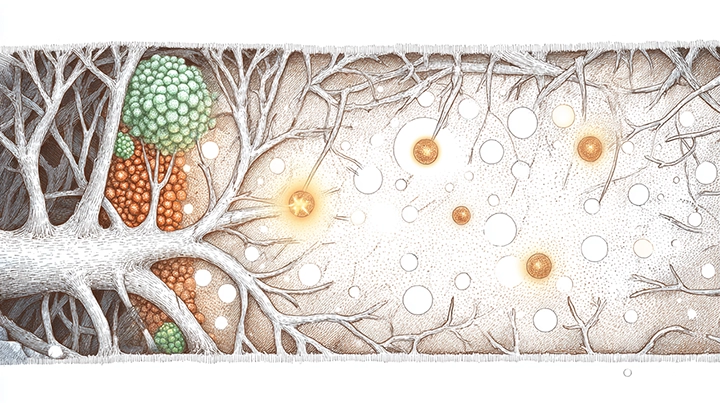
A 2026 study published in Nature Plants found that the arbuscular mycorrhizal fungus Rhizophagus irregularis transfers small RNAs into plant root cells during symbiosis. These fungal RNAs appear to help promote root colonization, demonstrating that cross-kingdom RNA signaling is not limited to plant pathogens. It may also operate within beneficial plant–fungus partnerships.
Beneficial fungi do not simply enter roots and exchange nutrients. They may also communicate with plants at the molecular level, shaping host responses so that symbiosis can successfully form. This transforms mycorrhizal fungi from passive soil helpers into active biological negotiators.

Arbuscular mycorrhizal fungi form highly branched arbuscule structures inside plant root cells, where nutrients and molecular signals are exchanged between fungus and plant. Credit: M. Piepenbring, via Wikimedia Commons, CC BY-SA 3.0The Ancient Partnership Beneath Most Land Plants
Arbuscular mycorrhizal fungi form one of the oldest and most widespread symbioses on Earth. Roots of roughly 80% of land plants are colonized by fungi from the Glomeromycotina, forming structures known as arbuscular mycorrhizae.
The relationship is fundamentally based on exchange. The fungus gathers mineral nutrients from the soil and delivers them into plant root cells through highly branched structures called arbuscules. In return, the plant supplies the fungus with carbon-rich sugars and lipids produced through photosynthesis.
Although this exchange sounds straightforward, biologically it is extremely delicate. The fungus must enter the root without triggering full immune rejection. The plant must allow colonization while still maintaining control of its defense systems. Root cells must accommodate fungal structures without losing their integrity or function.
Symbiosis is not passive cooperation. It is regulated access shaped by continuous biological negotiation.
Small RNAs as Molecular Messages
The study focuses on small RNAs—short regulatory molecules capable of influencing gene expression inside cells. In many organisms, small RNAs silence specific messenger RNAs, reducing or blocking the production of certain proteins.
In plant–pathogen interactions, researchers already know that fungi and oomycetes can deliver small RNAs into plant cells to suppress defense responses. Plants themselves can also send small RNAs into pathogens as part of immune defense.
What makes this study important is that it extends this concept into beneficial symbiosis. Using Rhizophagus irregularisand the model legume Lotus japonicus, researchers found fungal small RNAs associated with the plant’s AGO1 RNA-silencing machinery during colonization. AGO proteins are central components of gene-regulation systems inside plant cells.
In simpler terms, fungal RNA messages entered the plant’s own regulatory machinery.

Lotus japonicus served as the model plant in this study, allowing researchers to track fungal RNA transfer and its effects on root colonization.Credit: Ավետիսյան91, via Wikimedia Commons, CC BY-SA 4.0Evidence of Cross-Kingdom RNA Signaling
The researchers identified fungal small RNAs from R. irregularis inside colonized Lotus japonicus roots and found them associated with the plant AGO1 protein. These fungal RNAs displayed sequence features and size characteristics consistent with functional regulatory molecules.
The team predicted potential plant target genes for the fungal RNAs, including genes involved in defense-related processes. To test whether the fungal RNAs could influence gene silencing, researchers used reporter constructs within Lotus japonicus hairy roots.
The results were spatially specific. Reporter activity appeared primarily near fungal structures such as arbuscules and intraradical hyphae inside root tissues. Control roots lacking fungal colonization did not show the same activation patterns.
This detail matters scientifically because it suggests fungal RNA communication does not occur randomly throughout the entire root system. Instead, signaling appears concentrated near active colonization sites—exactly where compatibility between plant and fungus must be carefully maintained. The fungus was not simply growing inside the root. It was communicating locally with surrounding plant cells.

Arbuscles and hyphae of vesicular arbuscular mycorrhizae inside a plant root, captured at 40× magnification. These structures are where nutrient and molecular signal exchange between fungus and plant occurs. Credit: Rajarshi Rit, via Wikimedia Commons, CC BY 4.0Why Beneficial Symbiosis Still Requires Defense Management
At first glance, it may seem strange that a beneficial fungus would need to suppress plant defense responses at all. But from the plant’s perspective, the distinction between a mutualistic symbiont and a harmful invader is not always immediately obvious.
Fungal cell walls contain molecules such as chitin and β-glucans that can trigger immune responses in plants. Arbuscular mycorrhizal fungi likely need mechanisms to reduce excessive defense activation during early colonization and inside arbuscule-containing root cells.
This is where fungal small RNAs may become especially important. Rather than aggressively overwhelming the plant, the fungus may fine-tune local immune responses just enough to permit symbiosis while preserving a relationship that ultimately benefits both organisms.
Mycorrhizal colonization is therefore a form of molecular diplomacy. The fungus does not simply force entry into the root. It sends signals that help the plant tolerate and coordinate the relationship.
Blocking Fungal RNA Reduced Colonization
One of the study’s strongest findings came from experiments using a short-tandem-target-mimic strategy, or STTM. Researchers designed constructs capable of sequestering four candidate fungal small RNAs: Ri sRNA8, Ri sRNA11, Ri sRNA15, and Ri sRNA23.
When these fungal RNAs were blocked inside Lotus japonicus roots, colonization by R. irregularis decreased compared with control roots. The fungal RNAs were not merely present during colonization—they contributed functionally to the establishment of symbiosis itself.
The effect was also sequence-specific. Roots containing scrambled control sequences did not show the same reduction in colonization.
The conclusion is clear: when the plant could no longer respond to specific fungal RNA messages normally, the fungus colonized less successfully. RNA communication appears to be part of the symbiotic toolkit, not an incidental observation.
A New Layer in Sustainable Agriculture
Arbuscular mycorrhizal fungi are already considered important for sustainable agriculture because they may improve phosphorus uptake, support root performance, and enhance resilience under certain environmental conditions. However, agricultural use of mycorrhizal inoculants often remains inconsistent.
A fungal inoculant may work effectively in one crop system or soil environment while producing weaker results elsewhere. This study suggests one possible reason: successful symbiosis depends not only on fungal presence, but also on communication compatibility.
A mycorrhizal fungus is not simply a biofertilizer particle added to soil. It must recognize the host plant, enter the root, regulate defense responses, form arbuscules, exchange nutrients, and maintain compatibility within a constantly changing root environment. Small RNA signaling may represent one layer of that communication system.
Future agricultural science may therefore move beyond asking which fungal species improve crop growth and instead investigate which molecular signals support compatibility, how plants respond to those signals, and how environmental stress influences the entire conversation.

The soil food web illustrates how fungi, bacteria, plants, and animals interact within soil ecosystems. Mycorrhizal fungi occupy a central role as mutualists supporting plant nutrition and root health. Credit: USDA Natural Resources Conservation Service, via Wikimedia Commons, Public DomainBeneficial Fungi Are More Biologically Complex Than Expected
One of this study’s most important lessons is that beneficial fungi are not biologically simple organisms.
It is tempting to divide fungi into two categories: harmful pathogens and helpful symbionts. But the molecular mechanisms underlying those relationships may overlap more than previously assumed. Pathogenic fungi use small RNAs to manipulate plant defenses during infection. This study now suggests that beneficial mycorrhizal fungi may also use RNA-based signaling to support colonization.
The difference lies not in the molecular tools themselves, but in the ecological outcome of the interaction. In pathogenic relationships, the result may be disease and plant damage. In mycorrhizal symbiosis, the result is nutrient exchange, improved root performance, and mutual benefit. The same broad category of molecular communication can therefore operate within very different ecological contexts.
This makes fungi more sophisticated than simple soil organisms. They are participants in molecular conversations shaping plant health, ecosystem stability, and agricultural resilience.
Ecosystems May Be Built on Biological Conversations
The study demonstrates that beneficial mycorrhizal fungi use small RNA transfer as part of the symbiotic process supporting root colonization. Fungi are not merely exchanging nutrients mechanically through roots. They are participating in molecular communication systems capable of influencing plant responses at the genetic level.
The implications extend beyond one fungus or one crop species. Future agriculture, ecosystem management, and soil biology may increasingly depend on understanding these hidden communication networks operating underground.
Plants and fungi are not only connected physically through roots and hyphae. They may also be connected informationally through molecular messages exchanged beneath the soil surface.
FAQ — Mycorrhizal Fungi and RNA Communication
What is arbuscular mycorrhiza? It is a symbiotic relationship between plant roots and fungi from the Glomeromycotina, where nutrients and carbon are exchanged through specialized root structures called arbuscules. This partnership supports the majority of land plant species globally.
What did this study discover about fungal RNA? The study found that Rhizophagus irregularis transfers small RNAs into Lotus japonicus root cells during colonization, and that these RNAs associate with the plant’s own gene-regulation machinery and functionally contribute to symbiosis establishment.
Why is cross-kingdom RNA signaling important? Because it demonstrates that organisms from different kingdoms—such as fungi and plants—can exchange regulatory RNA signals that influence gene expression and biological compatibility, extending a concept previously known mainly in pathogenic interactions.
How could this research help sustainable agriculture? Understanding fungal RNA communication may improve mycorrhizal inoculant design, root colonization reliability, nutrient uptake efficiency, and soil-based biological strategies for crops where consistency has been a limiting factor.
Are mycorrhizal fungi harmful to plants? Generally no. Arbuscular mycorrhizal fungi are typically beneficial symbionts that help plants access mineral nutrients, particularly phosphorus, while receiving carbon compounds in return.
References
Researchers. (2026). Arbuscular mycorrhizal fungus Rhizophagus irregularis transfers small RNAs into plant root cells during symbiosis. Nature Plants. https://www.nature.com/articles/s41477-026-02247-2