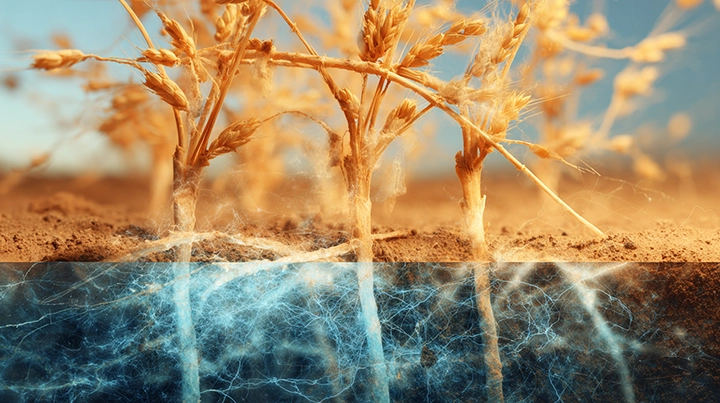
How Serendipita indica Strengthens Pearl Millet Against Environmental Stress
When Plants Don’t Just Dry—They Begin to Fail
Drought is often described as a shortage of water, but for plants, the damage runs deeper. As soil moisture declines, internal systems begin to destabilize. Photosynthesis slows, nutrient transport weakens, and cellular structures lose integrity. What starts as dehydration becomes a cascade of physiological failure.
Over time, oxidative stress accumulates, damaging proteins, lipids, and membranes. Growth declines, tissues deteriorate, and survival becomes uncertain. For crops in arid and semi-arid regions, this is no longer an occasional event. Rising temperatures and increasingly unpredictable rainfall have made it a persistent condition.
The question has shifted. It is no longer only about protecting plants from drought on the outside. It is about strengthening their capacity to endure it from within.

Cracked dry soil in the submerged village of Aceredo during early 2022's drought in northern Portugal and Spain. Credit: o_andras, via Wikimedia Commons, CC BY-SA 4.0A Fungus That Lives Inside the Root
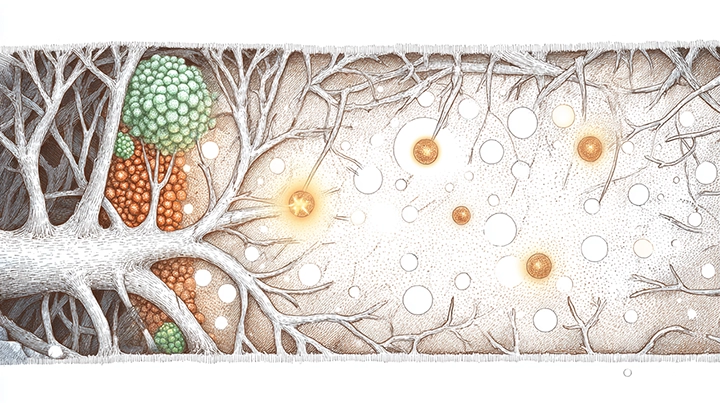
One answer may already exist beneath the soil surface. Serendipita indica is an endophytic fungus that colonizes plant roots without causing disease. Unlike pathogenic fungi, it forms a cooperative relationship with its host—integrating into root systems and interacting directly with plant physiology rather than disrupting it.
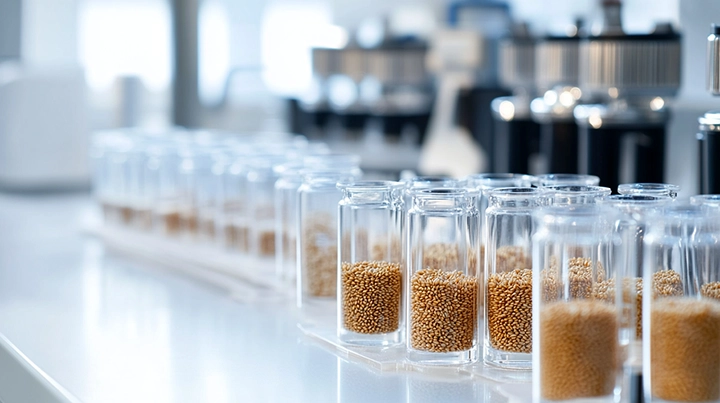
In a controlled study, pearl millet seedlings were grown under drought conditions, with and without fungal colonization. The results were consistent and measurable. Plants associated with S. indica maintained greater physiological stability across multiple stress indicators. Uncolonized plants showed clear signs of decline.
This repositions what fungi can be in an agricultural context. Here, the organism is not a contaminant or a threat. It is a biological partner in adaptation.

Nkazimulo Ngwenya, Scientific Officer at ICRISAT-Bulawayo, checks the pearl millet seed crop at Matopos Research Station in Zimbabwe.Credit: Swathi Sridharan (ICRISAT), via Wikimedia Commons, CC BY-SA 2.0What the Data Showed
Under drought conditions, uncolonized plants experienced significant reductions in biomass, chlorophyll content, and water retention. Markers of cellular damage—including electrolyte leakage and malondialdehyde accumulation—increased, both signs of membrane instability and oxidative injury.
Plants colonized by S. indica followed a different pattern. Water balance was better maintained, physiological activity remained more stable, and cellular damage indicators stayed consistently lower across the study period.
Across every major stress measure, the fungal-associated plants performed better. The fungus does not eliminate drought. It changes how the plant responds to it.
Managing Stress From the Inside
Much of drought damage is biochemical rather than mechanical. As stress intensifies, reactive oxygen species accumulate within plant cells, triggering oxidative damage that disrupts essential cellular functions.
S. indica appears to influence this process directly. By modulating antioxidant responses within the plant, the fungus helps reduce oxidative stress and maintain cellular stability during periods of water deficiency.
This matters because it targets the mechanism, not just the symptom. Rather than preventing environmental stress entirely, the fungus helps the plant manage its internal consequences. The outcome is not immunity. It is resilience.

Pearl millet is a staple crop across arid and semi-arid regions of Africa, where water availability directly shapes food security. Credit: Shikoha Tautiko, via Wikimedia Commons, CC BY-SA 4.0A Complement to External Inputs
Modern agriculture relies heavily on external interventions—irrigation, fertilizers, chemical treatments—to sustain crop productivity under stress. These approaches can be effective, but they are increasingly resource-intensive and difficult to scale under worsening climate conditions.
The relationship between pearl millet and S. indica points toward a different direction. Rather than compensating for environmental stress from outside the plant, it builds resilience from within through biological interaction. This reflects a shift in how crop protection is being framed: not only through what is applied to the soil or the plant, but through what already lives in relationship with it.
Why Pearl Millet, and Why Now
Pearl millet is a foundational crop in arid and semi-arid regions, particularly across parts of Africa and Asia where water scarcity is a structural constraint rather than a seasonal one. Its natural drought tolerance already makes it valuable under difficult conditions, but increasing environmental pressure continues to test its limits.
Enhancing that resilience through fungal symbiosis could meaningfully improve crop stability in the regions where agricultural failure carries the most direct consequences for food security. The research is not theoretical in its implications. It applies directly to systems under the greatest strain.

Plant–microbe partnerships occur at multiple levels of complexity, from individual microbial interactions to rhizosphere community dynamics.Credit: Birgit Mitter, Nikolaus Pfaffenbichler and Angela Sessitsch, via Wikimedia Commons, CC BY-SA 4.0Toward Microbial Partnerships in Agriculture
The implications extend beyond pearl millet and a single fungal species. Researchers are increasingly examining how plant-associated microbial systems influence growth, stress tolerance, and environmental adaptation across a range of crops.
Endophytic fungi like S. indica may become part of future agricultural strategies—managed biological partnerships that work alongside traditional practices to support more resilient production systems. Field performance, long-term stability, crop specificity, and scalability still need to be addressed before broad adoption becomes practical. What the research offers today is a credible biological framework, not yet a ready-made solution.
Rethinking What Fungi Do
This study challenges a familiar assumption about fungi—that their primary role is disease or decay. Fungal systems in nature occupy a much wider range of ecological positions. Some degrade. Some compete. Some cooperate.
Serendipita indica belongs to the cooperative category. It strengthens plant systems, stabilizes stress responses, and supports survival under adverse conditions. Its role points to something broader: that resilience in biological systems often emerges not from isolation, but from the relationships within them.
FAQ — Fungal Symbiosis and Drought Resistance
Can fungi really help crops survive drought? Yes. Certain endophytic fungi improve plant stress tolerance by enhancing water retention, stabilizing physiological activity, and reducing cellular damage during drought. Serendipita indica has demonstrated this effect in pearl millet under controlled conditions.
Is Serendipita indica harmful to crops? No. It is a beneficial fungus that forms a symbiotic relationship with plant roots. It colonizes root tissue without causing disease, supporting growth and resilience rather than disrupting it.
How does the fungus improve drought tolerance? It regulates the plant’s internal stress response—particularly by modulating antioxidant systems and reducing oxidative damage within plant cells during water deficit.
Can this approach replace irrigation or fertilizers? Not as a direct substitute. Fungal symbiosis is best understood as a complementary strategy that builds plant resilience from within, alongside rather than instead of existing agricultural inputs.
Is this technology used in farming today? It is still in the research and development phase. Further studies on field performance, scalability, and crop specificity are needed before widespread practical use becomes feasible.
References
Jogawat, A., et al. (2026). An endophytic fungus Serendipita indica enhances drought tolerance of pearl millet.ResearchGate. https://www.researchgate.net/publication/393258997