When Mold Leaves Earth
Mold is usually treated as something to remove from homes, hospitals, food systems, and spacecraft interiors. In enclosed environments, fungal growth can threaten air quality, contaminate surfaces, damage materials, and create health concerns. But a 2022 study published in Frontiers in Microbiology asked a very different question: could a mold-like fungus become useful for space exploration?
Researchers cultivated the melanized fungus Cladosporium sphaerospermum aboard the International Space Station while monitoring ionizing radiation beneath the fungal biomass. The goal was to test whether this dark, melanin-rich fungus could grow in low Earth orbit and whether its biomass might reduce radiation exposure compared with a no-growth control.
The same biology that makes fungi persistent survivors may become an engineering advantage. On Earth, Cladosporiumis often discussed as an indoor mold concern. In space, a melanized fungal layer may become a prototype for living, self-regenerating radiation shielding.

The International Space Station orbits Earth at an altitude where astronauts face continuous exposure to ionizing radiation—one of the greatest challenges for long-duration spaceflight. Credit: NASA, via Wikimedia Commons, Public DomainRadiation: The Invisible Barrier to Deep-Space Travel
One of the greatest obstacles to long-duration spaceflight is radiation exposure. Beyond Earth’s protective atmosphere and magnetic field, astronauts face ionizing radiation capable of damaging DNA, increasing cancer risk, impairing tissues, and threatening mission safety.
Shielding is possible, but conventional materials create a major engineering problem: mass. Every kilogram launched into space is extremely expensive, and future missions to Mars or long-term lunar habitats cannot simply transport unlimited shielding material from Earth.
This is why biological shielding concepts are attracting attention. If a protective material can grow, regenerate, or be produced from a small starting culture, it may reduce launch burden while supporting long-duration missions.
The study explored this idea using Cladosporium sphaerospermum, a dematiaceous fungus known for heavy melanin pigmentation and unusual tolerance to stressful environments. The researchers described the experiment as a meaningful proof of concept showing that fungal biomass can survive and grow under the microgravity and radiation conditions of low Earth orbit. The appeal is not that fungi would replace all conventional shielding—it is that fungal biomass or fungal-derived melanin could eventually become one layer within a future hybrid radiation-protection system.
Why Cladosporium sphaerospermum?
Cladosporium sphaerospermum is a melanized fungus, meaning it produces large amounts of dark pigment known as melanin. Melanin is widely recognized for its role in pigmentation and ultraviolet protection across many organisms, but fungal melanin may also help protect against ionizing radiation and other environmental stresses.
This gives the fungus a highly unusual profile. It is not valuable because it is fragile or delicate. It is valuable because it is resilient. In environments where many organisms struggle, melanized fungi may continue growing, repairing damage, and surviving under stress. For spacecraft and off-world habitats, that kind of biological durability becomes scientifically interesting.
A living material capable of tolerating radiation while regenerating itself could theoretically support long-term missions in ways conventional static materials cannot. Still, this does not mean astronauts would simply allow uncontrolled mold growth inside spacecraft. Any future application would require strict containment systems, engineered substrates, sterilization protocols, air-quality management, and carefully controlled biotechnology processes. The scientific idea is not “mold everywhere in space.” It is controlled fungal engineering.

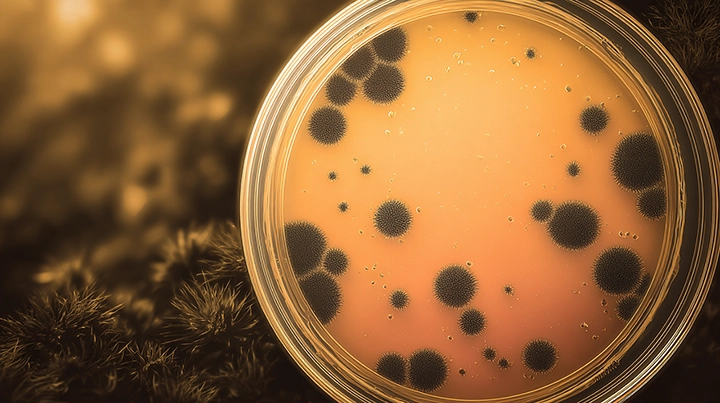
A culture of *Cladosporium sphaerospermum*, one of the melanin-rich fungi detected aboard the International Space Station Credit: Medmyco, via Wikimedia Commons, CC BY-SA 4.0What Happened on the International Space Station
The researchers implemented a small payload experiment aboard the ISS to cultivate C. sphaerospermum while monitoring radiation levels beneath the fungal biomass. Radiation measurements under the fungal layer were compared with a control region where no fungal growth occurred.
The fungus successfully grew in orbit. The fungal growth rate in space was approximately 1.21 ± 0.37 times higher than the ground control, suggesting a possible adaptive response to the orbital radiation environment. The experiment also detected measurable radiation attenuation beneath the fungal biomass compared with the no-growth control. Beneath an approximately 1.7 mm mature fungal layer, measured radiation was around 0.84% lower than the negative control.
That number is modest, but scientifically important. A thin biological layer producing even a small measurable reduction suggests that thicker, denser, engineered, or melanin-enhanced fungal materials may deserve further investigation.
This was not a finished shielding system for Mars habitats. It was an early prototype experiment demonstrating that melanized fungal biomass can grow in space and may contribute to measurable radiation reduction under orbital conditions.

A global map of estimated radiation dosage on Mars, produced by NASA's 2001 Mars Odyssey mission — illustrating the intense cosmic ray exposure that any future human mission would face Credit: Mars Radiation Experiment (MARIE) team, NASA/Jet Propulsion Laboratory/JSC, Public DomainMelanin as a Biological Armor Layer
The most important biological feature in this story is melanin itself. In fungi, melanin helps protect cells from environmental stressors including ultraviolet radiation, oxidative stress, desiccation, and potentially ionizing radiation. Some researchers have explored whether melanized fungi may benefit metabolically from radiation exposure—a concept sometimes described as radiotrophy or radioadaptation.
Fungal melanin may function as a form of biological armor, interacting with radiation in ways that help protect the organism and potentially reduce radiation passing through the biomass.
This does not make melanin a magical solution to space radiation. Deep-space radiation is extremely complex and includes multiple particle types and energy levels. A material effective against one type of radiation may be less effective against another. But if melanin can be biologically produced, concentrated, engineered into composites, or combined with other materials, it may become part of future radiation-management systems for long-duration exploration.
From Living Fungus to Space Construction Material
The most compelling long-term possibility is not simply growing mold on a petri dish in orbit. It is integrating fungal biotechnology into future material systems.
Space habitats will likely require materials that are lightweight, repairable, regenerative, and compatible with in-situ resource utilization. Instead of transporting every building material from Earth, astronauts may eventually manufacture some components using biological systems and locally available resources. Melanized fungal biomass could theoretically appear as dried fungal panels, melanin-rich coatings, fungal-regolith composites, protective habitat layers, or biologically produced shielding additives.
This is where fungi become more than organisms. They become manufacturing platforms. The same mycelial growth capable of producing packaging, insulation, or biomaterials on Earth may one day contribute to off-world infrastructure systems. The same melanin helping fungi survive stressful environments may eventually support radiation management for astronauts living beyond Earth.

A shipping container made from MycoBond — a biodegradable mycelium composite grown from crop waste — demonstrating how fungal materials could replace conventional packaging and, potentially, serve structural roles in space habitats Credit: mycobond, via Wikimedia Commons, CC BY-SA 2.0This Is Still an Early Proof of Concept
The study should be read with excitement, but also with scientific restraint.
The ISS experiment was small, and the radiation attenuation observed was modest. A thin fungal layer cannot by itself solve the enormous radiation challenges associated with Mars missions or deep-space habitation. There are also major engineering and safety questions. Living fungi aboard spacecraft would require strict containment. Spores could not be allowed to contaminate environmental-control systems. Growth conditions, nutrient supply, waste management, crew health, moisture balance, and long-term material stability would all require careful management.
Future applications may therefore rely less on free-growing fungal colonies and more on processed biomass, purified melanin, engineered composites, or controlled biomanufacturing systems that produce shielding materials safely under monitored conditions. The study is important because it opens a technological door—not because it fully solves the problem.
Controlled Fungal Biotechnology Is Not Space Contamination
One of this study’s most important lessons is the distinction between uncontrolled fungal contamination and controlled fungal biotechnology.
In indoor environments and spacecraft, accidental mold growth can be dangerous. It may release spores, damage materials, compromise air quality, and create operational risks. Controlled fungal systems are fundamentally different. In biotechnology applications, selected fungal strains are cultivated intentionally under monitored environmental conditions for defined engineering purposes.
This is the same principle behind fermentation systems, mycelium packaging, fungal leather, fungal insulation, and fungal-protein production. Fungi become useful when their biology is directed carefully. They become dangerous when growth escapes control. Space fungal biotechnology would therefore depend on precision, containment, and engineering discipline at every stage.
Future Spacecraft May Partly Be Biologically Grown
The ISS experiment demonstrates that melanized fungal biomass can survive and grow under orbital conditions while producing measurable radiation attenuation. Although the shielding effect remains modest and highly experimental, the study expands the future possibilities of biological manufacturing in space environments.
Long-duration exploration may eventually depend not only on metals, polymers, and prefabricated structures launched from Earth, but also on regenerative biological systems capable of producing useful materials during the mission itself. Fungi—organisms humans often associate with decay and contamination—may become part of the infrastructure helping civilization survive beyond Earth.
FAQ — Fungi and Space Radiation Shielding
Can fungi really grow in space? Yes. Cladosporium sphaerospermum was successfully cultivated aboard the International Space Station under low Earth orbit conditions, and its growth rate in orbit was comparable to ground controls.
Why is melanin important for fungal radiation research? Melanin may help fungi tolerate environmental stress and potentially reduce radiation exposure through radioprotective interactions with ionizing particles, making melanin-rich fungi scientifically interesting for space applications.
Did the fungus completely block space radiation? No. The experiment observed only modest radiation attenuation of approximately 0.84% beneath a 1.7 mm fungal layer. The study should be understood as an early proof of concept rather than a functional shielding solution.
Would astronauts use uncontrolled mold as shielding? No. Any practical application would require highly controlled biotechnology systems, engineered containment, purified or processed materials, and strict safety protocols—not free-growing fungal colonies inside spacecraft.
Why is biological shielding attractive for space missions? Biological systems may potentially regenerate, self-repair, or be produced during missions using minimal initial mass, reducing the need to launch large quantities of shielding material from Earth.
References
Verseux, C., et al. (2022). Cladosporium sphaerospermum aboard the International Space Station: radiation shielding potential. Frontiers in Microbiology. https://www.frontiersin.org/journals/microbiology/articles/10.3389/fmicb.2022.877625/full