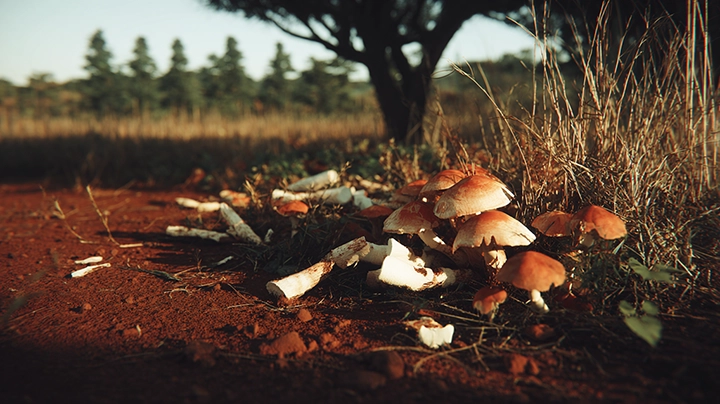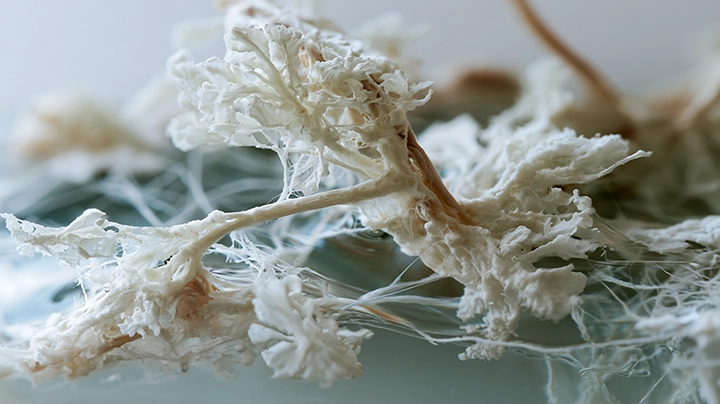

Fungal mycelium fully colonizing a growth medium under laboratory conditions — the same kind of controlled cultivation that researchers are now exploring for biomedical material design.Credit:
KarolMasztalerz / Wikimedia Commons, CC BY-SA 4.0Fungal mycelium is most often imagined spreading invisibly through soil, wood, or damp building materials. In uncontrolled environments, that growth can become a contamination concern. In a laboratory, the same biological architecture can become a material.
A 2025 article published in JOM explores a new kind of mycelium-based biomaterial: multilayer, functionally graded organic living hydrogels built entirely from pure mycelium. The study focuses on Marquandomyces marquandii, a fungus adapted to submerged cultivation, and demonstrates that controlled fungal growth can produce a hydrated, multilayer structure capable of retaining up to 83% water.
The finding positions mycelium beyond packaging, insulation, leather alternatives, and food proteins — and into the emerging world of biomedical soft materials.
What Hydrogels Are and Why Medicine Needs Them
Hydrogels are water-rich materials that can mimic the softness and hydration of biological tissues. Because of this property, they are widely studied for applications including wound dressings, tissue scaffolds, drug delivery systems, cartilage repair, soft robotics, and cell-supporting matrices.
The challenge is that hydrogels must balance several competing properties simultaneously. They need to hold water, remain mechanically stable under stress, support biological compatibility, and maintain structure through repeated deformation. Many conventional hydrogels rely on synthetic polymers, chemical crosslinkers, or complex fabrication processes.
Pure mycelium hydrogels offer a different approach — one grown rather than assembled.
The Fungus at the Center: Marquandomyces marquandii
The study centers on Marquandomyces marquandii, formerly classified within the genus Metarhizium. Unlike many familiar mycelium-material fungi such as Ganoderma or Pleurotus — which are typically grown on solid agricultural residues and can face limitations in water retention and hydrophobicity — M. marquandii is well adapted to submerged cultivation. That makes it suited for liquid fermentation and hydrated material formation.
Using stationary liquid fermentation, researchers produced a mycelium-based hydrogel with a porosity-graded, multilayered structure. The material was not a uniform block. Instead, it formed distinct layered architecture with variation in porosity across its depth, while retaining up to 83% water within its hyphal-integrated matrix.

Fungal hyphae under the microscope reveal the branching filament architecture that gives mycelium its structural properties — the same network that forms the matrix of pure mycelium hydrogels.Credit:
Aristonlipa / Wikimedia Commons, CC0 1.0 Public DomainThat internal variation is significant. Biological tissues are rarely uniform. Skin, cartilage, vascular tissue, and wound environments all contain gradients — changes in stiffness, hydration, porosity, or structure across different layers. A fungal material that naturally develops internal gradients during growth could prove valuable for tissue-inspired design.
The fungus did not merely grow biomass. It grew structure.
A Matrix Built by Hyphae
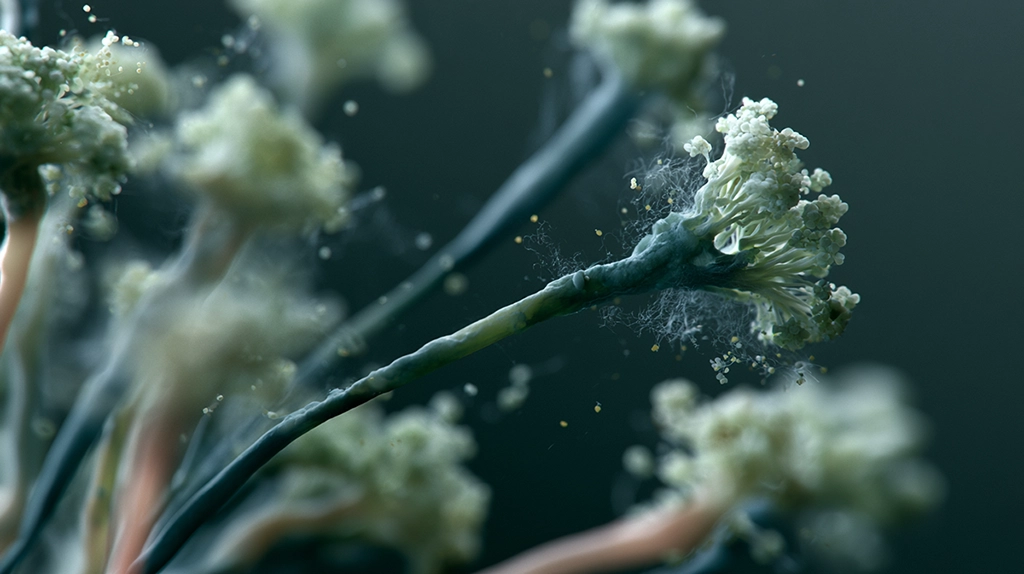
Mycelium is made of hyphae: fine, branching fungal filaments that grow, intertwine, and form three-dimensional networks. In most mycelium composite materials, these networks bind plant fibers, sawdust, or agricultural waste into boards, foams, or leather-like sheets.
In this hydrogel study, the mycelium itself becomes the material. The result is a pure fungal network — no substrate, no binders, no added polymers — that holds water and maintains a soft matrix. The multilayered and porosity-graded architecture suggests that fungal growth patterns can serve as a form of biological manufacturing.
Rather than machining, molding, or printing a material into shape, researchers guide an organism to assemble structure through its own growth.
Mechanical Stability Under Repeated Stress
A hydrogel that holds water is not automatically useful. It must also survive handling and repeated deformation.
The M. marquandii-derived hydrogel demonstrated mechanical stability under repetitive shear stress up to 100% shear strain. The material maintained its hydrated, hyphal-integrated matrix through repeated deformation cycles — a relevant property for biomedical contexts where materials experience continuous mechanical forces.
Wound dressings flex and move with skin. Tissue scaffolds may experience compression or shear during use. Soft biological interfaces must maintain structure while interacting with living systems. The reported stability suggests that pure mycelium hydrogels may offer a mechanically resilient soft matrix alongside their biological architecture.
This does not mean the material is ready for clinical use. It means the material has characteristics worth deeper scientific investigation.
From Fungal Growth to Biofabrication

Fungal mycelium transforming plant biomass into structured composite panels — a demonstration of biofabrication, where the organism itself is the manufacturing process.Credit:
Vera Meyer & Sven Pfeiffer / Wikimedia Commons, CC BY-SA 4.0The broader significance of this research lies not only in the specific fungus, but in the manufacturing concept it represents.
Traditional biomaterial production often depends on extracted polymers, chemical processing, or additive manufacturing. Mycelium-based biofabrication offers a different model: the organism itself is the builder. The fungus grows the network, organizes the matrix, and creates material structure through its own biology — assembling microscopic filaments into macroscopic form, creating porosity, connectivity, and layered structure without being printed strand by strand.
This approach could reduce certain manufacturing steps while opening design possibilities that purely synthetic processes cannot easily replicate.
Biomedical Potential, Carefully Interpreted
The study positions M. marquandii-derived hydrogels as a compelling platform for future biomedical exploration. That potential deserves careful interpretation.
A promising hydrogel prototype is not the same as a wound dressing, implant, or approved clinical scaffold. Before any medical application, researchers would need to address biocompatibility testing, sterilization validation, degradation control, immune-response evaluation, reproducibility, mechanical benchmarking, storage stability, and regulatory assessment. If the material remains living, additional biosafety questions would apply.
This is the normal path of biomaterial development. The study is valuable because it creates a new scientific platform to investigate — not because it delivers a finished product.
Why Pure Mycelium Matters
Many mycelium composites combine fungal growth with plant fibers, agricultural waste, or other substrates. Those mixed-substrate materials are valuable for packaging, insulation, and panels. But biomedical hydrogels require more controlled purity, hydration, and structural consistency.
A pure mycelium hydrogel offers a cleaner biological matrix, and allows researchers to study fungal hyphae as the primary structural element rather than as a binder within a composite. For applications requiring precise control over composition, porosity, mechanics, and hydration, that distinction may matter considerably.
A New Frontier in Fungal Biomaterials

Ganoderma lucidum — one of the fungal species studied in mycelium biomaterial research — illustrates the biological diversity that researchers are drawing on to develop next-generation materials.Credit:
Eric Steinert / Wikimedia Commons, CC BY-SA 3.0Fungal biomaterials have already entered conversations around sustainable packaging, alternative leather, building insulation, and food ingredients. This study extends that territory into hydrated biomedical materials — a frontier with different requirements, different opportunities, and different standards of proof.
That expansion also shifts the way fungi can be understood. Mold is frequently associated with contamination, decay, or moisture damage. Controlled mycelium, guided under laboratory conditions, can become a platform for material innovation at the frontier of medicine and biology.
The future of mycelium technology may extend across multiple fields: architecture, medicine, food, textiles, environmental remediation, and soft robotics. Each application will require different fungal species, growth conditions, safety controls, and performance targets. Species selection, as this study demonstrates, matters enormously. Not every fungus is suited to every material. Some form tough composites. Some bind plant waste. Some, like M. marquandii, may be better suited to soft, hydrated matrices designed to face biological systems directly.
Understanding fungal diversity may prove to be one of the keys to designing the next generation of biomaterials.
The difference between mold as a contamination risk and mycelium as a fabrication platform comes down to a single variable: control.
When that control is achieved, fungi are not merely decomposers. They are architects of form.
Common Fungal Species Referenced in This Article
Marquandomyces marquandii, Ganoderma lucidum, Pleurotus ostreatus, Phanerochaete chrysosporium, and Trametes versicolor are among the fungal species discussed in mycelium biomaterial research. These organisms vary significantly in growth behavior, structural output, and potential material applications.
FAQ: Mycelium Hydrogels and Biomedical Materials
Can mycelium be used as a medical material? Not yet in clinical settings. The M. marquandii hydrogel is a research prototype with promising properties that requires extensive testing before any biomedical application is possible.
Why is Marquandomyces marquandii suited for hydrogel formation? It is adapted to submerged cultivation, which helps it produce a hydrated, multilayered mycelium structure that overcomes the water-retention and hydrophobicity limitations of other mycelium-material fungi.
What does 83% water retention mean for a biomaterial? It means the material holds a large proportion of water within its structure, giving it softness and hydration levels that may be compatible with biological tissues.
How is a pure mycelium hydrogel different from a mycelium composite? A composite combines mycelium with plant fibers or agricultural substrates. A pure mycelium hydrogel is built from the fungal network alone, offering more controlled composition for advanced applications.
What is biofabrication? Biofabrication uses biological organisms or processes to produce materials or structures. Here, the fungus itself grows the layered matrix rather than requiring synthetic manufacturing steps.
References
- Multilayer functionally graded organic living hydrogels from pure mycelium. JOM (2025). https://link.springer.com/article/10.1007/s11837-025-07685-5