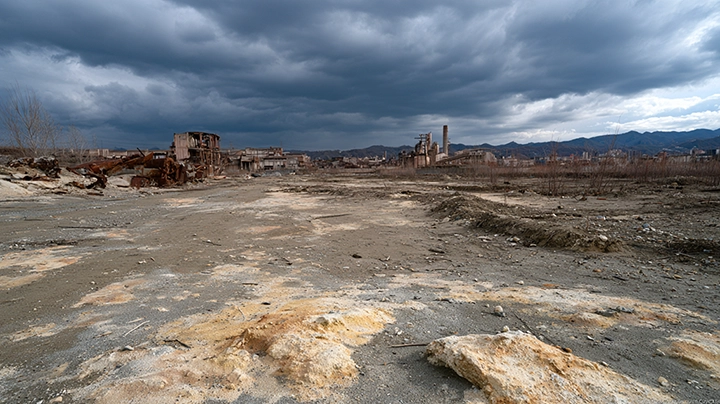

Credit: U.S. Department of Agriculture / Lance Cheung / Wikimedia Commons, Public Domain
Mercury contamination is widely recognized for its toxic effects on ecosystems, wildlife, and human health. These pollutants persist in soils for decades, creating sustained environmental stress that degrades biological systems and alters ecological function.
Most discussions of contaminated landscapes focus on damage and degradation. What receives less attention is the microbial life that continues to operate within these systems — organisms that survive, adapt, and function under conditions that would eliminate most biological activity.
A study published in Scientific Reports shifts attention toward that microbial life. By examining soil communities at two historically contaminated sites in the United States, researchers investigated how fungi and bacteria respond to long-term mercury exposure — and what their survival reveals about ecological resilience and the potential for biological remediation.
The central finding is that contaminated environments are not biologically inactive. They remain dynamic systems in which microorganisms continue to survive, compete, and adapt under chemical stress.
Two Sites With Decades of Contamination
The research focuses on soils from the Savannah River Site and the Oak Ridge Reservation — two locations shaped by long-term industrial and nuclear activity, with mercury contamination histories measured in decades rather than years.
These sites provide what laboratory experiments cannot: real-world conditions of sustained exposure, with soil chemistry, microbial communities, and contamination gradients that reflect actual environmental conditions rather than controlled approximations.
To analyze microbial communities across these sites, the study integrates multiple analytical techniques, including quantitative PCR, fungal ITS sequencing, bacterial 16S rRNA sequencing, and shotgun metagenomics. This combination provides both taxonomic and functional insight — revealing not only which organisms are present but also how they function at the genomic level.
Modern analytical tools now allow a systems-level view of microbial ecosystems. The result is a more complete picture of life in contaminated soils than has been possible through single-method approaches.
Why Bioavailability Matters More Than Total Concentration
Mercury contamination is not uniform in its biological impact. The study distinguishes between total mercury, methylmercury, and bioavailable mercury — three measurements that carry different levels of biological relevance.
Microorganisms respond primarily to the fraction of mercury they can interact with, not to total concentration alone. Soils with similar total mercury levels may present very different biological conditions depending on how much mercury is chemically accessible to living cells.
Methylmercury is particularly significant from a toxicological perspective. It is the form most readily absorbed by biological systems and the most concerning for ecological and human health outcomes.
Understanding which fraction of contamination is biologically relevant is essential for accurate environmental risk assessment. A site’s total mercury measurement may substantially overestimate or misrepresent the stress actually experienced by its microbial communities.
Bacteria Respond to Mercury as a Selective Filter

Bacterial populations show clear sensitivity to increasing mercury exposure. As contamination rises, bacterial diversity tends to decline — reflecting the toxic effects of mercury on cellular processes, enzyme systems, and DNA integrity.
Only bacteria carrying resistance mechanisms are able to persist under high mercury concentrations. These mechanisms, which can include mercury reduction, methylation, or sequestration systems, allow certain lineages to tolerate conditions that eliminate most microbial competitors.
The result is a community shaped by selective pressure. Mercury acts as an ecological filter — restructuring bacterial communities by removing sensitive species and concentrating those capable of tolerating chemical stress. The community that remains is less diverse but more specifically adapted to the conditions present.
Reduced diversity does not necessarily mean reduced activity. But it does mean that ecological functions previously distributed across many species may become concentrated in fewer, specialized organisms — a structural shift with consequences for how the system as a whole functions.
Fungi Demonstrate Greater Stability Across Contamination Gradients
In contrast to bacteria, fungal communities demonstrate greater stability across contamination gradients. While diversity may decrease in the most heavily polluted soils, fungi remain present and active under conditions that suppress many other microorganisms.
Dominant groups in the study — including Ascomycota and Basidiomycota — encompass species known for stress tolerance. Their structural and biochemical characteristics may contribute to this persistence. Fungal cell walls, with their complex polysaccharide and protein architecture, may provide a degree of physical buffering against chemical stressors not available to bacteria.
This resilience should be understood at the group level rather than assumed for all fungal species. Fungal communities are diverse, and responses to mercury contamination vary across species, genera, and environmental conditions. What the study demonstrates is a pattern of comparative stability at the community level — not universal tolerance.
The Biochemical Toolkit of Mercury-Tolerant Fungi

Several biological mechanisms may contribute to fungal tolerance of heavy-metal stress in contaminated soils.
Biosorption involves the binding of metal ions to cell-wall components, reducing bioavailable mercury in the immediate environment. Bioaccumulation refers to internal uptake and storage of metals within fungal cells in forms that reduce their toxic activity. Enzymatic transformation can alter the chemical state of mercury, potentially converting it between forms with different toxicity and mobility profiles.
At the molecular level, metallothioneins — small, cysteine-rich proteins that bind and sequester metal ions — and glutathione-based detoxification pathways can limit intracellular mercury damage. These mechanisms allow fungi to maintain metabolic function even under conditions of elevated metal exposure.
While not all of these mechanisms were directly measured in this study, they are consistent with observed survival patterns and with broader literature on fungal responses to heavy-metal stress. Fungi emerge from this picture not as passive occupants of contaminated environments but as active biochemical participants engaged in ongoing chemical interaction with their surroundings.
Functional Shifts Across the Microbial Community
Metagenomic analysis adds another layer to the findings. Contaminated soils are enriched in genes associated with stress response, membrane transport, nutrient acquisition, and environmental adaptation.
Long-term mercury exposure alters not only species composition but also the collective functional capabilities of microbial communities. The community shifts toward survival-oriented functionality — maintaining essential metabolic processes while emphasizing mechanisms that allow persistence under chemical pressure.
These functional shifts carry practical implications. A community enriched in stress-response genes may perform less efficiently at ecological functions such as organic matter decomposition, nutrient cycling, or soil-structure support that are important for ecosystem recovery. Understanding these trade-offs is essential for any remediation strategy that relies on indigenous microbial communities to restore ecological function.
What This Means for Bioremediation
The persistence of mercury-tolerant microorganisms suggests potential applications in environmental remediation. Certain fungi and bacteria may influence metal mobility, chemical transformation, and pollutant stabilization in ways that could support decontamination efforts.
However, survival in contaminated environments does not guarantee effective remediation. Demonstrating that an organism tolerates mercury is not the same as demonstrating that it can meaningfully reduce mercury concentrations, alter mercury speciation, or improve soil conditions in a practical context.
Effective application requires understanding specific mechanisms, quantifying effects under relevant field conditions, and evaluating scalability from site-level observations to practical remediation programs. Microbial communities represent a promising resource — but one that must be guided by careful evaluation of capability and operational context before being incorporated into remediation strategies.
Contaminated Soils as Laboratories of Adaptation
Beyond remediation, this research reframes how contaminated environments should be understood.
Sites like the Savannah River Site and Oak Ridge Reservation are often characterized primarily by their pollution legacy. This study reveals that they are also active biological systems in which microbial communities continue to function, adapt, and evolve under extreme chemical stress.
These environments serve as natural experiments in ecological resilience — systems where the pressures of long-term contamination have shaped communities in ways that reveal biological limits and capabilities not visible under ordinary conditions. The organisms that survive at these sites carry information about adaptation, tolerance, and ecological function under stress that may be valuable far beyond the specific context of mercury contamination.
Pollution does not eliminate life. It transforms ecosystems into selective environments that concentrate and reveal what life can sustain.
Toward Integrated Environmental Microbiology
Advances in genomics and metagenomics-based analysis are enabling more comprehensive understanding of microbial systems. Studies that integrate chemistry, microbiology, ecology, and environmental genomics can reveal connections between contamination patterns, community structure, and functional capability that single-discipline approaches cannot capture.
Future research may identify specific organisms, genes, or mechanisms capable of contributing meaningfully to mercury remediation and ecosystem recovery. It may also reveal how microbial community composition predicts ecological resilience, and how ecosystem function changes as contamination levels shift over time.
These findings could inform more sustainable approaches to managing contaminated environments — approaches that leverage existing biological potential rather than relying entirely on physical or chemical interventions.
Environmental microbiology is shifting toward integrated, systems-level understanding. Microbial adaptation is becoming a key component of how environmental scientists and land managers approach contaminated landscapes.
Common Heavy-Metal-Tolerant Fungi
Aspergillus niger, Penicillium chrysogenum, Trichoderma harzianum, Phanerochaete chrysosporium, and Pleurotus ostreatus are among the fungal species associated with tolerance to heavy-metal-contaminated environments. These organisms have been studied for their roles in biosorption, enzymatic transformation of contaminants, and persistence under elevated metal concentrations.
FAQ: Mercury Contamination and Microbial Adaptation
Does mercury contamination eliminate microbial life?
No. Mercury reduces diversity but selects for organisms capable of tolerating toxic conditions. Contaminated soils remain biologically active systems.
Why is bioavailable mercury important?
Bioavailable mercury represents the fraction that organisms can interact with, making it more relevant to biological impact than total mercury concentration alone.
Are fungi more resistant than bacteria to mercury contamination?
Some fungal groups show greater community-level resilience, but tolerance varies among species and environmental conditions.
Can mercury-tolerant microorganisms clean up contaminated soils?
They may contribute to remediation processes, but effectiveness depends on specific mechanisms, field conditions, and controlled application.
What functional changes occur in mercury-contaminated microbial communities?
Both species composition and functional gene profiles shift toward stress-response and survival mechanisms under long-term heavy-metal exposure.
References
- Microbial community adaptation in mercury-contaminated soils at the Savannah River Site and Oak Ridge Reservation. Scientific Reports (2025). https://www.nature.com/articles/s41598-025-25944-y