
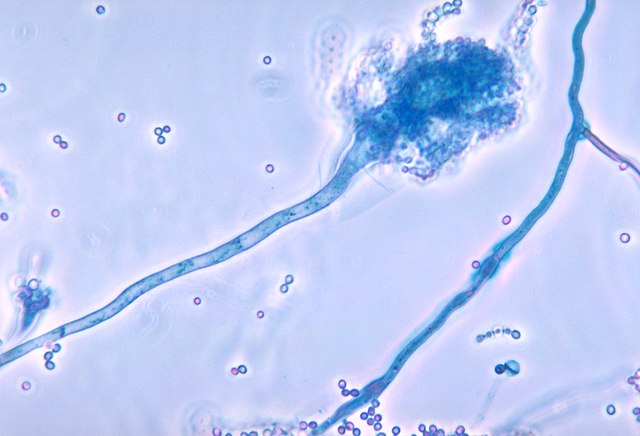
A Hidden Passenger Within a Deadly Mold
Inside the shadowed architecture of Aspergillus fumigatus — a mold already infamous for preying on the immunocompromised — scientists have uncovered an unexpected companion. This covert partner is a double-stranded RNA virus embedded deep within the fungus, quietly shaping its behavior like an unseen coil augmenting an electrical field.
The discovery, announced by researchers at the Hebrew University of Jerusalem, reveals that the fungus’s destructive power may depend not on its own biology alone, but on the influence of this internal viral guide.
A Fungal Killer — Now Revealed to Be a Duo
Clinicians have long treated A. fumigatus as a solitary invader responsible for life-threatening lung infections. Mortality can reach 50%, especially in patients undergoing chemotherapy, recovering from organ transplants, or living under the shadow of suppressed immunity.
But the new findings suggest the fungus cannot fully achieve its virulence without its viral partner. Under the virus’s influence, A. fumigatus withstands oxidative stress, evades immune defenses, and thrives where lungs should suffocate it.
To probe this relationship, the research team engineered virus-free fungal strains. Without the virus, the fungus weakened noticeably: reproductive output declined, melanin production diminished, and infections in animal models became far less severe.
Even more compelling, antiviral treatments directed solely at the mycovirus improved survival — despite the fungus remaining present.
The virus, it seems, behaves not as a passenger but as an internal regulator, subtly twisting biological dials that determine the fungus’s aggression.
The Viral “Backseat Driver” and the Biology of Control

Dr. Neta Shlezinger described the viral resident as a molecular “backseat driver.” In my view, it more closely resembles a parasitic oscillator within an intricate circuit — one whose influence does not create the current, but redirects it. Remove this silent modulator, and the fungal machinery loses its coherence. The waveform collapses from a destructive surge to a harmless hum.
This dual organism — fungus and virus intertwined — forces us to reconsider our assumptions about pathogenic identity.
If a microbe’s virulence can be engineered by an interior virus, then infection becomes not the action of a single species, but the result of a symbiotic engine working in unison.
A New Strategy: Disarming the Virus, Not Destroying the Fungus
Antifungal therapies have long lagged behind the evolution of resistance. Our weapons are blunt, slow to innovate, and often toxic.
But this discovery opens a new horizon.
Instead of trying to exterminate the fungus itself, we may disable the viral component that fuels its strength. An antiviral-based approach transforms the battlefield: rather than detonating the structure, we cut the internal wire supplying its power.
This strategy suggests a future with antiviral adjuncts, diagnostic tools that identify virus-loaded fungal strains, and predictive models that measure disease severity not only by fungal burden but by viral presence.
It is a more elegant, more precise path — one that speaks to the engineering mindset, where disabling a single internal regulator can quiet an entire machine.
A Redefined Understanding of Mold Ecology
This revelation compels us to view molds not as solitary organisms, but as biological consortiums — complex alliances between fungi and the viral passengers shaping their behavior.
Such partnerships may determine how molds survive disinfectants, tolerate environmental extremes, or gain footholds in hospitals and indoor environments.
If A. fumigatus harbors such a partner, what of other pathogenic molds? What of those populating air ducts, industrial systems, or food-fermentation chambers?
The fungal kingdom may be threaded with viral overseers whose impact we have only begun to comprehend.
The New Battlefront: The Invisible Architect Within
The emerging picture is striking. The true adversary in many fungal infections may not be the mold itself, but the viral conductor living within it — setting the rhythm, dictating the tempo, and guiding the assault.
As global health agencies warn of increasing fungal threats, this study offers a profound truth: we must examine not only the visible organism but also the hidden forces animating it.
Much like alternating current revealed the invisible structure of electrical transmission, this discovery illuminates the unseen currents governing one of medicine’s most formidable pathogens.
The future of antifungal intervention may lie not in harder blows, but in the precise quieting of the virus that whispers in the fungus’s core.
References
- Hebrew University of Jerusalem. (2025). Discovery of mycoviral modulation in Aspergillus fumigatus virulence.
- Nature Microbiology. (2025). dsRNA mycovirus enhances oxidative stress resistance in Aspergillus fumigatus.
- Centers for Disease Control and Prevention (CDC). (2024). Aspergillosis overview.
- Wikipedia: Aspergillus fumigatus, Mycovirus, Double-stranded RNA virus, Melanin biosynthesis, Fungal ecology.
Key Takeaways
- Mycoviruses—viruses that infect fungi—are widespread throughout the fungal kingdom and play important roles in modulating fungal virulence, reproduction, and antifungal susceptibility.
- Some mycoviruses reduce the virulence of pathogenic fungi (hypovirulence), offering potential as biological control agents against crop diseases like chestnut blight and Botrytis cinerea.
- Other mycoviruses increase antifungal drug resistance in infected fungi by altering gene expression patterns, potentially contributing to the global antifungal resistance crisis.
- Mycovirus research is revealing entirely new virus families—including members with no known relatives in plant or animal virus taxonomy—expanding our understanding of viral diversity on Earth.
- Transmission of mycoviruses occurs primarily through cell fusion (anastomosis) between fungal individuals of compatible mating types, making spread within natural fungal populations more limited than respiratory or waterborne viruses.
Frequently Asked Questions
What are mycoviruses and how long have they been known?
Mycoviruses (fungal viruses) are viruses that infect and replicate within fungal cells. They were first discovered in the 1960s in the cultivated mushroom Agaricus bisporus (‘mushroom X disease’), initially identified as double-stranded RNA (dsRNA) elements that impaired mushroom production. Since then, mycoviruses have been identified in hundreds of fungal species across all major fungal divisions, with a remarkable diversity of genome types (dsRNA, positive-sense ssRNA, negative-sense ssRNA, and DNA viruses are all represented in fungal hosts). Most mycoviruses appear to establish persistent, asymptomatic infections in their hosts—they do not lyse (destroy) the fungal cell but coexist as chronic intracellular residents, sometimes for the entire lifespan of the fungal colony.
How do hypovirulent mycoviruses work as biocontrol agents?
The best-studied example of mycovirus-mediated biological control is chestnut blight (Cryphonectria parasitica), caused by a fungal pathogen that virtually eliminated American chestnut trees in the 20th century. In Europe, where chestnut blight also arrived but caused less total devastation, researchers discovered that many C. parasitica strains are infected with a mycovirus (Cryphonectria hypovirus 1, CHV-1) that dramatically reduces their virulence. Virally infected strains grow more slowly, produce fewer spores, and cause smaller, healing cankers rather than lethal girdling infections. When hypovirulent strains are inoculated into blight cankers, the virus can spread from infected to uninfected strains through hyphal anastomosis, converting virulent strains to hypovirulence. This approach has achieved significant blight suppression in some Italian and French forests.
Can mycoviruses spread from fungi to plants or animals?
Transmission of mycoviruses from fungi to plants or animals is not part of their normal biology—mycoviruses are adapted to fungal intracellular environments and lack the surface proteins or entry mechanisms needed to infect non-fungal cells. However, some plant viruses (particularly those of the Chrysoviridae and Partitiviridae families) have close relatives that infect both fungi and plants, suggesting evolutionary transitions may have occurred. There is no documented evidence of mycoviruses infecting or causing disease in animals or humans. The primary significance of mycovirus-plant interactions is that virus-infected fungal pathogens may be less virulent on their plant hosts, as with Botrytis cinerea strains infected with BcMyV1 (Botrytis cinerea mycovirus 1), which show reduced gray mold virulence.
How might mycoviruses contribute to antifungal drug resistance?
Research has identified mechanisms by which mycovirus infection can alter fungal susceptibility to antifungal drugs. In some Candida and Aspergillus strains, mycovirus infection has been associated with upregulation of efflux pump genes and stress response pathways that are also involved in drug resistance—potentially ‘pre-adapting’ fungal cells to resist drug pressure. Some mycoviruses may affect the expression of azole target genes. Additionally, the cellular stress of mycovirus infection may increase the rate of beneficial mutations in the fungal genome, accelerating resistance evolution under drug selection pressure. The extent to which mycoviruses contribute to clinical antifungal resistance is still being studied, but represents a novel and underappreciated potential mechanism.
What do mycoviruses tell us about the origin and diversity of viruses on Earth?
Mycoviral diversity is vastly greater than previously appreciated, with metagenomic studies of environmental fungal samples revealing hundreds of previously unknown virus families with no relatives in animal or plant virology databases. This suggests that fungi—which have existed for at least 1 billion years—have been hosts for viruses throughout much of that time, and have served as evolutionary reservoirs for viral diversity that may have seeded some plant and animal virus families through host range expansion events. The discovery of DNA viruses (uncommon in fungi until recently), satellite viruses, and viruses with completely novel genome architectures in fungal hosts is expanding the ‘virosphere’ (the total known diversity of viruses) substantially and challenging previous assumptions about what types of viruses can infect which hosts.