A Silent Attack That Starts on the Skin
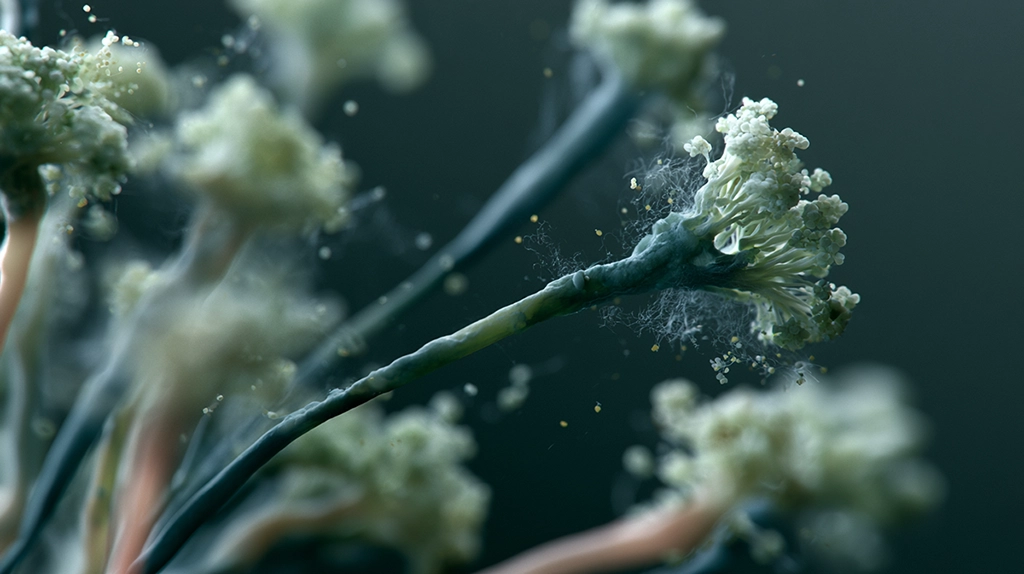
The fungus is Batrachochytrium dendrobatidis, commonly known as Bd, the pathogen responsible for chytridiomycosis. It is considered one of the most destructive wildlife diseases ever recorded, linked to the decline of more than five hundred amphibian species worldwide.
What makes Bd particularly lethal is its unusual mode of attack. It does not invade organs or bloodstreams. Instead, it targets a place so ordinary that it’s easy to overlook—the skin.
Just as molds like Aspergillus can creep down the human respiratory tract, quietly narrowing the space where air should flow freely, Bd begins its assault on the frog’s most essential respiratory organ: the skin itself.
Because amphibians depend on their skin for gas exchange and for maintaining water and electrolyte balance, the infection gradually thickens and hardens this delicate surface. When the skin stops functioning, the frog cannot regulate its internal physiology. Eventually, its heartbeat falters and stops—often without wounds, swelling, or dramatic symptoms. It simply dies in silence.

An Ecological Domino After Frogs Vanish
Across Central America, Bd spread with astonishing speed, causing amphibian populations to collapse in mere months. Some researchers described entire regions where frogs “seemed to vanish within a single season.”
Once frogs and tadpoles were gone, the rest of the ecosystem felt the shock immediately.
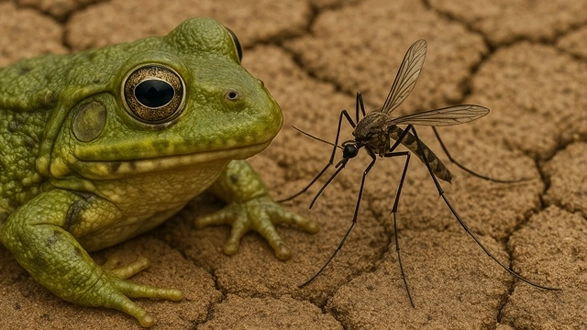
Without frogs to consume mosquito larvae, aquatic insects, and other invertebrates, these organisms multiplied rapidly.
Without tadpoles grazing on algae, ponds turned murky and oxygen-poor.
Insects along riverbanks surged in number, as if a natural constraint had been suddenly lifted.
The ecological seat that frogs once held—central, stabilizing, indispensable—was left completely and abruptly empty.

Cracks in the Forest Reach Human Communities
The imbalance did not stay in the forest.
It crossed straight into people’s homes.
Residents began noticing more mosquitoes indoors; soon afterward, clinics reported higher numbers of malaria cases. Even more striking, the rise in malaria almost perfectly overlapped with the timeline of amphibian collapse.
For scientists, the chain of events was unmistakably clear:
frog decline → mosquito surge → human disease spike.
For local families, no scientific explanation was needed.
When frogs disappeared, mosquitoes came.
When mosquitoes came, people got sick.

A Crisis Amplified by Climate and Human Movement
If we view the malaria increase alone, it might seem like a public-health issue. But tracing it backwards reveals a deeper root: a fungus gaining strength in a warming, destabilizing climate.
Hotter, wetter conditions create environments where Bd thrives.
Extreme weather weakens amphibians already stressed by heat or drought.
And the microclimate refuges that once protected them from infection no longer offer the same buffer in an era of relentless climatic swings.
Human activity magnifies the problem.
Cross-border wildlife trade, the pet industry, and invasive species transport Bd into populations with no immunity.
Even worse, Bd can survive for long periods in the environment, allowing outbreaks to persist even after local amphibians have vanished.
Bd is not just a biological problem—it is a symptom of our era.

Fungi and Human Health: A Deeper Connection Than We Imagine
We tend to think of mold and health as matters of allergy, infection, or damage to the respiratory tract—problems that occur within the boundaries of our own bodies. As long as we clean the walls and keep the air dry, it feels as though fungi should stay out of our lives.
But reality is far more intertwined.
Humans do not live outside the environment—we live inside it, as one node in a much larger ecological web.
Fungi don’t only affect a tree, a frog, or a human lung.
They shape insect populations, alter water quality, destabilize food webs, and redirect the pathways through which diseases move across landscapes.
Bd makes this connection visible:
A pathogen doesn’t need to infect humans to harm them.
Sometimes all it needs is a small ecological gap—and the consequences travel the rest of the way on their own.
In a future that is wetter, hotter, and more volatile, understanding this invisible line between ecosystems and human health may be the first step toward anticipating the crises yet to come.
References
Academic
- Voyles, J. et al. (2009). “Pathogenesis of chytridiomycosis, a fungal disease of amphibians.” PNAS. DOI: 10.1073/pnas.0906899106
- Rohr, J.R. et al. (2020). “Widespread amphibian declines cause proportional increases in malaria incidence.” Science. DOI: 10.1126/science.aay1845
- Kilpatrick, A.M. et al. (2010). “The global emergence of Batrachochytrium dendrobatidis.” EcoHealth. DOI: 10.1007/s10393-010-0329-3
Official Sources
- WHO — Malaria fact sheet: https://www.who.int
- CDC — Chytridiomycosis overview: https://www.cdc.gov
- IUCN Amphibian Red List
Key Takeaways
- The catastrophic global decline of amphibians from chytrid fungus disease has cascading ecological consequences for human health, food systems, and ecosystem services—not only for the amphibians themselves.
- Amphibians consume enormous quantities of insects including mosquitoes (malaria, dengue, Zika vectors) and agricultural pests; frog population declines have been linked to measurable increases in insect-borne disease rates.
- A 2022 study in the journal Environmental Health Perspectives estimated that the chytrid-driven collapse of frog populations in Latin America was associated with a 1–2% increase in malaria incidence in affected communities.
- Tadpoles filter algae and organic matter from water bodies, playing a critical water purification role; their loss alters nutrient cycling and can trigger cyanobacterial bloom events.
- The frog-human disease connection illustrates the One Health framework: ecological integrity, animal health, and human health are deeply interconnected and cannot be managed in isolation.
Frequently Asked Questions
How do frog declines increase human disease risk?
The ecological mechanism linking frog declines to increased disease in humans runs through insect vector populations. Frogs and toads are voracious insect predators—a single adult frog can consume thousands of insects per year, including mosquitoes that transmit malaria, dengue, yellow fever, Zika, and other diseases. When frog populations collapse, as has occurred across Latin America, sub-Saharan Africa, and Southeast Asia following chytrid fungus epidemics, the predation pressure on mosquito and other insect populations is removed. The resulting increase in mosquito abundance can translate directly into higher disease transmission rates in human communities near affected amphibian habitats.
What ecological services do amphibians provide beyond insect control?
Amphibians perform multiple ecological roles: as predators of insects, invertebrates, and small vertebrates; as prey for snakes, birds, fish, and mammals that depend on them as food sources; as scavengers of organic material and detritus; as hosts for parasites that would otherwise affect other animals; and as nutrient cycling agents that transfer energy between aquatic and terrestrial ecosystems. Tadpoles are particularly important as grazers of algae and periphyton in streams and ponds, preventing algal overgrowth and maintaining water clarity. Their body mass, when they metamorphose and emerge onto land, represents a significant nutrient subsidy to terrestrial food webs. Loss of amphibians from an ecosystem creates ripple effects through multiple trophic levels.
Has the malaria-amphibian connection been directly proven?
The 2022 study in Environmental Health Perspectives by Springborn et al. used epidemiological modelling and satellite data to estimate the statistical association between the documented timing of amphibian population collapses in Costa Rica and Panama (caused by Bd chytrid fungal spread in the 1990s–2000s) and subsequent increases in malaria incidence in those regions. The study found a statistically significant increase in malaria cases temporally and spatially correlated with the amphibian declines, controlling for other variables. This is compelling observational evidence but does not constitute controlled experimental proof of causation. Other factors (land use change, insecticide resistance patterns) may contribute to malaria trends in the same regions.
What is One Health and why is it relevant to amphibian decline?
One Health is a transdisciplinary framework recognising that human health, animal health, and ecosystem health are deeply interconnected and that addressing health challenges requires considering all three dimensions together. The amphibian-chytrid-human disease connection is a textbook One Health scenario: a fungal pathogen (initially spread by human wildlife trade) causes mass die-offs of wild animals, which disrupts the ecological services those animals provide, which then feeds back as increased human disease risk. Traditional siloed approaches—wildlife conservation as one discipline, human disease control as another, ecosystem management as a third—are poorly equipped to detect or respond to these cross-domain connections. One Health approaches systematically integrate ecological monitoring with human disease surveillance.
Are there other examples of wildlife disease causing human health consequences?
Yes—the frog-malaria connection is one example of a broader pattern of ecological disruption affecting human health. Other documented cases include: Lyme disease emergence and spread linked to the extirpation of predators and changes in small mammal communities; West Nile virus amplification related to changes in bird community composition; Hantavirus pulmonary syndrome increases following rodent population booms triggered by altered predator-prey dynamics; and COVID-19’s origins in wildlife-human interfaces. Conversely, some wildlife diseases that affect humans directly—such as avian influenza and Ebola—emerge from disrupted wildlife habitats where human-animal contact intensifies. The common thread is that biodiversity loss and ecological disruption consistently increase emerging disease risk.