When the Forest Falls Silent

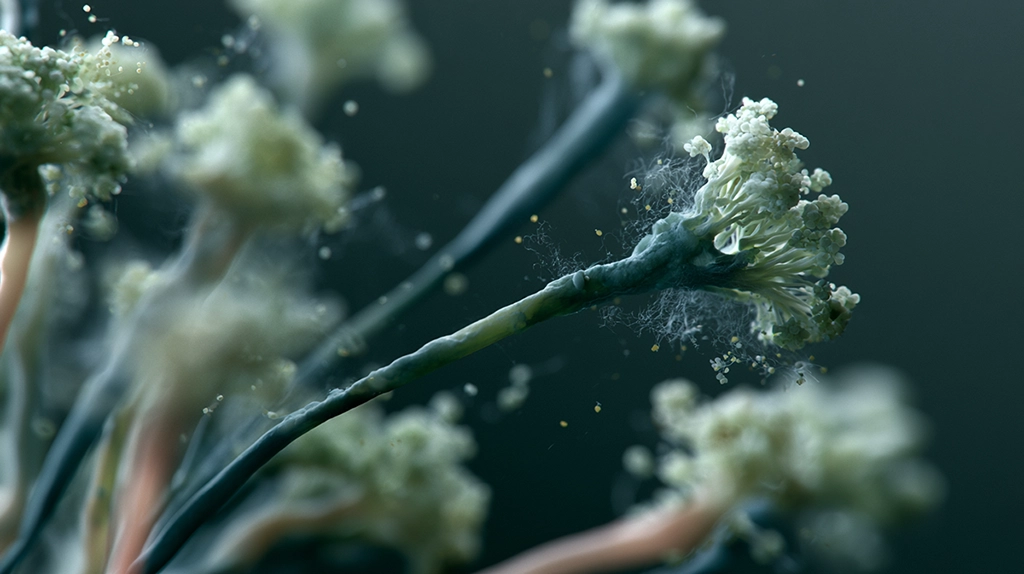
There are places in Panama where the morning air once trembled with sound—choruses of frogs calling from leaf, branch, and stream. Today, many of those voices are gone. The cause is not a predator, a poison, or a human machine. It is a fungus—Batrachochytrium dendrobatidis (commonly known as Bd, pathogen page: Bd – Wikipedia), known simply as Bd. A microscopic pathogen that infiltrates amphibian skin, Bd disrupts the delicate exchange of water and electrolytes that frogs depend on to breathe and survive. In a matter of decades, it has contributed to the decline or extinction of more than 500 amphibian species. Few pathogens on Earth have rewritten an entire branch of the animal kingdom with such speed or severity.
But something different is happening now. After years of loss, scientists are beginning to answer Bd with a tool as invisible and far-reaching as the fungus itself: climate-driven forecasting.
Thirteen Years of Data in a Single Living Map
The researchers behind this study assembled a dataset so detailed and extended that it resembles a biological chronicle rather than a simple analysis. Over 13 years, they collected:
daily temperature profiles,
humidity and moisture readings,
solar radiation levels,
and canopy cover measurements —
all mapped at kilometer-level resolution across Panama’s jungles, mountains, valleys, and lowlands.
To this environmental archive, they added 4,900 fungal-load samples from frogs across 314 sites, representing different elevations, habitats, and seasons.
The result is not just a map; it is a time-lapse of disease, climate, and survival. For the first time, researchers could watch Bd rise and fall with the weather, with forest structure, with microclimates, and with the rhythms of the land itself.
With this data in hand, they built a predictive model—a fungal weather system—that shows where Bd thrives, where it struggles, and where it might strike next.
The Climate Signature of a Killer Fungus

The analysis revealed a pattern as sharp as an electrical wave on an oscilloscope: Bd is not random. It is governed by climate.
The fungus proliferates in cool, moist, shadowed environments—conditions that amphibians themselves often rely on for survival.
By examining climate patterns in the 15 days prior to each amphibian sampling event, scientists could accurately forecast infection severity. Cool nights and persistent humidity combined with dense forest cover created ideal fungal conditions. Warm spells, dry air, or increased sunlight weakened the fungus’s foothold.
What emerges is a profile of Bd not as a chaotic invader, but as a climate-tethered organism—one whose lifecycle can be tracked, anticipated, and, crucially, used to guide conservation strategies.
When Risk Is Mapped, Survival Becomes Strategized
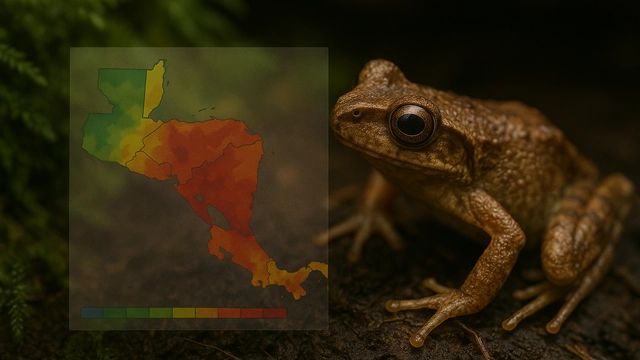
The researchers produced risk maps with unprecedented clarity: kilometer-by-kilometer projections of low, medium, and high likelihood of Bd outbreaks.
These maps are not theoretical—they guide action.
Conservationists can now:
• reinforce protected areas where the model predicts imminent fungal surges,
• deploy field teams to monitor high-risk corridors,
• select amphibian reintroduction sites inside stable microclimates.
Perhaps most valuable is the identification of refuge zones—regions where amphibians coexist with Bd at low, survivable levels.
These areas may hold the genetic or ecological keys to long-term resistance. They are nature’s strongholds, revealed not by chance but by climate-enabled science.
A Fungal Threat Bound to the Planet’s Pulse
The study reveals something larger than amphibians and larger than Panama: Bd’s behavior is inseparable from climate.
Temperature, humidity, and sunlight determine where the fungus lives, where it kills, and where it recedes. As climate systems change—bringing irregular rains, heat waves, or new cloud cover patterns—the dynamics of Bd will shift accordingly.
This is more than a wildlife crisis. It is an example of how fungal pathogens across ecosystems will increasingly move with climate volatility.
But this study demonstrates something hopeful: the very climate patterns that empower Bd can be used to anticipate it.
This research feels like a turning point
Not because it eradicates Bd—it doesn’t. But because it introduces a new kind of vision: one where fungi are no longer treated as unpredictable terrors, but as organisms whose paths can be traced through science, modeled through climate, and anticipated through data.
Amphibian conservation has long been reactive. This approach flips the sequence—giving scientists, for the first time, a chance to move faster than the fungus.
In the silent forests where frog songs once lived, that shift may be enough to preserve what remains—and perhaps, one day, bring the chorus back.
References
Academic Sources
- Longo, A. V., et al. (2019). *Global epidemiology of Batrachochytrium dendrobatidis. PNAS. DOI: 10.1073/pnas.1812562116
- Rohr, J. R., et al. (2020). Climate and chytridiomycosis. Nature Climate Change. DOI: 10.1038/s41558-020-0769-z
- Scheele, B. C., et al. (2019). Amphibian fungal panzootic causes catastrophic and ongoing loss. Science. DOI: 10.1126/science.aav0379
Official Sources
- CDC — Chytridiomycosis Overview: https://www.cdc.gov/fungal/diseases/chytridiomycosis/index.html
- IUCN Amphibian Red List: https://www.iucnredlist.org/initiatives/amphibians
- FAO Climate and Biodiversity Data Portal
Key Takeaways
- Climate modelling integrated with chytrid fungus (Batrachochytrium dendrobatidis, Bd) growth parameters allows prediction of future habitat suitability for the amphibian plague pathogen under various climate scenarios.
- Bd has caused the most catastrophic vertebrate disease in recorded history, driving over 90 species of amphibians to extinction and severely reducing populations of 500+ more species.
- Chytrid fungus grows optimally at 17–25°C; climate-driven temperature shifts are expected to expand Bd’s range in some high-altitude tropical refugia while potentially reducing pressure in historically core habitats that are warming beyond its optimal range.
- Conservation forecasting using climate models can identify amphibian hotspot populations at greatest future risk, enabling proactive captive assurance colony programmes before catastrophic declines occur.
- The interaction between climate change and chytrid is complex: warming may help some currently infected populations by raising temperatures above Bd’s thermal optimum, while cold refugia lose their natural protection.
Frequently Asked Questions
What is Batrachochytrium dendrobatidis and why is it so lethal to amphibians?
Batrachochytrium dendrobatidis (Bd) is a chytrid fungus that infects the keratinised skin of amphibians, causing the disease chytridiomycosis. Frogs and salamanders with severe infection develop thickened, abnormal skin that impairs their ability to regulate water and electrolyte balance through cutaneous absorption—since amphibians ‘breathe’ through their skin and absorb water directly, skin dysfunction is rapidly fatal. Bd produces zoospores that swim in water and directly infect other animals, allowing rapid spread through aquatic habitats. The pathogen appears to have originated in Asia (possibly Korean populations of Pelophylax frogs) where native species have co-evolved partial resistance, and was spread globally through the international wildlife trade beginning in the 1970s–1980s.
How has chytrid fungus caused amphibian extinctions?
Chytridiomycosis has caused population crashes and extinctions of amphibians on every inhabited continent, but its most severe impacts have been in the Americas, Australia, and highland regions of Africa. The IUCN Red List estimates that Bd has contributed to the decline of at least 501 amphibian species, with 90 believed extinct or extinct in the wild. Some of the most iconic losses include: the golden toad (Incilius periglenes) of Costa Rica; several species of gastric-brooding frogs (Rheobatrachus species) of Australia; and dozens of harlequin toad (Atelopus) species across Central and South America. The disease spread so rapidly through naive (previously unexposed) amphibian populations that many species declined 90% or more before researchers understood what was causing the crash.
How can climate models predict future chytrid impacts?
Climate-chytrid prediction modelling combines two datasets: thermal growth curves of Bd in culture (showing that Bd grows optimally at 17–25°C and is killed above 30°C and below 0°C) with climate projections for specific habitats where vulnerable amphibian populations occur. Researchers overlay predicted temperature changes at specific elevations and latitudes to forecast whether conditions in currently Bd-infected refugia will shift toward or away from Bd’s optimal growth range. High-altitude tropical cloud forest habitats—currently ideal for Bd because they are perpetually cool and moist—may be at particularly high risk if climate change raises their temperatures into the Bd optimal range. Conversely, some low-altitude areas may warm above Bd’s thermal limit, potentially creating refugia.
Are any amphibian populations recovering from chytrid infection?
Some cautious recovery signals are emerging from certain populations. In the Sierra Nevada of California, mountain yellow-legged frogs (Rana muscosa and R. sierrae) have shown signs of partial genetic resistance developing in surviving populations, with some sites showing gradual population recovery. In parts of Spain, midwife toad (Alytes obstetricans) populations have shown partial resistance development. Probiotic treatment approaches—applying beneficial skin bacteria that produce anti-Bd compounds—have shown effectiveness in controlled trials. However, global recovery of amphibian biodiversity from Bd would require either evolution of resistance across hundreds of species or eradication of Bd from natural environments—neither of which is currently feasible.
What conservation actions are being taken to protect amphibians from chytrid?
Multi-pronged conservation responses include: captive assurance colonies for the most critically endangered species (Amphibian Ark programme has established captive populations of over 500 species); probiotic bioaugmentation (introducing anti-Bd bacteria to wild populations and individual animals); selective breeding of resistant individuals; disease surveillance and early detection to guide pre-emptive captive collection before populations crash; and intensive management of the best remaining wild refugia. Prevention of further spread via wildlife trade regulation is also critical, since novel Bd strains (particularly the highly virulent Bd-GPL lineage) continue to be transported globally. Amphibian survival funds coordinate resources across these approaches.