1. The Sweet Smell of War
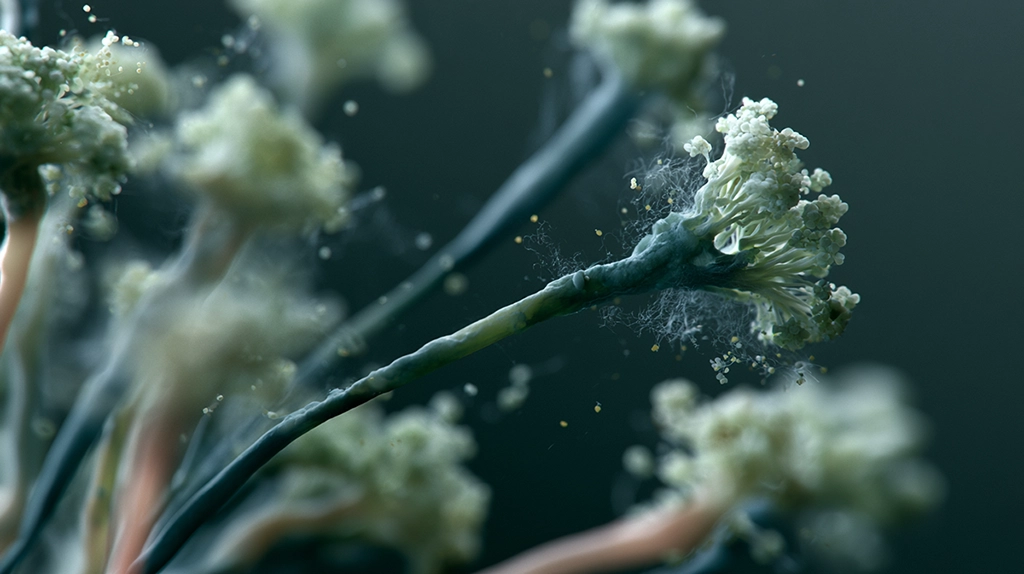
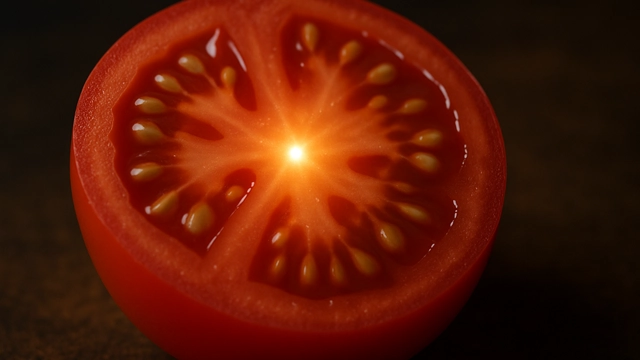
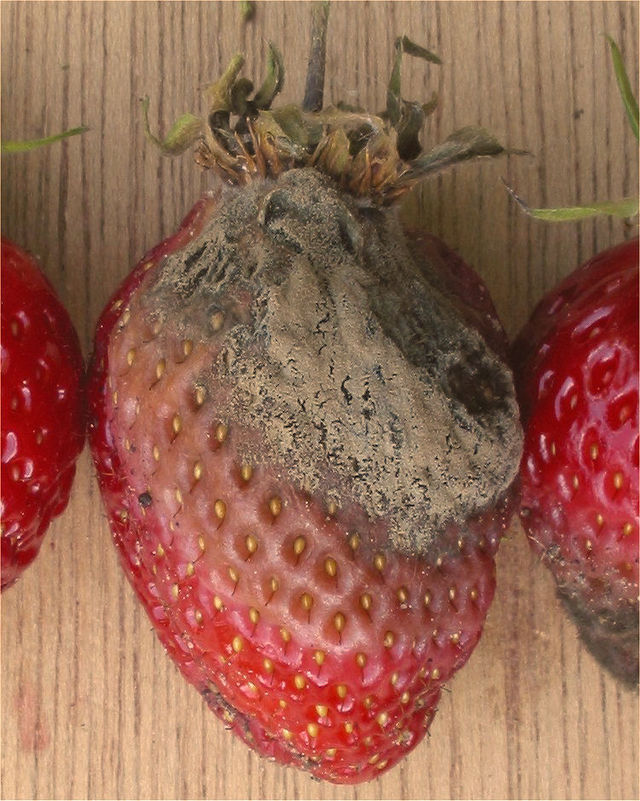
It begins in the produce aisle — a battlefield disguised as freshness. Strawberries gleam, tomatoes blush, but beneath the surface, Botrytis cinerea is waiting. The gray mold thrives in silence, riding humidity and oxygen, turning ripeness into rot.
For decades, we’ve fought it with synthetic fungicides, only to breed stronger, more cunning adversaries. But now, an unlikely molecule has entered the ring — one that smells faintly sweet, almost fruity.
Meet 3-methyl pentanoic acid (3MP) — a compound better known as a flavoring agent than a weapon. And yet, in the lab, it does what countless chemicals have failed to do: it stops Botrytis cold.
Not with brute toxicity.
But with precision — and a little confusion.
2. The Flavor That Kills

The research, published in BMC Microbiology (2025), takes a page from science fiction.
At concentrations as low as 12 μL/L, 3MP completely halted gray mold on tomatoes and strawberries — in vivo, not just on a petri dish.
- Mycelial growth: Paralyzed
- Spore germination: Blocked
- Germ tube elongation: Severed
The molecule didn’t scorch or suffocate.
It whispered chaos into the fungus’s own systems.
3. Inside the Fungal Mind

Under the microscope, Botrytis looked alive — until you stained it. Using fluorescein diacetate (FDA) and propidium iodide (PI), researchers saw the truth: membranes ruptured, cytoplasm leaking, cell viability collapsing.
But the real coup happened at the molecular level. 3MP went straight for the fungus’s control center — the pathways that let it sense and survive environmental stress.
Two in particular:
- CWI Pathway (Cell Wall Integrity): the framework that maintains fungal structure against osmotic or mechanical stress.
- MAPK Signaling (Mitogen-Activated Protein Kinase): the communication line that tells the cell how to respond, adapt, and repair.
After 3MP exposure, key genes — Chs1, Bmp1, Bmp3, Sak1 — were silenced or severely disrupted.
It was as if someone had cut the power to every alarm and repair system inside the cell.
The result wasn’t just death.
It was disorientation. The fungus couldn’t tell what was wrong, so it couldn’t fix itself.
4. The Precision of Confusion
Traditional fungicides are blunt instruments — copper, sulfur, carbendazim — effective but indiscriminate. They kill, but they also pollute. They drive resistance faster than innovation can keep up.
3MP is different. It’s targeted and biocompatible, already part of the food system. This makes it not only safer but strategically invisible to fungal evolution. Botrytis has no evolutionary memory of fighting flavor molecules.
This is the future of what I call cognitive fungicides — agents that don’t annihilate the fungus outright, but scramble its internal logic. They exploit its intelligence against itself.
The elegance of 3MP lies in how small it is — just a few carbons and hydrogens — yet capable of collapsing an entire survival network. In chemical warfare terms, it’s a whisper that unravels an empire.
5. Rethinking Postharvest Control
Every year, postharvest diseases destroy up to one-quarter of the world’s fruits and vegetables. That’s billions in waste, millions in lost labor, and untold carbon footprint from spoiled produce.
The market is hungry for safer, smarter antifungals — ones that consumers won’t fear, regulators won’t ban, and fungi won’t outwit.
3MP fits that profile almost perfectly:
✅ Naturally derived
✅ Low-residue, low-toxicity
✅ Already approved for flavoring use
✅ Dual mechanism: physical disruption + genetic interference
It doesn’t fight fungi like an outsider.
It turns their own networks inward.
Imagine storage facilities, shipping containers, even greenhouses infused with 3MP vapor — not the stench of pesticide, but the faint aroma of fruit, quietly rewriting fungal behavior.
6. The Molecular Elegy of 3MP
If you look closely, there’s something poetic here. The very compound designed to enhance taste has become a defender of it. The molecule that once pleased consumers now protects them.
This isn’t the first time chemistry has turned ironic, but rarely with such precision. The study’s authors didn’t just find a biofungicide — they found a biological counterpoint to our industrial excess.
In the age of overengineering, 3MP is a reminder that small molecules can still outthink big systems.
7. A New Chapter in Myco-Intelligence
The larger message is evolutionary. Botrytis is a master strategist — capable of genetic improvisation, metabolic camouflage, and rapid resistance.
But what it can’t resist is being misunderstood.
By disorienting the fungus’s stress-response pathways, 3MP doesn’t attack its strength — it attacks its awareness.
That’s a lesson for the entire field of plant pathology: the next frontier isn’t potency, it’s precision.
In the same way AI doesn’t replace human thought but amplifies it, molecules like 3MP don’t just suppress fungi — they manipulate their decision trees.
It’s not warfare. It’s interception.
8. The Verdict from MoldNewsHub
We’ve seen thousands of “natural antifungal” claims, but few with molecular receipts this clean.
3MP doesn’t promise miracles; it delivers mechanistic proof — the gold standard of science credibility.
If follow-up trials confirm stability, scalability, and cost-efficiency, this could mark a quiet revolution in postharvest protection — where aroma chemistry meets fungal cognition.
“The beauty of 3MP isn’t just in its efficacy,” as one researcher told MoldNewsHub.
“It’s in the clarity. We know what genes it hits. We know how it dies.”
And that’s rare — because most fungicides just kill.
This one makes mold forget how to live.
References
- FDA GRAS Database – Flavoring Substances
- PubChem: 3-Methylvaleric Acid
- Wikipedia: Botrytis cinerea, MAPK Pathway, Cell Wall Integrity Signaling
Key Takeaways
- 3-Methyl-1-propanol (3MP), a naturally occurring compound found in bread, cheese, and fermented foods, demonstrates significant activity against Botrytis cinerea gray mold—functioning as a volatile ‘fungal assassin’ at food-safe concentrations.
- 3MP inhibits Botrytis cinerea by disrupting cell membrane integrity and interfering with mitochondrial membrane potential, reducing both spore germination and mycelial growth.
- The compound is produced naturally by Lachancea thermotolerans and other fermentation yeasts, raising the possibility of biological control approaches using producing microorganisms rather than purified compound.
- A key advantage of 3MP is that it targets the mitochondria through a different mechanism from all currently registered fungicides, making it effective against fungicide-resistant Botrytis strains.
- Post-harvest application of 3MP vapor to strawberries, tomatoes, and table grapes has shown commercially relevant reductions in gray mold incidence in controlled environment studies.
Frequently Asked Questions
What is 3-methyl-1-propanol and where does it naturally occur?
3-Methyl-1-propanol (also known as isobutanol or 1-butanol, 3-methyl) is a short-chain alcohol with a mildly alcoholic, fusel oil character. It is a natural fermentation byproduct produced by many yeasts and bacteria during carbohydrate metabolism, and is found naturally in bread, beer, wine, cheese, and other fermented foods at trace concentrations (typically 1–10 mg/kg). It is approved as a flavouring substance in the EU (E 2011) and has GRAS status in the US. Its natural occurrence in commonly consumed fermented foods provides an important safety baseline for potential food contact applications.
How does 3MP differ from other antifungal compounds in its mechanism?
Most registered fungicides target either ergosterol biosynthesis (azoles, polyenes), cell wall synthesis (echinocandins), DNA/RNA synthesis, or specific mitochondrial complexes (SDHIs, QoIs). 3MP acts on the mitochondrial membrane potential—disrupting the electrochemical gradient that drives ATP synthesis—but through a mechanism distinct from Complex II inhibitors (SDHIs) and Complex III inhibitors (strobilurins). This makes it functionally novel and potentially effective against Botrytis strains with resistance mutations in the typical fungicide target genes. The volatile nature of 3MP also means it can act through the gas phase without direct contact, providing a fumigant effect complementary to contact fungicides.
Can biological control agents producing 3MP be used instead of purified compound?
Yes—several research groups are investigating whether yeasts or bacteria that naturally produce 3MP could serve as biocontrol agents, colonising the fruit surface and producing inhibitory concentrations of 3MP in situ. This approach would eliminate the need to apply purified compound, potentially reducing cost and registration complexity. Lachancea thermotolerans is one candidate organism; certain Pichia and Metschnikowia yeast species have also been studied for Botrytis biocontrol and produce several volatile inhibitory compounds including 3MP. Commercial biocontrol products based on Aureobasidium pullulans and Candida oleophila are already marketed for post-harvest gray mold control, though they work through different mechanisms.
What produce types benefit most from 3MP post-harvest treatment?
Soft, high-value fruits with short post-harvest lives and high Botrytis susceptibility are the primary targets for 3MP treatment development. Strawberries (where gray mold is the leading post-harvest disease in most producing regions) have been the most studied commodity in 3MP research. Table grapes (which are stored for months and are highly susceptible to Botrytis berry infection) are another priority target. Tomatoes (particularly cherry and roma types handled in bulk packaging) and raspberries are also under investigation. The enclosed atmosphere conditions of modified atmosphere packaging (MAP) and cold store rooms are ideal for maintaining effective volatile concentrations around treated produce.
How close is 3MP to commercial use as a post-harvest treatment?
3MP post-harvest antifungal treatment is at the research and development stage, with published studies demonstrating efficacy at controlled scales but without available commercial products. Key steps toward commercialisation include: obtaining regulatory clearance in target markets (EPA in the US, EFSA evaluation in the EU); development of practical delivery systems that maintain effective concentrations in commercial cold storage environments; demonstration of commercial-scale efficacy trials; and establishment of residue limits and monitoring requirements. The GRAS/natural food compound status of 3MP is advantageous—it may qualify for a minimum-risk pesticide exemption under EPA FIFRA regulations, simplifying registration compared to conventional fungicides.