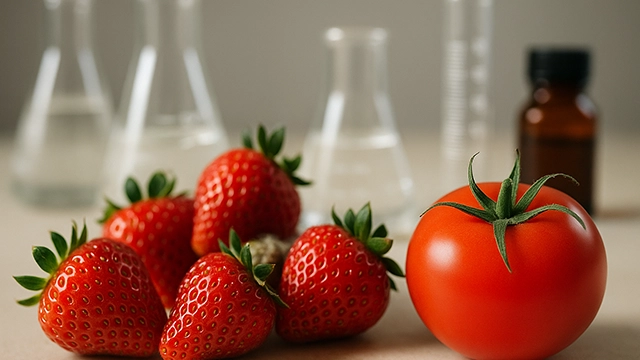
I. Where Sweetness Meets Decay
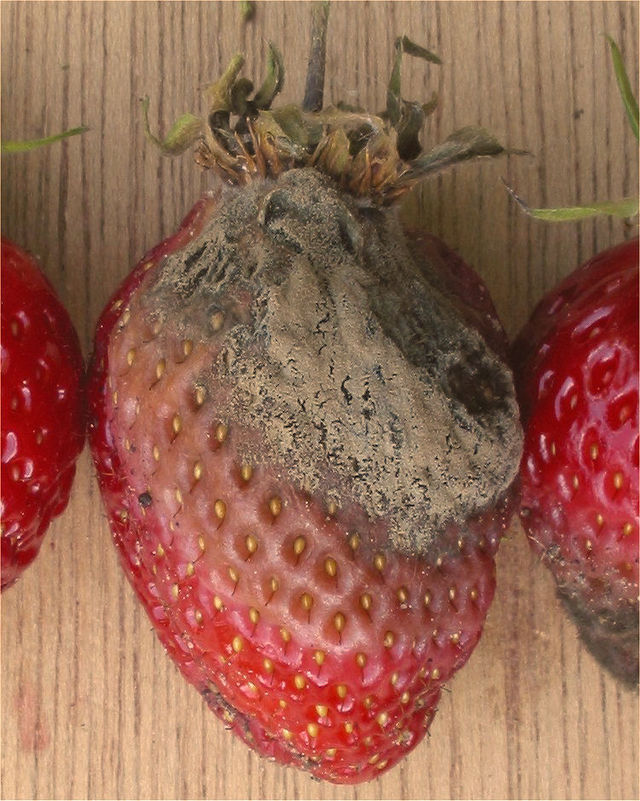
There’s a moment every grower dreads. A crate of perfect strawberries leaves the farm glowing red and alive — and by the time it reaches the shelf, gray fuzz blooms across their surface like ash after a quiet fire.
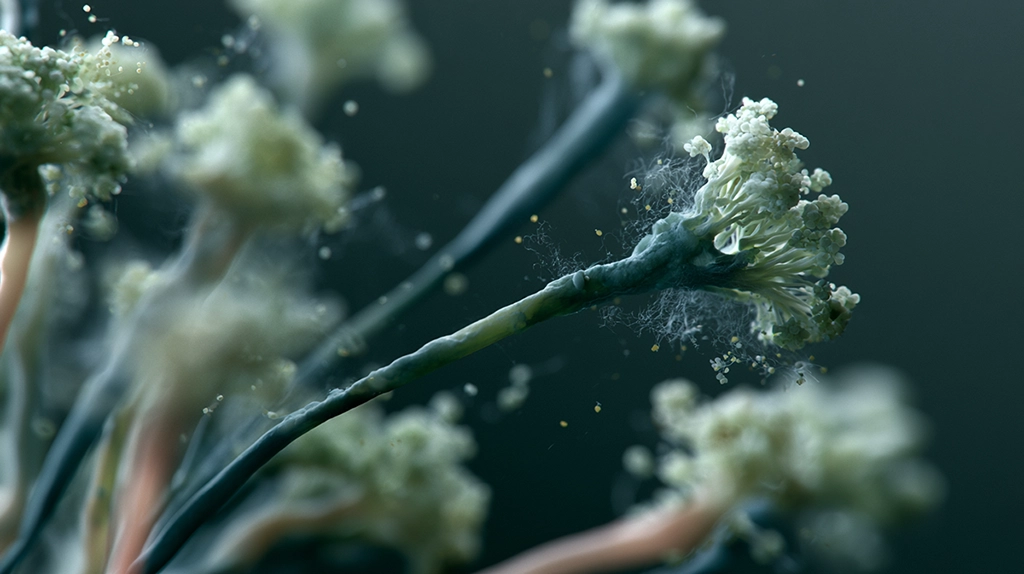
That’s Botrytis cinerea, the gray mold fungus. It doesn’t roar in; it whispers, colonizing fruit silently during transport, feeding on the softness that makes them so appealing in the first place.
For decades, the response has been chemical — layers of fungicides meant to stop decay before it starts. Yet the fungus adapts faster than the rules can change.
But in one of those small, poetic turns that science loves, researchers have found a potential answer in a familiar place: the world of flavor itself.
The molecule is called 3-methyl pentanoic acid (3MP). To food chemists, it’s a flavor enhancer. To fungi, it might be a molecular saboteur.
II. A Molecule with a Double Life
3MP isn’t exotic. It already exists in the toolkit of the food industry — a short-chain fatty acid known for its fruity, slightly cheesy aroma, found in everything from beverages to processed dairy.
But when scientists introduced it to cultures of B. cinerea, something remarkable happened: the fungus simply stopped growing.
In controlled trials, 3MP:
- Inhibited spore germination and mycelial expansion, halting gray mold at its earliest stage.
- Prevented germ tube elongation, blocking the physical invasion process that lets fungi penetrate plant tissue.
- Protected real fruit — strawberries and tomatoes — at concentrations as low as 12 μL/L, keeping them mold-free without any synthetic fungicide support.
These aren’t “preliminary” hints. These are controlled, measurable outcomes. For the first time, a compound designed for taste is proving itself as a postharvest shield.

III. The Science of Sabotage
3MP doesn’t kill in the crude sense. It disables.
At the cellular level, the compound disrupts membrane integrity, leaving fungal cells leaky and unable to regulate themselves. Under fluorescence microscopy, treated spores glow with the unmistakable signal of death — not explosive, but methodical.
Dig deeper, and the story becomes molecular. The study revealed two major systems inside B. cinerea that collapse under 3MP exposure:
- Cell Wall Integrity (CWI) pathway — a vital network maintaining fungal structure. The key gene Chs1, responsible for chitin synthesis, is sharply suppressed.
- MAPK signaling cascade — the fungus’s internal communication grid, managing stress and pathogenic behavior. Genes like Bmp1, Bmp3, and Sak1 go silent.
Think of MAPK as the fungal nervous system — a set of switches that help it sense, decide, and adapt. When 3MP turns off those switches, the organism doesn’t just weaken. It forgets how to survive.

IV. Smart Biofungicides: The Next Chapter
The term biofungicide often conjures images of vague natural extracts or essential oils whose activity depends on luck more than logic. 3MP changes that narrative.
It’s a defined molecule with a clear mechanism, measurable targets, and a regulatory head start thanks to its existing role in food systems.
This makes 3MP part of an emerging class of smart biofungicides — compounds that combine biological safety with pharmaceutical precision.
Real-world implications follow naturally:
- Cleaner labels: No synthetic residues or hidden chemicals.
- Reduced cold-chain dependence: Fruits can last longer at ambient temperatures.
- Lower resistance risk: By targeting both membranes and gene regulation, 3MP gives fungi no simple evolutionary escape route.
It’s not about adding another layer of protection — it’s about rewriting what “protection” means in a world where food waste and chemical overload can no longer coexist.
V. Between Flavor and Function
There’s something poetic about this molecule’s dual identity. For years, 3MP’s job was to make food taste alive; now it might also keep it literally alive.
It reminds us that the boundary between chemistry and biology — between pleasure and protection — is thinner than we imagine. A molecule doesn’t know whether it was designed for taste or defense. It only reacts, interacts, and reveals its character under the right microscope.
And maybe that’s the real lesson here: the solutions to our most persistent problems often hide in familiar compounds, waiting for us to ask a different question.
What if flavor could fight decay?
What if safety could be molecular, not mechanical?
Those questions aren’t just scientific curiosities. They’re cultural ones — the kind that reshape how we define “natural,” “safe,” and “sustainable.”

VI. Donna’s Reflection: A New Language of Freshness
I’ve spent enough time in labs to know that discovery rarely feels cinematic. It smells of agar plates and burnt electrodes, not victory. But this story — the flavor that turned fighter — feels different.
The researchers behind 3MP aren’t just finding another antifungal. They’re writing a new grammar of freshness — one where microbial intelligence meets molecular empathy.
Still, the questions ahead are real:
- Can 3MP remain stable across weeks of transport and fluctuating humidity?
- Can it work beyond strawberries — on apples, grapes, or ornamental plants?
- Can its activity be integrated into edible coatings or mist systems suited to large-scale logistics?
Those are challenges worth pursuing. Because if the molecule holds, it could redefine postharvest protection — from reactive chemistry to anticipatory design.
And if that happens, maybe one day we’ll look at a tray of strawberries and see not a race against decay, but a quiet alliance between nature’s sweetness and science’s restraint.
After all, the best defenses don’t always roar.
Sometimes, they taste faintly of fruit.
In a world tired of trade-offs between safety and shelf life, maybe this is what innovation looks like now:
a hint of acid, a little science, and a fruit that lasts just long enough to be remembered.
References
- Nature Communications: “3-Methylpentanoic Acid Suppresses Botrytis cinerea Growth via MAPK Pathway Disruption” (2024)
- PubChem: 3-Methylpentanoic Acid Compound Summary
- NIH: Molecular Mechanisms of Gray Mold Pathogenesis
- FAO: Postharvest Losses and Fungal Spoilage in Fruits
Key Takeaways
- The flavorant compound 2-nonanone (a naturally occurring ketone found in many foods) demonstrates significant antifungal activity against Botrytis cinerea, the ‘gray mold’ responsible for major losses in strawberries, grapes, tomatoes, and other soft fruits.
- 2-nonanone acts through volatile inhibition—it does not need direct contact with the fungus, making it suitable for fumigant-type post-harvest applications in cold storage facilities.
- The compound is already categorised as GRAS (Generally Recognized as Safe) by the FDA, meaning regulatory approval pathways for food-grade antifungal applications would be faster than for novel compounds.
- Resistance to synthetic fungicides including iprodione and boscalid is widespread in Botrytis populations, creating urgent need for alternative control strategies with different mechanisms of action.
- Volatile-based antifungal approaches complement rather than replace other integrated disease management tools, offering particular value as a post-harvest treatment when fungicide residue concerns are highest.
Frequently Asked Questions
What is Botrytis cinerea and why is it so economically damaging?
Botrytis cinerea (gray mold) is one of the most economically destructive plant pathogens globally, causing an estimated $10–$100 billion in annual crop losses. It infects over 200 plant species, including almost all commercially important fruits, vegetables, and ornamental crops. The fungus is particularly damaging because: it can infect through multiple routes (wounds, senescing tissue, direct penetration); it produces enormous numbers of airborne spores that rapidly colonise adjacent fruit in packed crates or retail displays; it can grow at refrigeration temperatures (as low as 0–4°C), making cold storage insufficient to prevent loss; and it has developed resistance to virtually every class of fungicide used against it through multiple mechanisms. Post-harvest gray mold losses alone are estimated at 20–30% of harvested strawberries in some production regions.
How does 2-nonanone inhibit Botrytis cinerea?
2-nonanone (a methyl ketone with a slightly sweet, waxy odour) inhibits Botrytis cinerea through several mechanisms identified in laboratory studies. As a volatile compound, it disrupts the fungal plasma membrane, altering its fluidity and permeability. It appears to interfere with mitochondrial function, reducing the energetic capacity of the fungus. It also inhibits spore germination and germ tube elongation—critical stages in the initial infection process. As a volatile, 2-nonanone creates an inhibitory atmosphere around treated produce that prevents spore germination on fruit surfaces even without direct application to the fungal cells, making it particularly useful in the enclosed atmosphere of cold storage.
What is the GRAS status of 2-nonanone and why does it matter for agricultural use?
GRAS (Generally Recognized As Safe) is an FDA designation indicating that a substance is considered safe for its intended food use based on a history of safe use in food or adequate scientific data. 2-nonanone is naturally present in many foods including cheese, beer, wine, and various fruits and vegetables, and has GRAS status as a food flavouring compound. For agricultural applications, GRAS status significantly accelerates the regulatory pathway because it establishes a safety baseline; EPA registration as a minimum-risk pesticide or biopesticide may be available rather than the full conventional pesticide registration process. This reduces the time and cost required to bring a 2-nonanone-based product to market compared to a novel synthetic compound.
How widespread is fungicide resistance in Botrytis cinerea?
Fungicide resistance in Botrytis cinerea is one of the most advanced resistance problems in plant pathology. The fungus has developed documented resistance to: benzimidazoles (including thiophanate-methyl, formerly the primary treatment); dicarboximides (iprodione); phenylpyrroles (fludioxonil); hydroxyanilides (fenhexamid); SDHI fungicides (boscalid and related compounds); and partially reduced sensitivity to DMI (demethylation inhibitor) fungicides. Resistance mechanisms include target-site mutations, efflux pump overexpression, and modifications to metabolic pathways. Populations in commercial strawberry and grape production regions in Europe, California, and other intensive production areas often carry multiple resistance traits simultaneously, severely limiting effective fungicide options.
What other natural volatile compounds show antifungal activity against gray mold?
Extensive research has identified numerous natural volatile compounds with Botrytis inhibitory activity, particularly from essential oils and plant metabolism. Linalool (from lavender and many herbs) reduces spore germination at concentrations achievable in enclosed atmospheres. Thymol and carvacrol (from thyme and oregano) are potent antifungals with demonstrated efficacy against Botrytis. Geraniol (from rose geranium) inhibits gray mold infection of strawberries in semi-commercial trials. Cinnamaldehyde (cinnamon bark oil) has strong antifungal activity but may cause phytotoxicity at effective concentrations. The challenge for all volatile approaches is delivery: maintaining effective concentrations in commercial cold storage without phytotoxic effects on the product requires careful formulation and controlled-release technology.