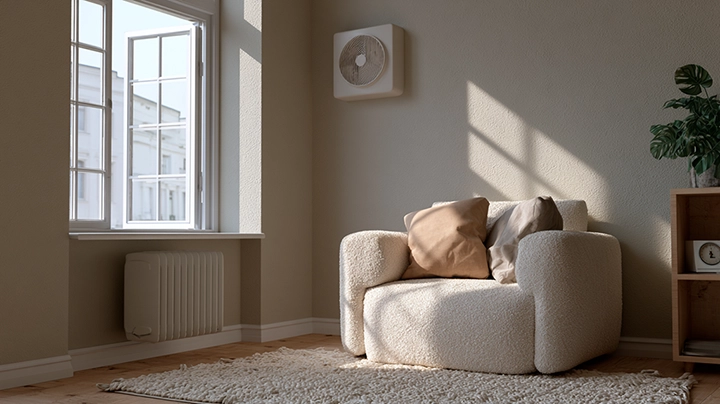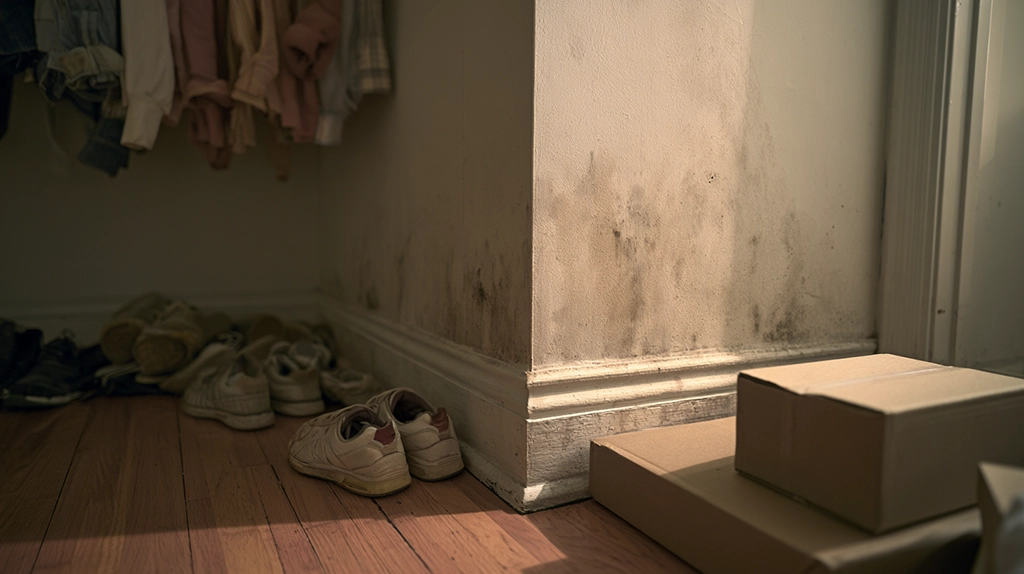
Factories often invest heavily in dehumidifiers, believing that maintaining indoor relative humidity (RH) below 60% will guarantee mold prevention. On paper, the numbers look good. In practice, however, mold still appears. Why? Because air humidity does not equal surface moisture.
Spores Need Surfaces, Not Numbers
Mold does not grow in the abstract concept of “air”—it germinates on surfaces. Even if average RH looks safe, condensation or absorption can create micro-wet zones invisible to the eye. Studies confirm that mold can germinate when surface moisture persists despite moderate RH. For fungi, these wet spots are far more decisive than overall air readings. A single layer of condensation on a wall or pallet can turn a “dry” warehouse into a biological hotspot.

Condensation and Porous Materials
The most common source of surface wetness is condensation. When humid air meets a cooler surface below the dew point, droplets form. These droplets may linger long enough to trigger germination. Materials like cardboard, wood, and textiles amplify the problem by absorbing water vapor. Even at seemingly safe RH levels, their internal moisture remains high, making them hidden reservoirs for mold growth (material susceptibility research). In food factories, stacked cartons or wooden pallets are frequent starting points for contamination, precisely because their surfaces never truly dry.

Airflow and Dead Zones
Air circulation is another overlooked factor. Corners, stacked goods, and poorly ventilated shelves often trap humid air, creating “dead zones” beyond the reach of dehumidifiers. Field surveys show that localized conditions in storage areas can support mold even when central monitoring systems indicate compliance. In other words, sensors tell only part of the story. Without airflow management, drying systems treat the average but fail to address the extremes.
Misleading Numbers and Costly Failures
The obsession with air humidity leads to blind spots in audits and risk assessments. Factories often rely on RH data alone to demonstrate compliance, while ignoring whether surfaces are actually dry. The result: humidity reports look excellent, yet pallets, cartons, or product surfaces still develop mold. In one leather warehouse, RH was consistently below 60%, yet Aspergillus flavus was isolated from products after condensation formed on untreated walls. The financial loss exceeded millions in spoiled goods and damaged brand reputation.
Global Standards and Local Reality
International bodies like ASHRAE and WHO recommend controlling both RH and condensation to minimize microbial risks. Critical moisture levels for building materials have been established in laboratory settings, showing that mold can develop on gypsum, wood, or paper even at 75% RH if surface conditions allow. Yet many factories implement only half of the solution, focusing on RH numbers without evaluating surface wetness.
Toward Surface-Oriented Prevention
True prevention requires shifting focus. First, surface moisture detection tools—such as infrared thermography or moisture meters—should complement RH monitoring. Second, airflow design must minimize stagnant zones, ensuring dehumidification reaches every corner. Third, packaging choices matter: switching from untreated cardboard to coated or synthetic alternatives reduces risk. Finally, staff training is essential: workers must understand that “dry readings” do not equal “dry surfaces.”
Rethinking Mold Control
Mold is a local problem, not an average one. Overreliance on air humidity data is like reading the weather forecast without noticing puddles on the ground. To prevent costly failures, factories must integrate both air and surface perspectives. Only then can drying systems truly deliver, and only then can mold be kept at bay.
References
- Gorny, R. L. (2004). Fungal fragments as indoor air biocontaminants. Applied and Environmental Microbiology. NCBI
Key Takeaways
- Maintaining air relative humidity (RH) below 60% does not guarantee mould prevention—surface moisture is what mould actually grows on.
- Mould germinates on surfaces, not in air: condensation on walls, pallets, or equipment creates localised micro-wet zones even when overall RH readings appear safe.
- Thermal bridges, porous materials, and inadequate air circulation create surface moisture conditions that standard ambient humidity sensors consistently miss.
- Effective mould control requires surface moisture measurement tools, not just dehumidifiers calibrated to air RH targets.
- Most mould species begin germinating when surface water activity exceeds 0.80; some xerophilic species activate at as low as 0.70.
Frequently Asked Questions
What is the difference between air humidity and surface moisture?
Relative humidity (RH) measures the proportion of moisture in the ambient air. Surface moisture refers to the actual water content on or within a physical material. These two values can diverge significantly: even when room RH is below 60%, specific surfaces can remain wet due to condensation, capillary absorption, or direct contact—providing the moisture mould requires to germinate and grow.
At what moisture level does mould begin to grow?
Most common indoor mould species begin germination when the water activity at a surface exceeds approximately 0.80 (equivalent to ~80% equilibrium relative humidity at the surface). Xerophilic species—including certain Aspergillus and Penicillium strains—can initiate growth at surface water activity as low as 0.70–0.75, enabling them to colonise seemingly dry materials.
What are thermal bridges and why do they matter for mould risk?
Thermal bridges are structural elements—metal fixings, concrete columns, window frames—that conduct heat significantly differently from surrounding insulation. They cause localised temperature drops on interior surfaces, which can produce condensation even when the room’s bulk air temperature and humidity appear controlled. These cold spots are among the most common sites for mould colonisation in industrial and residential buildings.
How should facilities measure mould risk more accurately?
Comprehensive mould risk monitoring combines: capacitance-based surface moisture meters for direct material readings; data loggers positioned at floor level, near external walls, and close to thermal bridges (rather than centrally); and regular inspection of porous materials such as cardboard, wood, and fabric, which absorb and retain moisture independently of ambient air RH readings.
Can mould grow in a room where air humidity is below 60%?
Yes—and this is well-documented in peer-reviewed literature. Mould has been found growing in environments where bulk air RH measured as low as 50–55%, because localised surface moisture at specific points exceeded the threshold required for germination. This is why facilities that invest exclusively in dehumidification equipment frequently continue to experience mould problems despite achieving their target air humidity levels.