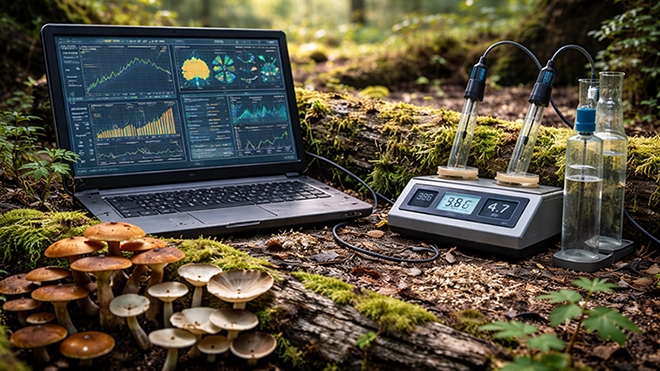
Adaptation Is Their Default State
Fungi are built for survival.
They grow in soil, water, air, and even in environments that would be toxic to most forms of life. They tolerate drought, chemical exposure, nutrient scarcity, and extreme temperatures with a level of resilience that makes them one of the most adaptable kingdoms on Earth.
But this adaptability raises a deeper question.
What actually happens when fungi are pushed to their limits?
A recent study explores this question by examining how Fungi respond to environmental and chemical stress. What emerges is not just a picture of survival, but a system of behavior — one that can be observed, measured, and potentially predicted.
Fungi as Living Response Systems
Fungi are not passive organisms reacting randomly to their surroundings. They operate more like responsive systems, constantly sensing and adjusting to environmental conditions such as temperature, pH, nutrient availability, and the presence of toxins.
These changes influence how fungi grow, what Enzymes they produce, and how they allocate energy. Under one set of conditions, a fungus may grow slowly and conserve resources. Under another, it may accelerate growth or activate specific biochemical pathways to break down complex or harmful compounds.
In this sense, fungi are not static life forms.
They are decision-making systems shaped by pressure.

What Does Stress Reveal About Fungi?
When fungi encounter stress, they do not simply shut down. Instead, they shift strategies.
A fungus exposed to nutrient scarcity may alter its Metabolism to extract energy more efficiently. In polluted environments, some species produce enzymes capable of breaking down toxic substances. Under temperature or pH stress, growth patterns and survival strategies can change dramatically.
These responses are not random.
They follow patterns.
And those patterns are what scientists are beginning to decode.

From Observation to Prediction
Understanding these patterns opens a critical possibility:
👉 If fungal responses can be predicted, they can be used reliably.
This is where the research moves beyond biology into engineering.
In industrial and environmental systems, unpredictability is a major limitation. If fungal behavior shifts unexpectedly, processes can fail, outputs can vary, and systems become unstable.
But if responses to stress can be mapped and modeled, fungi can be integrated into systems with far greater precision.
The goal is not to eliminate variability entirely.
It is to make it understandable and manageable.
Can Fungi Be Controlled?
The answer is not direct control — but something more subtle.
Fungi are not machines that can be switched on or off. However, their behavior can be influenced by adjusting the environment around them.
Changing pH levels can alter enzyme activity. Temperature shifts can influence growth rates. The introduction of specific compounds can trigger metabolic responses.
This leads to a key insight:
👉 We don’t control fungi directly.
👉 We control the conditions that shape how they behave.
In this way, fungal systems can be guided rather than forced.

Where This Matters in the Real World
The ability to predict and guide fungal behavior has wide-ranging implications.
In environmental remediation, fungi are used in Bioremediation to degrade pollutants and stabilize contaminated soils. Understanding how they respond to chemical stress ensures they remain effective in harsh conditions.
In industrial Biotechnology, fungal enzymes play a central role in manufacturing, food processing, and bio-based production. Optimizing environmental conditions improves efficiency and consistency.
In ecosystem monitoring, fungal responses serve as indicators of soil health and environmental stress, providing insight into how ecosystems are changing over time.
Across these domains, the same principle applies:
👉 performance depends on response
👉 response depends on environment
The Challenge of Variability
Despite their potential, fungi remain difficult to work with.
Small changes in environmental conditions can lead to large shifts in behavior. Growth patterns may change unexpectedly. Metabolic activity can vary. Outputs may become inconsistent.
This variability is both a limitation and a defining feature.
It reflects the fact that fungi are not rigid systems, but adaptive ones — constantly recalibrating themselves in response to their surroundings.
Why This Matters for the Future
As industries and environmental systems increasingly turn to biological solutions, predictability becomes essential.
Fungi offer powerful capabilities — from breaking down pollutants to producing valuable compounds — but their usefulness depends on how well we understand their behavior under real-world conditions.
This research points toward a future where fungi are not just observed, but designed into systems.
Not by altering the organism itself, but by shaping the environment it responds to.

❓FAQ: Fungi Under Environmental Stress
Why are fungi studied under stress conditions?
Because real-world environments are dynamic and often harsh. Studying stress responses helps predict how fungi behave outside controlled laboratory settings.
Can fungi survive extreme environments?
Yes. Many fungi tolerate toxic compounds, temperature extremes, and low-nutrient conditions.
How are fungal responses measured?
Scientists analyze growth rates, enzyme production, metabolic changes, and gene expression under different conditions.
Why is prediction important?
Predictability allows fungi to be used reliably in industrial and environmental systems.
Can fungal behavior be controlled?
Not directly, but it can be influenced by adjusting environmental factors such as temperature, pH, and nutrient availability.
References
Academic Sources
van der Heijden, M. G. A., Bardgett, R. D., & van Straalen, N. M. (2008).
The unseen majority: soil microbes as drivers of plant diversity and productivity in terrestrial ecosystems.
Ecology Letters.
Rangel, D. E. N. (2011). Stress induced cross-protection against environmental challenges on prokaryotic and eukaryotic microbes.
World Journal of Microbiology and Biotechnology.
Gasch, A. P. (2007). Comparative genomics of the environmental stress response in fungi.
Nature Reviews Microbiology.
https://doi.org/10.1038/nrmicro1705
Official Sources
Food and Agriculture Organization
https://www.fao.org
World Health Organization
https://www.who.int
United States Environmental Protection Agency
https://www.epa.gov