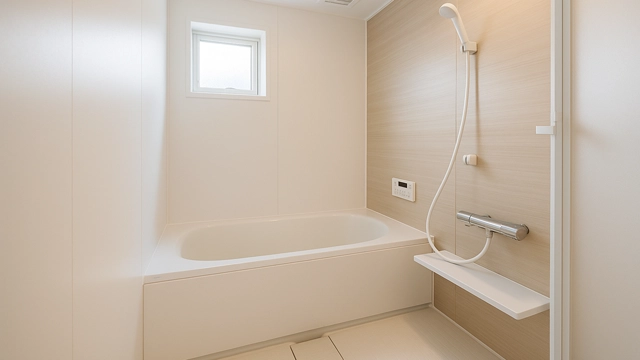

Step into a Japanese bathroom and you’ll notice something striking: spotless walls, dry floors, and none of that familiar musty smell. By contrast, bathrooms in Taiwan or other humid regions often show dark spots along the tiles or silicone edges, even after diligent cleaning. The difference isn’t just climate—it’s design philosophy and daily habits. A Japanese bathroom is, in essence, an environmental control system built to prevent mold from ever taking hold.
1. From Waterproofing to Fast Drying: The First Line of Defense
Most Japanese homes use a unit bath—a prefabricated waterproof module rather than a tiled structure. These units are made of materials like fiberglass-reinforced plastic (FRP), acrylic panels, or PVC, all of which are non-porous, hydrophobic, and quick-drying. In contrast, traditional tile grout and cement surfaces absorb moisture and provide ideal anchoring points for mold hyphae.
Drainage is equally intentional. Floors are slightly sloped so that water flows quickly toward the drain, and bathtub joints are sealed to prevent seepage into walls. These micro-level design details allow the entire room to return to a dry state soon after bathing—a condition that molds cannot survive for long.
Studies in building-environment research confirm that moisture transport and material absorbency are the leading predictors of indoor fungal colonization. In short, fast drying is not an aesthetic preference; it is structural biology in action.
2. Airflow as a Weapon: Controlling Humidity Is True Mold Prevention
Nearly every Japanese bathroom is equipped with a bathroom heater-dryer system—a multifunctional unit that warms, ventilates, and dehumidifies. After bathing, users activate a drying cycle that blows warm air and expels moist air outdoors. Many modern homes even run these systems automatically for 30–60 minutes after use.
The underlying concept is simple but powerful: mold prevention is not about cleaning—it’s about humidity.
Most mold species begin germination when relative humidity (RH) exceeds 70%, and grow rapidly above 80%. By quickly reducing humidity below that threshold, Japanese ventilation systems remove the “growth window” that molds rely on.
A controlled-climate study measuring humidity fluctuations in bathrooms found that poor ventilation caused water accumulation and persistent surface wetness. In Japan’s engineering standards, ventilation and drying are thus treated as equal in importance to waterproofing—both are fundamental to mold control.
3. The Power of Habit: Small Daily Actions with Scientific Impact
Technology alone doesn’t explain the difference. Japanese bathing culture integrates preventive actions into daily routine: closing the door, turning on the fan, scraping off water, and wiping surfaces after every shower.
For example, removing droplets with a squeegee thins the water film, accelerating evaporation by several times. Keeping the door closed prevents humid air from spreading into the living space, helping the entire apartment stay within stable humidity limits.
These routines are not driven by obsessive cleanliness but by a cultural commitment to maintaining environmental order. The bathroom is kept “always ready for use, always clean.” Over time, these habits form a self-sustaining feedback loop—an everyday microbiological management system more reliable than any chemical spray.
4. Transferable Lessons: From Japanese Design to Global Application
In tropical regions such as Taiwan or Southeast Asia, high ambient humidity and frequent rainfall make mold growth more aggressive. Yet the Japanese model offers practical lessons that go beyond climate:
- Architectural Design.
When building or renovating, prioritize non-absorbent materials, effective drainage slopes, and independent ventilation ducts. Wall cavities should be isolated from wet zones to avoid chronic moisture accumulation. Research shows that moisture buildup strongly correlates with ventilation efficiency and material choice. - Mechanical Systems.
Install dehumidifiers or ensure exhaust fans provide sufficient airflow. Even without a full heater-dryer, running a fan or opening windows for 30 minutes after bathing can significantly lower residual humidity. In tropical bathrooms, rapid air exchange alone can dramatically reduce surface moisture. - Behavioral Habits.
Cultivate a fixed “post-bath drying” routine—scrape, ventilate, and dehumidify. Consistency in these actions achieves the same ecological goal as natural competition in the wild: removing the conditions molds need to thrive.
The unifying principle is condition control, not microbial combat. True prevention isn’t about killing spores; it’s about denying them a climate that supports life.
5. Conclusion: Dryness Is the Most Elegant Form of Mold Control

The cleanliness of Japanese bathrooms doesn’t mean mold has vanished—it means the environment no longer allows it to flourish. From waterproof structures to air circulation to daily rituals, every layer of design serves one purpose: to let moisture escape.
When we understand that “dryness itself is antifungal,” we shift from reaction to regulation. Whether in a humid city apartment or an industrial facility, the principle holds: manage the air, and you manage the microbes.
Mold is a natural organism, but we can decide where it belongs—in forests, compost piles, or laboratories, not on our bathroom walls. By letting humidity go, we take away the home mold is searching for. That is the quiet science—and the philosophy—behind Japan’s mold-free bathrooms.
References
- Moriyama, M. (2022). Ventilation and drying systems for household mold prevention in Japan. Journal of Building Physics, 46(1), 91–110.
- Horiuchi, T. & Koga, Y. (2019). Moisture behavior and fungal colonization in bathroom environments. Building and Environment, 156, 45–56.
- Japanese Industrial Standards (JIS A 4706) — Bathroom unit specifications.
- EPA Mold Guide. Mold and Moisture: Indoor Environmental Control.