Planting Trees Isn’t the Same as Growing Forests
Across the world, millions of trees are being planted in an effort to restore landscapes lost to logging, wildfire, and climate change. From large-scale government programs to private sustainability projects, Reforestation has become a global priority.
But a quiet problem persists.
Many of these trees do not survive.
They are planted into soil that appears intact — stable, moist, and nutrient-bearing — yet something essential is missing. The failure is not always visible. It is not simply a matter of water or fertilizer.
It is biological.
Beneath the surface, the living systems that support forests are often gone.
What’s Missing Beneath the Soil?
In natural ecosystems, trees do not grow alone. They are part of a deeply interconnected underground network built largely by fungi, especially Mycorrhiza. These fungi extend far beyond the reach of roots, forming filamentous networks that link plants to nutrients, water, and even each other.
Through these networks, trees gain access to phosphorus and other essential elements, improve their tolerance to drought, and increase their ability to survive environmental stress.
When these fungal systems are absent or degraded, trees are effectively cut off from their support infrastructure. Seedlings struggle to establish, nutrient uptake becomes inefficient, and growth slows dramatically.
In degraded land, the soil may look complete.
But functionally, it is empty.

What Are Fungal Pellets?
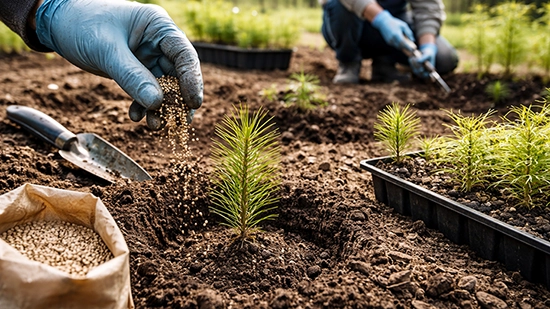
To address this hidden gap, scientists are introducing a new tool: fungal pellets.
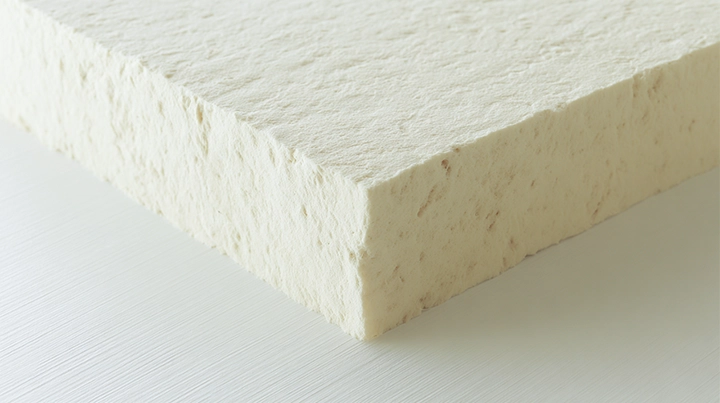
These are compact, engineered carriers of beneficial fungi and soil-supporting microorganisms, designed to be stable during transport and easy to deploy in the field. Once introduced into the soil, they act as biological inoculants, allowing fungi to establish quickly and begin rebuilding underground networks.
They are, in effect:
👉 ecosystem starter systems
Rather than waiting years or decades for fungi to return naturally, fungal pellets accelerate the process — restoring the invisible layer that forests depend on.

Why Do Reforestation Efforts Often Fail?
Most reforestation strategies focus on visible actions: planting seedlings, irrigating soil, stabilizing terrain. These steps are necessary, but incomplete.
What is often overlooked is the microbial foundation beneath the surface.
Without fungal networks:
roots remain isolated
nutrient access is limited
stress tolerance is reduced
This creates a structural mismatch:
👉 we plant trees into dead systems and expect living outcomes
The result is low survival rates and ecosystems that recover slowly, if at all.
How Do Fungal Pellets Change the System?
Fungal pellets intervene at the right level — not at the surface, but at the system layer.
When applied during planting, the fungi begin colonizing roots almost immediately. They extend into the soil, forming networks that reconnect plants to their environment. Nutrient exchange improves, water uptake becomes more efficient, and microbial diversity begins to rebuild.
Instead of waiting for ecosystems to recover passively, this approach actively reconstructs them.
The shift is clear:
👉 from planting vegetation
👉 to rebuilding biological networks
What Are the Benefits at Scale?
When fungal systems are restored early, the effects compound.
Seedlings gain access to resources from the start, increasing survival rates and accelerating growth. Soil structure improves as fungal filaments bind particles together, enhancing stability and water retention. Microbial communities diversify, supporting nutrient cycling and long-term ecosystem health.
Equally important, fungal pellets are practical. They can be transported efficiently, applied across large areas, and integrated into mechanized or even drone-assisted restoration systems.
This makes them not just biologically effective, but operationally scalable.
What Are the Limitations?
Despite their promise, fungal pellets are not a universal solution.
Fungal species must match local ecosystems to function effectively. Introducing the wrong organisms can disrupt existing microbial communities rather than restore them. Environmental conditions — including soil chemistry, climate, and existing biodiversity — also influence success.
Scaling the technology requires careful ecological design, not just distribution.
This is not plug-and-play restoration.
It is precision ecosystem work.

Why This Matters for Climate Change
Forests are central to climate mitigation. They store carbon, regulate temperature, and support biodiversity. But these functions depend on more than tree density.
They depend on system integrity.
Without fungal networks:
carbon sequestration is less efficient
ecosystems remain fragile
resilience to climate stress declines
Reforestation that ignores fungi risks building forests that look complete but function poorly.
Fungal-based restoration improves not just growth, but long-term stability.
❓ FAQ: Fungal Pellets and Forest Restoration
What are fungal pellets used for?
They introduce beneficial fungi into soil to support plant growth and accelerate ecosystem recovery.
Why are fungi important for trees?
They help trees absorb nutrients and water, improve stress tolerance, and support overall ecosystem stability.
Can forests recover without fungal pellets?
Yes, but recovery can take years or decades. Fungal pellets significantly accelerate the process.
Are fungal pellets environmentally safe?
They typically use natural fungi, but must be carefully matched to local ecosystems.
Can this method be used globally?
Yes, but effectiveness depends on selecting fungi adapted to specific regional conditions.
References
Academic Sources
Smith, S. E., & Read, D. J. (2008). Mycorrhizal Symbiosis. Academic Press.
van der Heijden, M. G. A., Bardgett, R. D., & van Straalen, N. M. (2008).
The unseen majority: soil microbes as drivers of plant diversity and productivity in terrestrial ecosystems. Ecology Letters.
Johnson, N. C., et al. (2010).
Resource limitation is a driver of local adaptation in mycorrhizal symbioses. Proceedings of the National Academy of Sciences.
https://doi.org/10.1073/pnas.0906710107
Official Sources
Food and Agriculture Organization — Forest restoration resources
https://www.fao.org/forestry
United Nations Environment Programme — Ecosystem restoration initiatives
https://www.unep.org
Intergovernmental Panel on Climate Change — Land use and forestry reports
https://www.ipcc.ch