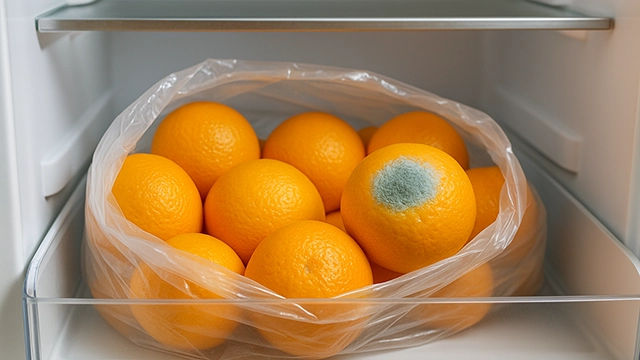
The refrigerator is the go-to place for keeping fruit fresh. We put oranges inside, believing they will stay safe. But soon enough, a familiar blue-green mold spot appears. How can mold grow in such a cold environment?
The truth is simple: refrigeration slows down decay, but it does not stop it. Mold is tougher than we think. It can tolerate cold, grow slowly, and wait patiently until the right moment to spread.
The hidden enemies: blue mold and green mold
Two fungi dominate the spoilage of oranges: Penicillium digitatum (green mold) and Penicillium italicum (blue mold). They are the major postharvest pathogens of citrus fruit worldwide.
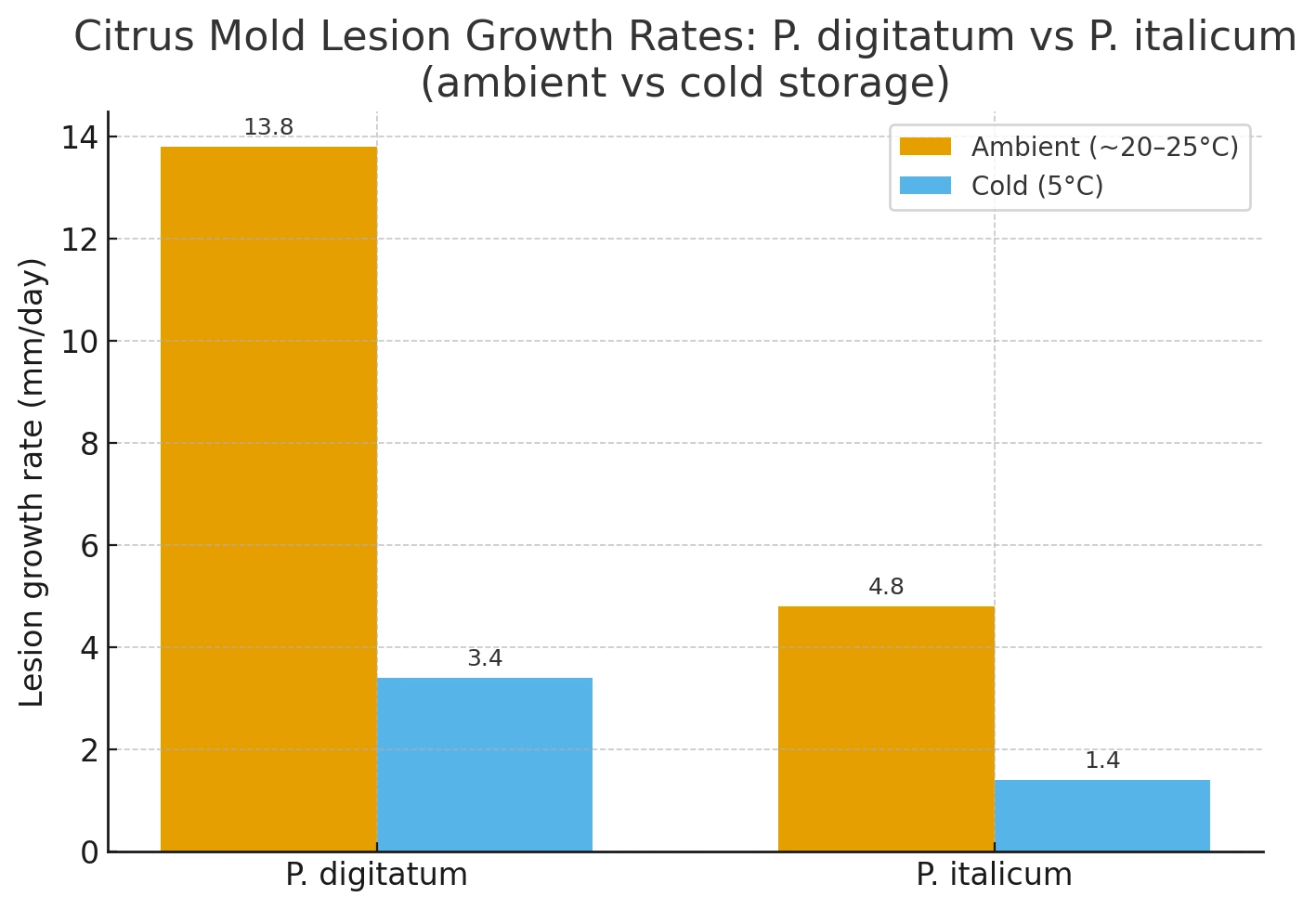
- Green mold (P. digitatum) prefers warmer and more humid conditions, so it grows fast at room temperature.
- Blue mold (P. italicum) adapts better to lower temperatures, which makes it more common in refrigerators.
Both fungi are responsible for huge economic losses. Every year, millions of tons of citrus fruit are wasted after harvest due to infections from these molds. For farmers and distributors, this means significant financial damage, while for consumers it shows up as spoiled fruit in the kitchen.
Another important fact: both are wound pathogens. This means they cannot invade through intact skin. They need an injury, scratch, or stem-end cut to infect the fruit. Even the tiniest bruise can open the door.

Can mold really grow at low temperatures?
Refrigeration does not kill spores. It only slows them down. Laboratory studies confirm this:
- P. italicum: Can germinate and grow slowly at 0–5 °C. On orange juice or moist fruit surfaces, it continues developing even in the cold.
- P. digitatum: Becomes almost inactive below 6–7 °C, but under high humidity and long storage, it can still germinate at 4 °C.
This explains why blue mold often appears first in the fridge, while green mold is more aggressive at room temperature. Cold storage is not a “mold killer.” It is only a “speed reducer.”
Why does mold still win in the fridge?
If refrigeration slows mold down, why do oranges still spoil? The answer lies in a combination of hidden factors:
- Wounds are entry points: Cuts from harvest, bruises from transport, or friction between fruits during storage all create small openings where spores can enter.
- Microclimates inside the fridge: Conditions are not uniform. Drawers trap humidity, door shelves fluctuate in temperature, and the cold-air vent can cause localized condensation. These variations provide niches where mold can thrive.
- Cross-contamination: A single infected orange can release millions of spores, which quickly spread to neighboring fruits.
- Time: Refrigeration slows the process, but after weeks spores eventually overcome the cold barrier.
In short, mold succeeds not because the fridge is “weak,” but because it exploits wounds, moisture, and time.

How to slow down mold growth
We cannot stop mold completely, but simple steps help reduce the risk:
- Choose uninjured fruit: Avoid oranges with cuts, soft spots, or broken skin.
- Keep them dry: Make sure the peel is dry before refrigeration. Wrapping each fruit in a paper towel absorbs condensation.
- Avoid sealed moisture traps: Do not store oranges in airtight plastic bags. Use breathable or perforated packaging.
- Separate spoiled fruit: Remove moldy oranges immediately to prevent cross-contamination.
- Eat them sooner: Refrigeration buys time, but not forever. Consume within 1–2 weeks.
On a larger scale, the citrus industry uses additional techniques such as hot water treatments, protective coatings, and natural essential oils to reduce mold. These industrial methods cannot be replicated at home, but they underline one truth: mold is resilient, and only a combination of strategies works.
The real truth about refrigeration
The fridge gives us a false sense of security: “cold means safe.” But science shows spores are not eliminated by low temperature. They simply slow down. With wounds and moisture, spores can still survive and grow in the cold.
Understanding mold’s survival power is not only about saving a few oranges. It also teaches us how to reduce food waste at home and how to respect the invisible life forms that share our environment. By learning from mold, we can make smarter choices: choose carefully, keep dry, separate the spoiled, and eat in time.
References
- Wikipedia: Penicillium digitatum, Penicillium italicum
- FAO. Citrus fruit statistics. FAO.org
- CDC. Mold Basics. CDC.gov
- PubMed. Postharvest citrus pathogens. PubMed