Meta Description
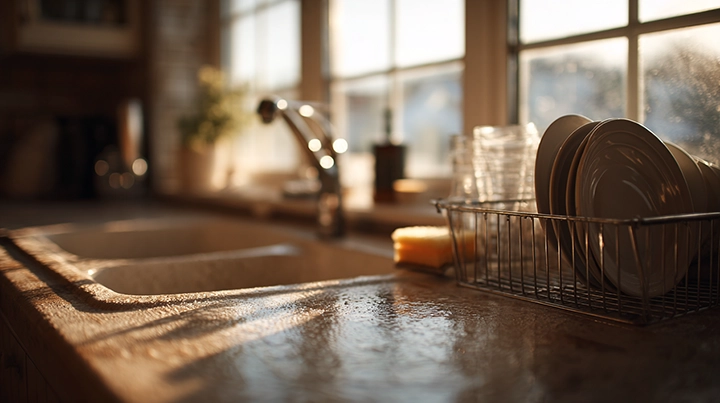
The kitchen looks clean. Surfaces are wiped, dishes are washed, and everything appears in order. But beneath that surface cleanliness, moisture lingers in ways that set the conditions for mold long before anything becomes visible.
The Kitchen That Never Fully Dries
Kitchens are associated with cleanliness and order. Surfaces are wiped, dishes are washed, and the space appears reset after each use. But a 2022 study in Frontiers in Microbiology examining kitchen microbiomes found that even in households with active food safety practices, common kitchen surfaces — sink drains, refrigerator handles, and countertops — consistently harbor complex microbial communities. The appearance of cleanliness and the microbiological reality of a kitchen are not the same thing.
The gap exists largely because of moisture. Steam from cooking settles into corners. Condensation forms on surfaces near the sink and dishwasher. Dampness remains in sponges, cloths, and cabinet interiors longer than expected. The kitchen does not fully dry between uses — and where moisture persists, mold finds the conditions it needs to establish itself.

When Everyday Patterns Create the Problem
Kitchens naturally concentrate the three things fungi need to grow: moisture, organic material, and stable surfaces. These conditions do not require a major event like a leak or a flood. They are built into the ordinary pattern of daily kitchen use.
A damp sponge left on the counter after washing dishes. A folded dishcloth that stays slightly wet for hours. A cabinet door closed immediately after a cycle of hot dishwasher steam. Steam from cooking that condenses on the underside of upper cabinets and the wall behind the stove. Each of these is a small event — unremarkable on its own, and repeated every single day.
Over time, the locations where these conditions overlap — where moisture is frequent, organic material is available, and airflow is limited — become what researchers call microhabitats. They are not obviously damp. They do not smell of mold yet. But they are gradually becoming stable environments where spores can settle and begin to grow.
Mold in kitchens does not appear suddenly. It emerges where conditions have quietly repeated long enough.
The Critical Distinction: Wet vs. Not Dry
The most important concept in kitchen mold prevention is not the one most people focus on.
A surface that gets wet and dries within an hour or two is not a significant mold risk. The moisture window is too brief for spores to germinate and establish a colony. The problem is not being wet — it is remaining not-quite-dry.
A sponge that retains moisture for six hours between uses. A cabinet interior that stays at elevated humidity all day because the door traps steam from the dishwasher. The underside of a dish rack where water pools rather than drains freely. These are not obviously wet surfaces — they are surfaces that never fully return to a dry state.
This distinction matters because it changes where attention should go. According to the EPA, the key to mold control is moisture control — and in the kitchen, that means tracking not just where water is used, but where it lingers after use.

The High-Risk Zones: Where to Look First
Kitchen mold does not distribute evenly. It concentrates in specific locations where moisture, limited airflow, and organic material converge. Understanding which areas carry the highest risk allows for targeted attention rather than exhaustive whole-kitchen monitoring.
The sink drain and immediate surroundings. Research on kitchen microbiomes consistently identifies the sink drain as the most heavily colonized surface in domestic kitchens. Moisture is continuous, organic material from food particles is abundant, and airflow into the drain area is essentially zero. The area around the base of the faucet and along the sink-counter junction shares similar characteristics.
Under the sink. This enclosed space combines limited airflow with proximity to water connections. Even a slow drip from a supply line or drain connection — too gradual to create an obvious puddle — can sustain a persistently damp environment. Absorbent materials stored under the sink, like cleaning product packaging or paper bags, accelerate the problem.
Behind and under the refrigerator. The refrigerator generates heat and a small amount of condensation from its cooling cycle. Spills that flow under the unit and are not cleaned, combined with limited airflow and moderate warmth, create conditions suitable for mold. The drip tray underneath some refrigerator models is a specific site that frequently goes unexamined.
Cabinet interiors after dishwashing. Steam from an opened dishwasher travels directly into any open cabinet above or nearby. When the door is closed before that steam has dissipated, the cabinet interior traps humidity against any organic material stored within it — wooden shelving, food packaging, cleaning supplies.
The kitchen range hood and surrounding wall. Cooking generates steam, vaporized oils, and organic particles that settle on the hood exterior, the wall behind the range, and the ceiling immediately above. These surfaces are warm, often imperfectly cleaned, and in some positions receive little airflow.
Airflow: The Variable That Determines Outcomes
The difference between a kitchen that manages moisture effectively and one that doesn’t often comes down to airflow — and specifically, to the areas where air barely moves.
Open, well-ventilated kitchen surfaces dry relatively quickly after use. The problem locations are the enclosed ones: the interior of closed cabinets, the space under the sink, the gap between the refrigerator and the adjacent wall, the corner behind the dish rack where a damp cloth sits folded.
Using the kitchen range hood during and after cooking helps remove steam and organic particulates before they settle on surfaces. Even when cooking does not produce visible steam — sautéing vegetables, boiling pasta — the hood removes the moisture that would otherwise condense on nearby surfaces as the air cools.
Leaving cabinet doors open briefly after dishwashing allows the humidity trapped inside to dissipate into the broader kitchen air, where it can escape through ventilation rather than settling on cabinet interiors. This is a small habit that meaningfully changes the moisture environment of a space that would otherwise be sealed for hours.

Prevention Habits That Change the Environment
Effective kitchen mold prevention is not about deep cleaning more often. It is about a set of consistent daily habits that interrupt the moisture patterns that enable mold to develop.
Dry sponges between uses. A wet sponge left on the counter or in the sink creates an ideal mold environment: moisture, organic material, and warmth. A sponge that is wrung out thoroughly and stood upright — or better, stored in a position where air reaches all surfaces — dries between uses and becomes a significantly less hospitable environment.
Don’t fold wet cloths. A folded damp dishcloth traps moisture in its interior, which may take four to six hours to fully dry. During that time, it is actively creating mold-favorable conditions. Hanging cloths to dry flat in a ventilated position, or using them once before washing, removes a persistent source of kitchen humidity.
Wipe, then dry. Wiping surfaces after food preparation removes organic residue — the nutrient source for mold. But a wiped surface that remains slightly damp has had one problem addressed and the other left in place. Completing the process with a dry cloth or paper towel makes the surface genuinely inhospitable.
Check under the sink monthly. This is the location most likely to develop a slow moisture problem that goes undetected. A monthly visual inspection — looking for discoloration, soft cabinet floor material, or any sign of moisture around pipe connections — catches problems before they become established mold colonies.
Maintain indoor humidity below 60%. Kitchen activities — boiling, washing, dishwashing — can push indoor humidity well above this level for extended periods. Using the range hood consistently, and opening a window during intensive cooking, helps prevent the kitchen from sustaining elevated humidity between uses.

FAQ: Kitchen Mold Prevention
Q: Why does mold appear in kitchens even when they look clean? Because surface cleanliness and microbiological conditions are not the same thing. Research on kitchen microbiomes shows that common surfaces harbor microbial communities regardless of cleaning frequency. The conditions that enable mold — moisture, organic material, limited airflow — are built into ordinary daily kitchen use and require environmental management, not just surface cleaning.
Q: What are the highest-risk locations in the kitchen? The sink drain and surrounding area, the space under the sink, the area behind and under the refrigerator, cabinet interiors that receive dishwasher steam, and the wall and ceiling surfaces near the cooking range. These locations combine moisture frequency, limited airflow, and organic material accumulation.
Q: Is cleaning enough to prevent kitchen mold? No. According to the EPA, the key to mold control is moisture control. Cleaning removes visible residue and surface contamination, but a clean surface that remains damp can still support mold growth. Drying is the critical step that cleaning alone does not complete.
Q: How does a kitchen sponge contribute to mold? A wet sponge left on the counter combines continuous moisture, abundant organic material from food residue, and warmth — precisely the conditions fungi need to grow. Wringing sponges thoroughly after each use and storing them where air can reach all surfaces significantly reduces this risk.
Q: What humidity level should the kitchen maintain? Below 60%, with an optimal range of 40–50%. Kitchen activities routinely push humidity higher — using the range hood during and after cooking, and opening windows when practical, helps return the kitchen to acceptable humidity levels between uses.
Q: When should I be concerned about mold in the kitchen? When you notice a persistent musty odor without visible mold, discoloration on cabinet interiors or under-sink surfaces, mold that returns within days of cleaning, or any sign of moisture around sink or appliance connections. These patterns suggest conditions that require environmental correction rather than surface treatment.
References
Academic Sources
- Carstens et al. (2022). Evaluation of the kitchen microbiome and food safety behaviors of predominantly low-income families. Frontiers in Microbiology. https://pmc.ncbi.nlm.nih.gov/articles/PMC9557297/
Official Sources
- U.S. Environmental Protection Agency — A Brief Guide to Mold, Moisture and Your Home: https://www.epa.gov/mold/brief-guide-mold-moisture-and-your-home
- CDC — Mold: https://www.cdc.gov/mold-health/about/index.html
Article prepared by the MoldNewsHub editorial team based on peer-reviewed research and publicly available scientific literature.