Meta Description
Mold in the home rarely announces itself dramatically. It starts with a faint smell, a patch in the corner, a wall that keeps getting damp. Here is how to recognize the early signals — and what they are actually telling you about your home.
Your Home Is Not a Sealed Box
Most people picture their home as something fixed and controlled — solid walls, shut doors, air that stays where it is put. In practice, a home behaves more like a living shell, in constant exchange with its surroundings. It absorbs humidity from outside air, releases moisture through cooking, bathing, and breathing, and responds continuously to weather, ventilation quality, and daily human behavior.
Within this ongoing exchange, mold does not arrive from outside as a sudden intruder. It emerges from within, taking advantage of conditions that already exist but have quietly tipped out of balance. Understanding mold means understanding your home as a system — not a structure to be cleaned, but an environment to be managed.

Where Mold Actually Comes From
Mold does not need a flood or a dramatic leak to take hold. It begins in much smaller moments — the kind that are easy to dismiss.
A slow drip under a bathroom sink that nobody notices for weeks. Steam from a morning shower that lingers because the extractor fan is weak. A carpet that dried after cleaning, but not quite thoroughly enough. A corner behind furniture that stays cool and slightly damp year-round.
These situations create what researchers call microenvironments — small pockets within a home where temperature, humidity, and airflow combine in ways that favor fungal growth. According to the EPA, wet areas should be dried within 24 to 48 hours to prevent mold from establishing itself — a window that is much shorter than most people assume.
What makes these microenvironments persistent is that they are often hidden. Behind walls, under flooring, inside ventilation ducts — mold can develop in spaces that are never seen until the problem is already significant.
Mold Is a Signal, Not Just a Stain
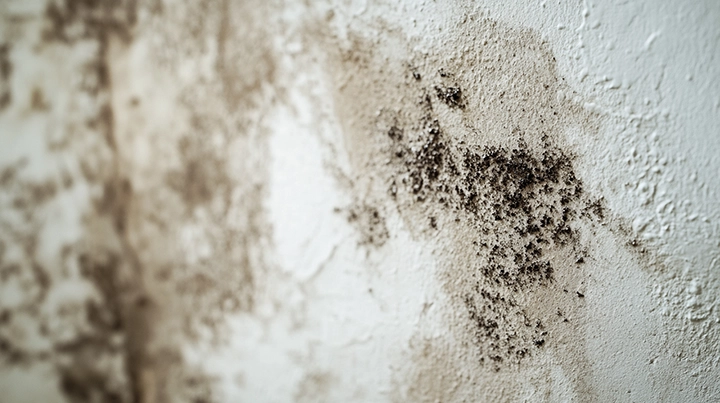
Here is the shift in thinking that changes how you respond to mold: it is not primarily a cleaning problem. It is a moisture problem that cleaning happens to make visible.
Fungal spores are always present in indoor air — carried in through open windows, on clothing, through ventilation systems. Outdoors, they play an essential ecological role in decomposing organic matter. Indoors, they remain largely inactive unless conditions allow them to grow. When moisture accumulates and airflow is limited, spores that were dormant in the background begin to germinate and colonize surfaces.
In this sense, mold appearing on a wall is not the problem — it is a symptom. The problem is the underlying condition that allowed it to establish. Addressing the stain without addressing the moisture is why, in studies of remediated homes, 40% experience mold regrowth within 12 months.

How to Read the Signals Before They Become Visible
Mold rarely announces itself with a dramatic outbreak. It communicates first through subtler signals that are easy to overlook or explain away.
A persistent musty smell is often the earliest indicator. The odor comes from microbial volatile organic compounds (MVOCs) released by actively growing mold — it can be detectable before any visible growth appears, particularly when mold is developing behind walls or beneath flooring.
Recurring dampness in the same location is another pattern worth taking seriously. If a wall or ceiling repeatedly feels damp after appearing to dry out, moisture is entering from somewhere — not simply evaporating from a one-time event.
Paint peeling, bubbling, or discoloration on interior walls often indicates moisture migration through the wall structure. Efflorescence — white crystalline deposits on brick or concrete — signals water movement through masonry.
Unexplained respiratory symptoms that improve when you leave the building and worsen when you return are a recognized pattern in mold-affected homes, particularly for individuals with allergies or asthma.
The key principle: persistence reveals more than appearance. A single damp patch after heavy rain is less concerning than a wall that becomes damp repeatedly, regardless of weather.
The Rooms That Carry the Highest Risk
Research on indoor mold exposure consistently identifies certain domestic environments as significantly more vulnerable than others:
Bathrooms are the highest-risk room in most homes. Steam from showers and baths raises humidity rapidly, and without effective mechanical ventilation, that moisture settles on cold surfaces — particularly around tiles, sealant, and the ceiling above shower areas.
Kitchens accumulate steam from cooking and moisture from washing. Cupboards under sinks are particularly prone, especially where pipe connections are not perfectly sealed.
Basements and ground-floor spaces tend to run cooler and receive moisture through concrete and masonry from surrounding soil. Without adequate vapor barriers and ventilation, condensation can form persistently on internal surfaces.
Rooms with external walls on two or more sides — corner rooms especially — are more exposed to cold bridging, where the wall structure becomes cold enough to cause condensation on its interior surface even when the room itself feels dry.
Energy-efficient building improvements such as added insulation and draught-proofing can, paradoxically, increase mold risk in some homes by reducing the air changes that previously allowed moisture to escape. Sealed, well-insulated homes need deliberate mechanical ventilation to compensate.

The Health Picture: Who Is Most Affected
The health effects of mold exposure are not uniform. According to Harvard Health, they exist along a spectrum shaped by individual sensitivity, exposure duration, and the specific mold species involved.
For most healthy adults, common indoor molds cause mild allergic symptoms — nasal congestion, eye irritation, sneezing, skin reactions. These are uncomfortable but typically resolve when exposure is reduced.
For people with asthma, mold is a recognized trigger. Spore inhalation can provoke inflammatory responses in the airways, increasing the frequency and severity of attacks. Children are particularly sensitive, and indoor mold exposure in early life has been associated with higher rates of asthma development.
For immunocompromised individuals — those undergoing chemotherapy, taking immunosuppressive medications, or living with conditions that impair immune function — certain mold species pose more serious risks, including pulmonary infections that are difficult to treat.
Stachybotrys chartarum, commonly called black mold, receives significant public attention, but toxicity from household mold is generally related to prolonged, heavy exposure rather than brief contact with typical domestic growth. The more common and immediate concern is allergic sensitization.
What to Do When You Find Mold
For small areas on hard, non-porous surfaces — tiles, glass, metal — physical removal followed by application of a dilute bleach solution and thorough drying is typically effective for surface mold. Ensure adequate ventilation during cleaning and use gloves and a mask.
For mold on porous materials — drywall, plasterboard, ceiling tiles, insulation, carpet — surface cleaning is insufficient. Mold penetrates these materials and cannot be fully removed without replacing the affected section.
For areas larger than approximately 1 square meter, or for any mold associated with significant water damage, professional remediation is recommended. The primary reason is not the mold itself but the likelihood that it extends beyond the visible area into wall cavities or structural materials.
In all cases, identify and address the moisture source first. Removing mold without resolving what caused it will result in recurrence. As research shows, remediation that does not address root causes fails in a significant proportion of cases within the first year.

Prevention: Managing Moisture, Not Just Surfaces
Mold prevention is fundamentally about maintaining the conditions that prevent mold from establishing — not about eliminating spores, which is neither practical nor possible.
Control indoor humidity. Most mold species require relative humidity above 70–80% to grow actively. Keeping indoor humidity below 60% — using dehumidifiers in damp spaces, ventilating during and after cooking and bathing — removes the primary enabling condition.
Repair leaks promptly. Even a slow drip creates persistent moisture in wall cavities. Pipe connections, roof penetrations, and window seals should be inspected regularly.
Improve ventilation in high-risk rooms. Bathroom extractor fans should run during and for at least 15–20 minutes after showering. Kitchen hoods should vent to outside air, not recirculate internally.
Avoid cold bridges. Furniture pushed tight against external walls restricts airflow and allows moisture to accumulate on wall surfaces. Leaving a small gap allows air circulation.
Dry wet materials quickly. Whether from a spill, flooding, or a repair — wet materials that remain wet beyond 24–48 hours become candidates for mold growth. The EPA’s 48-hour guideline is a practical minimum target.
The principle that runs through all of this: mold management is environmental management. The home that stays mold-free is not one that is cleaned more aggressively — it is one where moisture moves through rather than settling in.
FAQ: Household Mold
Q: Is mold always visible? No. Mold commonly grows behind walls, under flooring, and inside ventilation systems. A musty odor is often the first detectable sign, appearing before any visible growth. If a smell persists despite cleaning, hidden growth is likely.
Q: How quickly can mold grow after water exposure? The EPA recommends drying wet areas within 24–48 hours to prevent mold from establishing. Under ideal conditions — high humidity and warm temperatures — germination can begin within hours of sustained moisture exposure.
Q: Can I clean mold myself? For small areas on hard, non-porous surfaces, yes — with appropriate protective equipment and proper ventilation. For porous materials, large areas, or mold connected to water damage, professional remediation is recommended.
Q: Does all mold cause health problems? Not for everyone, and not equally. Health effects range from mild allergic responses in most people to asthma exacerbation in sensitive individuals to more serious infections in those with compromised immune systems. Children and the elderly are generally more vulnerable.
Q: If I clean the mold, is the problem solved? Only if the moisture source is also resolved. Studies show that mold regrows in approximately 40% of remediated homes within a year when the underlying cause is not addressed. Removing visible mold is a starting point, not a solution.
Q: What humidity level should I maintain indoors? Most guidance recommends keeping indoor relative humidity below 60%, with 30–50% considered optimal. Above 60–70%, conditions increasingly favor mold growth. A basic hygrometer — widely available and inexpensive — can help monitor this in moisture-prone rooms.
References
Academic & Research Sources
- Li et al. (2024). Indoor mould exposure: Characteristics, influences and corresponding associations with built environment — A review. Building and Environment. https://www.sciencedirect.com/science/article/pii/S0360132323009988
- Levine, H. (2025). Mold in the home: Identifying and treating the issue to prevent health problems. Harvard Health Publishing. https://www.health.harvard.edu/healthy-aging-and-longevity/mold-in-the-home-identifying-and-treating-the-issue-to-prevent-health-problems
Official Sources
- U.S. Environmental Protection Agency — Mold Course Chapter 9: https://www.epa.gov/mold/mold-course-chapter-9
- WHO — Dampness and Mould: https://www.who.int/publications/i/item/9789241598940
- CDC — Mold: https://www.cdc.gov/mold/default.htm
Article prepared by the MoldNewsHub editorial team based on peer-reviewed research and publicly available scientific literature.