Meta Description
The ground beneath our feet looks unchanged — but a growing body of research shows that climate change is quietly reorganizing the microbial communities that keep ecosystems alive. And the consequences may be far larger than what we can see.
The World Beneath Your Feet Is Already Shifting
Most of us experience climate change through things we can see: shrinking glaciers, earlier springs, more intense storms. But some of the most consequential changes are happening in a place we almost never look — beneath the surface of the soil, in a world of organisms too small to see without a microscope.
Recent research highlighted by Science News reveals that rising temperatures and shifting rainfall are not just altering visible landscapes. They are reorganizing the microbial communities inside the soil itself — the fungi, bacteria, and other microorganisms that quietly drive some of the most essential processes on Earth.
What looks stable from above may already be in motion below.

Soil Is Not a Foundation. It Is a Community.
We tend to think of soil the way we think of concrete — something solid, inert, a surface things rest on. That mental model is almost entirely wrong.
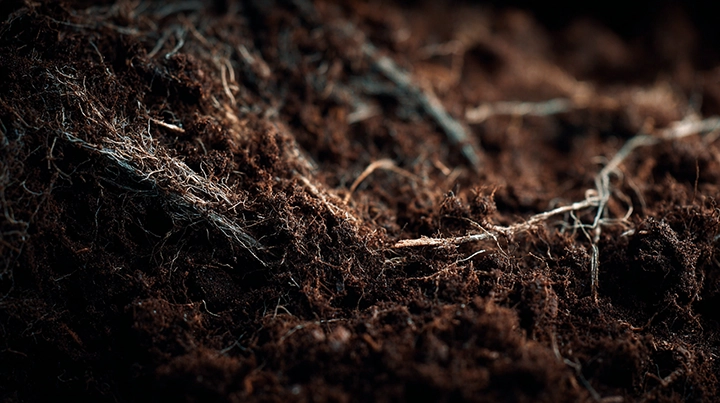
Soil is a living system, home to an extraordinary density of organisms. A single teaspoon of healthy forest soil can contain more microorganisms than there are people on Earth. Among these, fungi play an especially central role — extending thread-like networks through the soil, connecting plant roots, redistributing nutrients, and breaking down organic material that would otherwise accumulate and lock away the elements that plants need to grow.
These fungal networks do not just support individual plants. They link entire plant communities together, allowing nutrients and even chemical signals to move between trees that have no other way to communicate. The forests we walk through are, in a very real sense, held together by a web of fungi operating just below our feet.
This system has been running, largely undisturbed, for hundreds of millions of years. Climate change is beginning to test it in ways it has never experienced before.
A Community Under Pressure
When the temperature of the soil rises, even by a degree or two, microbial communities don’t simply slow down or speed up uniformly. They reorganize.
Some species thrive in warmer conditions. Others — adapted to the cooler, more stable environments that have existed for millennia — begin to decline. The result is a shift in the composition of the community: different organisms becoming dominant, different processes being emphasized, different rates of carbon and nutrient cycling emerging.
A 2025 global meta-analysis published in PNAS drew on 102 studies spanning multiple continents to quantify this effect. The findings were stark: warming reduced bacterial diversity by an average of 16% and fungal diversity by nearly 20%. Under the worst-case climate scenario — a 3.4°C increase by 2070 — fungal diversity in soils could decline by as much as 81%.
These are not abstract numbers. Fungal diversity in soil is directly linked to ecosystem stability, nutrient availability, and the capacity of soils to store carbon. Losing it does not mean the system stops — it means the system starts working differently, and often less reliably.

Carbon, Climate, and a Feedback Loop Nobody Wants
At the center of this story is carbon — and a feedback loop that has climate scientists paying close attention.
Soil holds more carbon than the atmosphere and all living plants combined. It stores this carbon in organic matter that microbes process slowly over time. When the microbial community is stable and diverse, this process is regulated. Carbon moves through the system at a rate the climate can absorb.
When the community shifts under warming, that regulation can break down.
In warmer conditions, accelerated microbial activity can speed up decomposition — releasing more carbon dioxide into the atmosphere. That warming, in turn, further stresses microbial communities. The soil, which was once a carbon sink helping to buffer climate change, can begin to function as a carbon source, releasing gases that accelerate the very warming that triggered the shift in the first place.
It is a feedback loop built into the ground itself. And it is one that becomes harder to reverse the longer it runs.
The Ripple Effects Above Ground
The changes do not stay underground.
Plants depend on mycorrhizal fungi to access phosphorus, nitrogen, and other nutrients they cannot efficiently absorb on their own. When those fungal partnerships weaken or disappear, plants under stress — already contending with drought, heat, and unpredictable growing seasons — lose one of their primary support systems.
In forests, this can affect regeneration. Young trees that cannot access enough nutrients struggle to establish themselves, potentially changing the composition of forests over decades. In agricultural systems, reduced microbial efficiency translates into lower soil fertility, greater dependence on synthetic fertilizers, and soils that are less resilient to extreme weather.
What begins as a shift in microbial diversity — invisible, underground, measured in percentages — gradually surfaces as changes in what grows, what survives, and how productive the land remains.

Slow Change, Lasting Consequences
One of the most disorienting things about this process is its pace.
Ecosystems do not collapse overnight because their soil fungi are declining. Instead, they drift — gradually becoming less efficient, less resilient, less able to recover from disturbances. Nutrient cycles slow. Soil structure weakens. Plant communities shift in subtle ways that take years or decades to fully register.
By the time the effects are impossible to miss, the underlying cause may have been running for a generation.
This slow pace is not reassuring. It is what makes the problem easy to underestimate. The consequences of what is already happening in the soil will not announce themselves dramatically. They will accumulate quietly, in the fertility of farmland, the stability of forests, and the capacity of ecosystems to absorb the carbon we continue to release.
Rethinking What “Protecting Nature” Means
The research points to something important about how we think about conservation and climate action.
Protecting a forest, in the traditional sense, means keeping trees standing. But the trees depend on what lives below them. A forest with intact canopy but degraded soil microbiome is not a healthy forest — it is a forest waiting to reveal the damage that has already been done.
Maintaining microbial diversity in soils may be as important to long-term ecosystem stability as protecting the species we can see. That means reducing land disturbance, limiting chemical inputs that harm soil organisms, and managing land in ways that support the invisible communities doing the most essential work.
The ground beneath us is not still. It is responding, adapting, and in some places, beginning to struggle. Understanding that — and acting on it — may be one of the most important things we can do for the systems that sustain all life on land.

FAQ: Climate Change and Soil Microbial Communities
Q: Why do soil microbes matter for climate change? Soil contains more carbon than the atmosphere and all living plants combined. The microbes that live in it — particularly fungi and bacteria — control whether that carbon stays stored or gets released as CO₂. When climate change disrupts these communities, it can trigger feedback loops that accelerate warming.
Q: How does warming affect soil fungi specifically? A 2025 meta-analysis in PNAS found that warming reduces fungal diversity by nearly 20% on average, with potentially far larger losses under severe warming scenarios. Fungi are particularly sensitive to temperature shifts because of their complex relationship with soil moisture and plant roots.
Q: Do soil microbial communities recover after warming? Recovery depends on the severity and duration of change. Short-term disturbances may be absorbed. Long-term warming, however, tends to produce shifts in community composition that persist even after conditions stabilize. The longer warming continues, the less reversible the changes appear to be.
Q: How does this affect farming and food production? Soil microbial communities are the foundation of soil fertility. When they decline, the efficiency of nutrient cycling drops — meaning crops receive less of what they need from the soil itself, and farmers must compensate with more fertilizer. This increases costs, reduces resilience, and further stresses the soil system.
Q: Is there anything that can protect soil microbiomes? Reducing land disturbance, maintaining plant diversity above ground, limiting synthetic fertilizer and pesticide use, and managing soil moisture all help. Some researchers are also exploring microbial inoculants — intentional introductions of beneficial microbes — as a way to restore degraded soil communities.
Q: What is a soil carbon feedback loop? It is a self-reinforcing cycle: warming increases microbial decomposition, which releases more CO₂, which causes further warming, which further disrupts soil microbes. Once this cycle is running at scale, it becomes increasingly difficult to interrupt.
References
Academic Sources
- Reich, P.B. et al. (2025). Rising global temperatures reduce soil microbial diversity over the long term. PNAS, 122(35). https://doi.org/10.1073/pnas.2426200122
- Verbiest et al. (2025). Long-term climate warming substantially reduces global soil microbial richness. One Earth. https://www.cell.com/one-earth/fulltext/S2590-3322(25)00337-9
- Jansson & Hofmockel (2020). Soil Microbiomes Under Climate Change and Implications for Carbon Cycling. Annual Review of Environment and Resources. https://www.annualreviews.org/content/journals/10.1146/annurev-environ-012320-082720
- Mason et al. (2024). Soil microbiome interventions for carbon sequestration and climate mitigation. mSystems. https://journals.asm.org/doi/10.1128/msystems.01129-24
News & Official Sources
- Garcia de Jesús, E. (2026). How warming is shifting microbial worlds. Science News. https://www.sciencenews.org/article/climate-change-disrupts-microbes-soil
- Aspen Global Change Institute — Small but mighty: The role of soil microbes in a changing climate: https://www.agci.org/research-reviews/small-but-mighty-the-role-of-microbes-in-a-changing-climate
Article prepared by the MoldNewsHub editorial team based on peer-reviewed research and publicly available scientific literature.