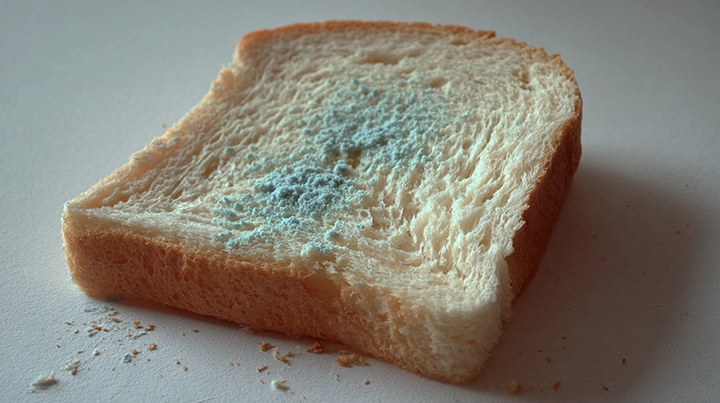
You’ve been there. A loaf of bread, mostly fine, with one green corner. A jar of jam with a faint white ring around the lid. A strawberry in the punnet that’s gone soft and fuzzy while the rest still look good. And the question that follows, every time: if I just cut that part off, is the rest okay?
It’s a reasonable question. It’s also usually the wrong one.
The Part You Can’t See
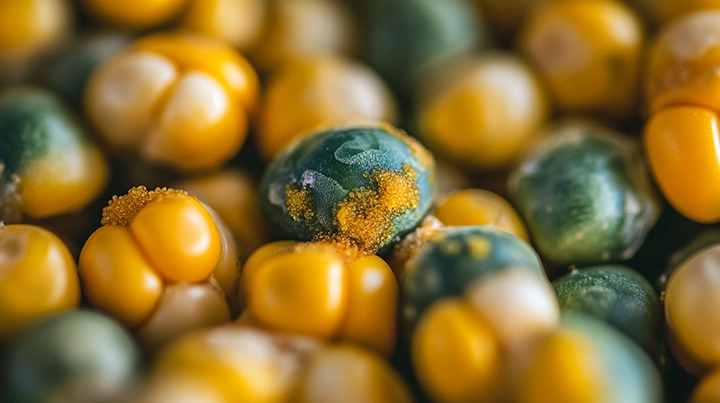
Mold doesn’t behave like a stain. It doesn’t sit on the surface waiting to be wiped away. It grows as a network of microscopic filaments — hyphae — that push downward and outward into the structure of whatever they’ve landed on. What you see on the surface, the fuzzy green or white or black patch, is only the reproductive portion of the organism. The part that releases spores. The part that became visible.
The rest of it is already somewhere you can’t see.
This is what makes the trim-and-eat instinct unreliable. Removing visible mold doesn’t remove the contamination. It removes the flag. The organism itself may extend centimeters beyond the visible boundary, deeper into the food’s interior, along pathways that leave no surface trace.

Why Bread Is Different From Cheese
Structure is everything. The reason food safety guidance treats a moldy baguette and a moldy block of cheddar so differently isn’t arbitrary — it comes down to how far the hyphae can travel, and how fast.
Soft, high-moisture foods — bread, cooked grains, yogurt, soft fruits, deli meats, jams — have open, porous structures that offer little resistance. Fungal filaments move through them quickly and extensively. By the time a spot becomes visible on the surface, the network has typically already spread well into the interior. These food systems also tend to support bacterial growth alongside mold, compounding the problem.
Hard cheeses and firm vegetables are different. Their dense cellular matrices slow penetration. For these, there’s a reasonable case for cutting away the affected area — but with margins. USDA food safety guidance recommends removing at least 2 to 3 centimeters around and below the visible mold, using a clean knife, and keeping the cut surface away from the rest of the food.
The caveat is important: if the food shows any softening, unusual moisture, or discoloration beyond the visible spot, the contamination has likely spread past safe limits. Dense doesn’t mean immune.

The Mold That’s Supposed to Be There
Not every fungus on food is a warning sign. Some foods depend on controlled mold growth for their character and safety — blue cheeses, brie, camembert. These use carefully selected Penicillium species, introduced under managed conditions, with growth tightly controlled throughout production.
The distinction is control. The mold in a properly made Roquefort is safe because the organism, the conditions, and the timing are all known. The mold that appears unexpectedly on the same cheese — a different color, an unusual texture, growth that wasn’t there when you bought it — is not part of that system. It indicates contamination and should be treated accordingly.
The Problem You Can’t Smell or See
Here is where the real complexity lies. The most significant health risk from moldy food is often not the organism itself, but what certain organisms can leave behind.
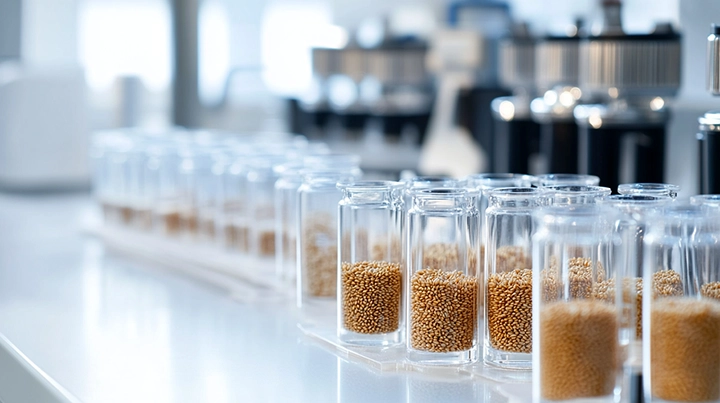
Some molds produce mycotoxins — chemical compounds that are stable, invisible, and not reliably destroyed by cooking. You cannot see them. You cannot smell them. If the mold that produced them is gone, the compounds may still be present. Aflatoxin, produced by Aspergillus flavus, is among the most studied; it is associated with liver damage and is classified as a human carcinogen. Fusarium species produce trichothecenes and fumonisins, linked to a range of acute and chronic health effects.
Not every mold produces mycotoxins, and not every exposure produces detectable harm. But in a household setting, there is no practical way to know which mold you’re looking at or whether mycotoxins are present. The uncertainty is the point.

What Symptoms Actually Mean
For most healthy people, eating a small amount of mold-contaminated food produces mild and short-lived effects — nausea, stomach discomfort, sometimes throat irritation. These symptoms typically resolve without intervention.
The more serious concerns are associated with repeated or high-level mycotoxin exposure, which is more commonly seen in agricultural contexts — contaminated grain stores, improperly dried cereals, peanut crops affected by Aspergillus — than in isolated household incidents. But the absence of immediate symptoms is not the same as the absence of risk. Some mycotoxin effects are cumulative and long-term, with no immediate signal at the time of exposure.
The Variables That Actually Matter
Mold needs moisture, warmth, and time. Remove any of those and growth slows or stops. This is why food safety is fundamentally a storage problem as much as a food type problem.
Food left at room temperature for extended periods, stored in humid conditions, or kept past reasonable timelines is significantly more likely to develop contamination. Proper refrigeration, airtight storage, and eating or freezing food before it deteriorates are more effective than knowing when to trim.
By the time you’re looking at visible mold, the environment has already provided everything the organism needed. Prevention addresses the problem before that moment arrives.
Making the Decision
The question of whether to trim or discard is ultimately a question about structure and uncertainty.
Soft food: discard. The network is already too far in.
Dense food with a localized spot: careful trimming may be appropriate, with wide margins and close attention to whether the food’s texture and moisture have changed.
Any food where uncertainty is high: discard. The cost of throwing away food is low. The cost of repeated exposure to mycotoxins you can’t detect is not.
FAQ
Is it safe to eat food if you remove the moldy part? It depends on the food’s structure. Soft, high-moisture foods should be discarded entirely. Dense, firm foods like hard cheeses may allow careful trimming with wide margins — but only if the food’s texture and condition are otherwise intact.
Can cooking make moldy food safe? Cooking can kill mold organisms, but it does not reliably destroy mycotoxins. These compounds are chemically stable and may remain in food even after heat treatment.
Why is moldy bread always unsafe to eat? Bread’s porous structure allows hyphae to spread rapidly through the interior. By the time surface mold is visible, internal contamination is typically already extensive.
Are all molds on food dangerous? Not inherently — some controlled molds in fermented cheeses are safe. But in household settings, there is no reliable way to distinguish safe from unsafe molds, which is why conservative guidance recommends discarding when in doubt.
What foods are most at risk? Soft, high-moisture foods: bread, soft fruits, yogurt, deli meats, cooked leftovers, and jams. These allow the fastest and deepest fungal penetration.
References
- USDA Food Safety and Inspection Service — Molds on Food: Are They Dangerous?: https://www.fsis.usda.gov/food-safety/safe-food-handling-and-preparation/food-safety-basics/molds-food-are-they-dangerous
- U.S. Food and Drug Administration — Food Safety for Consumers: https://www.fda.gov/food/consumers
- World Health Organization — Mycotoxins: https://www.who.int/news-room/fact-sheets/detail/mycotoxins