From Fabric to Fungus: A Hidden Collaboration
Museums are places of reverence, preservation, and—if we’re honest—an occasional quiet awe. But even in these sanctuaries of human achievement, something quietly wild is at work. In the still air behind climate-controlled doors, historic textiles are not just fading; they are evolving, shaped by silent partners we’re only beginning to appreciate: fungi.
A new study in Heritage Science (2025) gives us a fresh look at these microbial collaborators. Far from being mere agents of decay, certain fungi have chemically altered museum fabrics in ways both subtle and profound. They have, in effect, become co-authors of color—sometimes erasing, sometimes preserving, sometimes even enhancing the visual legacy of garments, tapestries, and sacred cloths. This is not simply a story of loss, but of transformation, creativity, and an ever-evolving conversation between matter and microbe.

Pigments Where They Shouldn’t Be
How do you unravel the history of color in an object that has seen centuries of hands, climates, and storage? The research team, composed of chemists, microbiologists, and conservators, employed a multi-pronged approach: Fourier-transform infrared spectroscopy (FTIR) and Raman spectroscopy to identify chemical bonds; scanning electron microscopy (SEM) to map pigment and fiber structure; DNA barcoding to reveal the fungal identities; and residue analysis to track both original dyes and later intruders.
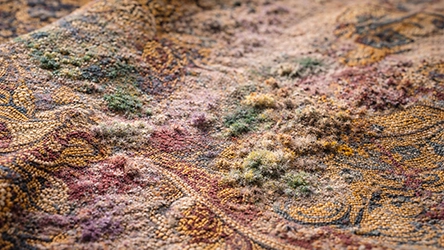
What they found is both unexpected and strangely poetic. Many textile surfaces showed color changes that could not be explained by the usual suspects—sunlight, air, or even the natural aging of plant-based dyes. Instead, these shifts pointed to a living, biological process. Fungi were found to have degraded original pigments such as indigo and madder, eating away the blue and red that once defined royal robes or ceremonial cloths. In their wake, fungi left their own pigments—metabolic byproducts that seeped into the gaps, sometimes filling them, sometimes creating new shades, and occasionally even stabilizing what was left.
These new pigments were not simply accidents. In some cases, they produced hues and patterns that appeared “historical” to the naked eye—an optical illusion born of microbial activity. In others, fungal metabolites crosslinked with the textile fibers, producing colorfast effects that outlasted the original dyes. It’s an art, and an accident, written in the quiet darkness of storage.

Meet the Mold: The Unseen Museum Residents
Who are the culprits—or collaborators—behind these chromatic changes? The usual suspects emerged:
Aspergillus and Penicillium, with their resilience in dusty, slightly damp corners
Cladosporium, common both in outdoor air and indoor repositories
Alternaria, Chaetomium, and Talaromyces, all with a history of thriving on organic-rich, undisturbed surfaces
These fungi aren’t random invaders; they’re uniquely adapted to the museum environment. They feast not on abundance, but on traces—residual protein, traces of natural glue, leftover dye. Their metabolic flexibility allows them to survive for decades in dormant form, waiting for the smallest pulse of moisture to resume their quiet chemical work. It’s a kind of patience only microbes possess.

Why It Matters: The Artistry (and Risk) of Fungi
- Mold as Accidental Pigment Producer
For centuries, conservators and curators have viewed fungi through a lens of fear: as spoilers, destroyers, erasers of human achievement. This research invites a new perspective. Fungi, it turns out, are not always villains. Their chemical interactions with fiber can create entirely new pigments—sometimes masking loss, sometimes producing color where none should be, sometimes stabilizing fragile dyes in a web of crosslinked chemistry. What appears “ancient” on a tapestry may, in fact, be the work of a recent microbial artist.
These revelations complicate our sense of authenticity and authorship. If a color has survived a millennium because a fungus “helped,” is that a loss, or a hidden form of preservation? Are visitors seeing the past as it was, or as it has become through a partnership with nature’s most patient chemists?

- Conservation’s Dilemma: Threat or Storyteller?
For museum professionals, these findings force a fundamental rethink. Aggressively removing all traces of fungi risks erasing a part of the object’s biography. Some fungal pigments are now more integral to the textile’s chemistry than the dyes originally applied by weavers and dyers centuries ago. Their removal could lead to physical weakness, sudden loss of color, or even damage to other conservation materials.
Instead, the study points to a new, more nuanced approach: routine non-destructive pigment mapping, DNA-based screening for fungal “contributors,” and selective preservation of microbial traces. Conservation becomes a dialogue, not a battle—balancing the urge to restore with respect for the object’s complex history. - Bioforensics: Fungi as Clues in Art and History
Perhaps most exciting is the door this research opens for art historians and bioforensic experts. The fungal DNA and pigments embedded in a textile can reveal its journey: periods of high humidity, hidden episodes of mishandling, or the invisible fingerprints of long-gone storage conditions. Microbes become the silent archivists, writing environmental data into every thread. In an era of forgery and uncertainty, these biological clues may soon play a key role in provenance analysis, authenticity verification, and even the reconstruction of lost heritage.
Lessons for Museums and Collectors: Navigating the Microbial Frontier
The study’s recommendations are both practical and profound:
Climate control, while necessary, is not a complete solution. Even a brief spell of moisture can awaken dormant fungi and restart pigment alteration.
Non-destructive pigment mapping and regular DNA sequencing should become part of standard conservation checks—catching problems before they bloom into full-scale damage, or before irreversible chemical changes take root.
Restoration should be strategic: in some cases, fungal pigments are so bonded to the fiber that their removal is both impractical and destructive. Instead, conservators might document and interpret these traces as part of an object’s narrative.
Interpretive labels and exhibition guides may need to evolve: visitors could be informed when the colors they see are “original,” or a remarkable product of fungal artistry.
The greatest lesson from this research is a gentle one: heritage is always changing, and the artists at work are not always those with names. Fungi have painted, erased, and preserved in silence, sometimes helping, sometimes harming, always participating. This isn’t a defeat for conservation, but a reason to approach objects with humility—and a reminder that beauty and science often share the same thread.
So next time you stand in front of a centuries-old tapestry or sacred robe, pause and imagine the invisible brushwork beneath the surface. Every fiber is a story, every shade a negotiation between human ambition and microbial creativity. In museums, as in life, art and science walk hand in hand, leaving the world richer for their collaboration.

References
Academic sources
Bottura Scardina, L., et al. (2025). Fungal pigments and microbial alteration in historic textiles. Heritage Science.
Official / institutional sources
International Council of Museums (ICOM). Preventive conservation and biological risks. https://icom.museum/en/resources/standards-guidelines/
UNESCO. Safeguarding textile heritage. https://www.unesco.org/en/culture