Pick up a piece of limestone. It feels solid — cold, dense, indifferent. It has been sitting in the same form, you might assume, for as long as anyone can remember. But look closely enough, and the surface is not a boundary. It is a negotiation.
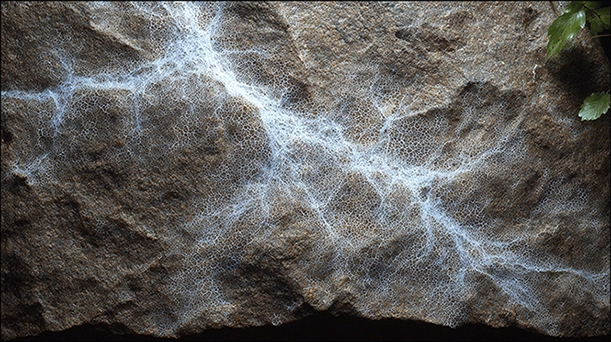
Somewhere in the microscopic architecture of that stone — in its pores, its crystal faces, its invisible irregularities — fungal filaments have worked their way in. They have been releasing acids, pulling ions from the mineral lattice, exchanging matter with something that was never supposed to be alive. The stone you’re holding has been quietly changing. It just hasn’t told you yet.
The Interface Where Biology Meets Rock
At the microscopic scale, fungal hyphae don’t stop at surfaces — they penetrate them. The filamentous networks that make up fungal mycelium are narrow enough to force their way into pores and mineral grain boundaries that no macroscopic organism could reach. What forms there is not a passive contact but an active interface: a zone where biological chemistry and inorganic structure continuously interact.
Through metabolic activity, fungi release organic acids — oxalic acid, citric acid, gluconic acid — along with a range of reactive compounds that alter the chemical environment immediately around them. These substances dissolve mineral surfaces, mobilize ions, and change local pH in ways that accelerate transformations that would otherwise take geological timescales. What would have taken ten thousand years without biological involvement might unfold in decades with it.
The result is not a fixed boundary between life and matter. It is a continuous exchange — one that operates below the level of observation but produces effects that accumulate over time.

Transformation, Not Just Decomposition
The familiar story of fungi is one of breakdown. They decompose fallen trees, recycle nutrients, dissolve the dead back into the living world. That story is accurate, but incomplete.
Under certain conditions, fungi do something more surprising: they build. Through a process called biomineralization, fungal activity can induce the precipitation of new mineral phases — solid materials that form from solution as a direct consequence of biological chemistry. Calcium oxalate crystals are one well-documented example, forming at the interface between fungal networks and calcium-containing substrates and persisting long after the organism that produced them has moved on.
This dual capacity — to both dissolve and precipitate, to break down and build up — reframes what fungi actually are within material systems. They are not one-directional agents of decay. They are participants in a cycle that runs in both directions, depending on what the environment provides.
Moving Elements Through the Earth
These interactions don’t stop at individual surfaces. They extend into the broader geochemical systems that govern how elements move through soils, rock formations, and built environments.
Fungal networks are physically connected across distances that far exceed what individual cells could cover. Through these networks, metals, nutrients, and mineral components are redistributed — drawn toward the organism in one location, deposited in another, transformed along the way. Fungi act as biological pipelines for geochemical movement, linking processes that would otherwise remain isolated.
This has real consequences for how soil chemistry develops, how contamination spreads or concentrates, and how the mineral composition of an environment shifts over decades. The organism doesn’t have to be visible to be doing significant work.

What Engineers Are Starting to Notice
These biological realities are beginning to attract attention in applied fields — not as problems to manage, but as capabilities to use.
In environmental remediation, fungal systems are being explored for their ability to immobilize heavy metals in contaminated soils. Rather than extracting contaminants through energy-intensive processes, fungal activity can be directed to change the chemical form of metals in place — converting mobile, bioavailable forms into stable mineral phases that no longer move through groundwater.
In resource recovery, the same mechanisms that allow fungi to dissolve minerals can be applied to low-grade ores and industrial waste streams, selectively extracting valuable elements that conventional processing would leave behind. In construction, biomineralization is beginning to appear in proposals for self-healing materials and bio-based binding agents — substances that improve over time rather than simply degrading.
Each of these applications reflects the same underlying shift: instead of trying to protect materials from biological influence, engineers are beginning to ask how that influence might be designed into the system.

The Challenge of Working with Living Systems
Integrating biology into material design introduces a category of complexity that synthetic materials don’t carry. Fungi respond to their environment. They change behavior as conditions shift. They are sensitive to temperature, moisture, chemistry, and competition from other organisms.
This variability is part of what makes them capable — it is the adaptability that allows them to colonize such a wide range of substrates and conditions. But it is also what makes them difficult to engineer with precision. A fungal system that performs well under one set of conditions may behave differently as those conditions evolve. Managing this over the lifespan of a building or a remediation project requires a different kind of thinking than working with steel or concrete.
The field is still early. But the underlying question — how do we incorporate biological dynamics into the materials we build with and depend on — is one that won’t go away.
Structure as Process
There is a deeper implication running through all of this. We tend to think of materials as objects defined by their state at a particular moment — a composition, a strength, a chemical formula. Fungal activity introduces time as an active dimension.
A stone is not simply what it is today. It is what it is becoming, through interactions that are happening right now at scales we cannot see without instruments. Stability, in this frame, is not an intrinsic property of a material. It is a condition maintained — or not — within a system that is continuously evolving.
That shift in perspective changes what questions engineers, architects, and material scientists should be asking. Not just: what is this material made of? But: what is this material doing?
FAQ
Can fungi really change minerals and rocks? Yes. Through the release of organic acids and reactive metabolites, fungi dissolve mineral surfaces, mobilize ions, and alter local chemistry — processes that accumulate over time into measurable material changes.
Do fungi only break down materials? No. In addition to decomposition, fungi can drive biomineralization — the precipitation of new mineral phases — meaning they can both dissolve and build, depending on environmental conditions.
Are these processes used in real engineering applications? They are being actively explored in environmental remediation, metals recovery from waste streams, and bio-based construction materials. Several applications are in development or early-stage field testing.
Can fungal activity be controlled in engineering systems? Partially. Environmental conditions can be managed to direct fungal behavior, but biological variability makes precise control more complex than with synthetic materials. This is one of the central challenges in the field.
Why are fungi relevant to sustainable material design? Fungi operate at ambient temperatures, can process natural and waste materials, and produce effects without high-energy inputs — making them potentially useful tools for lower-impact approaches to material transformation and construction.
References
- MDPI Minerals — Fungal Interactions with Minerals and Materials: https://www.mdpi.com/2075-163X/16/1/118
- U.S. Environmental Protection Agency — Bioremediation Overview: https://www.epa.gov/sites/default/files/2015-04/documents/a_citizens_guide_to_bioremediation.pdf
- Nature — Mycorrhizal Networks and Mineral Weathering: https://www.nature.com/articles/s41559-019-0833-9