Invisible Enemies in Every Kernel: The Twin Threat of Aflatoxin and Zearalenone
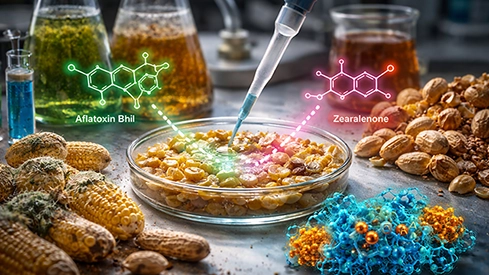
In the fields where our grains are grown, a silent adversary lurks. Aflatoxin B1 (AFB1), infamous as one of the most potent natural carcinogens known to science, and zearalenone (ZEN), a hormone-disrupting mycotoxin, often appear as a double act. Both are byproducts of ubiquitous fungi—Aspergillus for AFB1 and Fusarium for ZEN—that colonize corn, peanuts, and other staple crops. Their combined presence spells trouble for food safety around the globe, threatening livestock and human health and costing the agriculture sector billions each year.
Traditional strategies to control these mycotoxins range from chemical binders (which can be costly and environmentally problematic) to physical sorting and decontamination steps that rarely capture the whole problem. Worse, in many developing regions, these approaches are simply not accessible or effective, leaving millions exposed to contaminated food and feed.


PsCopA: The Enzyme That Changes Everything
Enter PsCopA, a novel multicopper oxidase enzyme discovered and engineered by researchers led by Ranran Ma. This bacterial enzyme, isolated from Pseudomonas and produced in Escherichia coli, marks a paradigm shift in mycotoxin detoxification. Unlike most detox enzymes, which specialize in breaking down a single toxin, PsCopA works on both AFB1 and ZEN—addressing two of the world’s most prevalent and hazardous fungal contaminants at once.
What sets PsCopA apart is its versatility and practicality. The enzyme requires no added cofactors or redox mediators—substances that are often expensive or environmentally unfriendly—and demonstrates remarkable stability, working efficiently across a broad range of temperatures (from 20°C to 80°C) and pH levels. In lab and real-world grain samples, PsCopA removed more than 90% of both toxins from contaminated cornmeal and peanut meal, an unprecedented feat in the field of enzymatic mycotoxin remediation.

A Safer Pathway: From Toxic to Tolerable
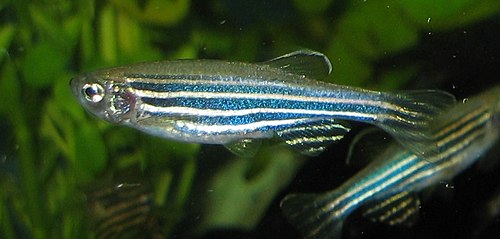
But destroying toxins isn’t enough. Many detoxification methods leave behind smaller fragments, some of which are still biologically harmful. Here, PsCopA again distinguishes itself: it transforms AFB1 into aflatoxin Q1 (AFQ1), and ZEN into α- and β-zearalanol (ZALs)—byproducts with dramatically reduced toxicity. In zebrafish toxicity trials, these breakdown products resulted in minimal liver stress and oxidative damage, even when both toxins were present. This holistic safety check is crucial: as food systems become more complex and global, solutions must be not just efficient, but truly safe.
Why PsCopA Is a Game-Changer for Global Food Security
The implications of this breakthrough are far-reaching. For one, dual-targeted enzymatic action is exceedingly rare. Most known enzymes are specialists, tackling just one molecular foe. With PsCopA, the agricultural and feed industries can, for the first time, address two major toxin classes in a single application—streamlining food safety protocols and reducing costs.
Moreover, because PsCopA doesn’t require any external cofactors, it’s ideally suited for practical, real-world use. Whether as a post-harvest grain wash, a feed supplement, or even as part of smart storage coatings to prevent toxin buildup, this enzyme is ready for deployment wherever contamination risk is highest. Its stability means it can withstand the tough processing conditions of modern agriculture, and its bacterial origins suggest it can be scaled up quickly using standard fermentation technology.
Looking Ahead: Applications and Industry Potential
Imagine a future where mycotoxin-contaminated harvests no longer need to be discarded, but can be safely and economically treated. PsCopA could be mixed into animal feeds, used in grain storage facilities, or added to processing water for nuts and cereals. Livestock would be protected from chronic toxin exposure—improving both animal health and food quality for humans. For regions where aflatoxin and zearalenone co-contamination are persistent problems, PsCopA offers a lifeline that is both affordable and sustainable.
This is more than a laboratory curiosity. PsCopA stands as a symbol of the next wave in microbial biotechnology—where enzymes are tailor-made to neutralize multiple threats at once, with real-world resilience and safety. It’s a victory for sustainable food systems and a model for addressing the growing complexity of global contamination risks.
For farmers, millers, regulators, and anyone who eats (that’s all of us!), this innovation marks a shift toward a future where the invisible threat of fungal toxins can finally be managed with precision, safety, and scale. The war against mycotoxins has a powerful new ally—and MoldNewsHub will be tracking every step.
References
Academic Sources
- Ma, R., et al. (2025). Dual Substrate Catalytic Detoxification of Aflatoxin B1 and Zearalenone by a Novel Enzyme PsCopA from Pseudomonas for Food and Feed Safety. Toxicon, 268, 108629. https://doi.org/10.1016/j.toxicon.2025.108629
- Qin, X., Xin, Y., Zou, J., Su, X., Wang, X., Wang, Y., Zhang, J., Tu, T., Yao, B., Luo, H., et al. (2021). Efficient Degradation of Aflatoxin B1 and Zearalenone by Laccase-like Multicopper Oxidase from Streptomyces thermocarboxydus in the Presence of Mediators. Toxins, 13(11), 754. https://doi.org/10.3390/toxins13110754
Official Sources
- U.S. FDA — Food Safety Modernization Act (FSMA): https://www.fda.gov/food/food-safety-modernization-act-fsma
- FAO — Food safety and mycotoxin-related resources: https://www.fao.org/food-safety/en/