Meta Description
Candida albicans lives harmlessly in most people — until a hidden molecular switch triggers its transformation into an invasive pathogen. New research may change how we treat it.
It’s Already Inside You. And It’s Been Waiting.
Right now, as you read this, a fungus is living inside your body.
It’s in your mouth. It’s lining parts of your gut. It’s sitting quietly on your skin. And in most cases, you’ll never feel it, never know it’s there, and never have a reason to think about it at all.
Its name is Candida albicans, and it has been a passenger in the human body for as long as our species has existed. Most of the time, it behaves itself — kept in check by the immune system and the billions of other microorganisms that share the same space. It is, for all practical purposes, one of us.
But every so often, something changes.
The fungus that lived quietly for years suddenly shifts. It starts growing differently, moving differently, behaving like something entirely other than what it was before. And when that happens, it can cause infections that range from a stubborn rash to a life-threatening bloodstream invasion.
What flips that switch — and whether we can stop it — is one of the most important questions in modern infectious disease research.

The Flatmate Who Suddenly Changes the Locks
Think of Candida albicans like a flatmate you’ve lived with for years without any issues. They pay their share, stay out of your way, and the household runs fine. You barely notice them.
Then one day — maybe you’ve been sick, maybe you took a long course of antibiotics, maybe you’ve been under intense stress — something shifts. The same flatmate who was never a problem starts taking over the kitchen, leaving doors unlocked, and inviting strangers in. The dynamic you thought was stable turns out to have been conditional all along.
That’s roughly what happens in the body when Candida albicans transitions from its commensal state — living harmlessly as part of the human microbiome — to its pathogenic one.
The trigger is rarely the fungus itself. It’s the environment around it.
When antibiotics wipe out competing bacteria, when chemotherapy suppresses the immune system, when a catheter creates a new surface for the fungus to cling to — Candida reads those changes and responds. It doesn’t wait to be invited. It simply takes the opportunity that’s been offered.
A Shape-Shifter With a Purpose
Here’s where the biology gets genuinely strange — and genuinely important.
Most organisms look more or less the same throughout their lives. Candida albicans doesn’t. When it decides to become dangerous, it doesn’t just behave differently. It literally changes its shape.
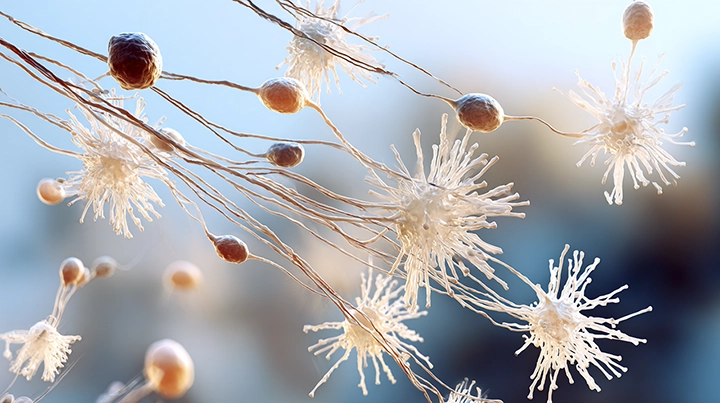
In its harmless state, it exists as a small, round yeast cell — unremarkable under a microscope, easily managed by a healthy immune system. But once the invasive program kicks in, those round cells begin to stretch and elongate into long, branching filaments called hyphae. It’s the same organism. It just looks — and acts — completely different.
Those filaments are not just cosmetic. They’re tools.
| Form | What it can do |
|---|---|
| Yeast (round) | Float through the bloodstream, colonize the gut quietly |
| Hyphae (filamentous) | Pierce through tissue, anchor to surfaces, build protective biofilms |
The hyphal form allows Candida to punch through the body’s epithelial barriers — the cellular walls that are supposed to keep pathogens out. It can form biofilms, which are essentially fortified communities of fungal cells encased in a protective layer that antifungal drugs struggle to penetrate. And it can hide from immune cells that would otherwise destroy it.
According to a 2025 multi-omics study, this transformation is driven by a complex web of molecular signals — not a single on/off switch, but an intricate system of pathways that reads the environment and decides, collectively, whether it’s time to act.

The Problem With Just Trying to Kill It
For decades, the medical response to Candida infections has followed a straightforward logic: find the fungus, and destroy it.
It makes sense on the surface. The fungus is causing harm. Remove the fungus, remove the harm. Drugs like fluconazole, echinocandins, and amphotericin B have saved countless lives by doing exactly that.
But the strategy has a fundamental flaw — one that’s becoming harder to ignore as resistance rises.
Killing Candida is increasingly difficult. Some strains have developed resistance to multiple drug classes, meaning the treatments that worked a decade ago are becoming less reliable. And because Candida is not an external invader but a permanent resident of the human body, you can’t simply keep it out. The moment treatment stops, the population rebuilds.
More troublingly, aggressive antifungal treatment can disrupt the broader microbial community — removing beneficial organisms alongside the target, sometimes making the underlying conditions worse.
The WHO has flagged Candida albicans as a critical-priority fungal pathogen, a recognition that current tools are under pressure and new approaches are urgently needed.

What If You Could Just Turn It Off?
This is where the research gets exciting.
A molecular switch — a regulatory system inside the fungus that determines whether it stays harmless or goes on the attack — has become one of the most compelling targets in antifungal research. The idea is simple, even if the science behind it isn’t: instead of trying to destroy Candida, what if you could simply prevent it from ever deciding to become dangerous?
Keep the switch off. Keep the fungus in its quiet, commensal state. Let it continue to exist in the body — where it belongs — but strip it of its ability to transform.
It’s a bit like the difference between evicting a difficult neighbor and simply finding a way to make sure they never cause problems in the first place. Less dramatic, but potentially far more effective.
Researchers are already investigating the specific transcription factors — proteins like Efg1, Cph1, and Ume6 — that control whether the hyphal growth program gets activated. If those proteins can be targeted precisely, the fungus loses its ability to shift into its invasive form, regardless of what’s happening in the surrounding environment.
It won’t eliminate Candida from the body. But it might make that permanent resident permanently harmless.
Why the Stakes Are Higher Than Ever
Fungal infections are increasing globally, and the trend isn’t slowing down.
Modern medicine has created a growing population of people whose immune systems are suppressed by design — organ transplant recipients who need immunosuppression to prevent rejection, cancer patients undergoing chemotherapy, people living with HIV, individuals on long-term steroid therapy. For all of them, Candida albicans is not a distant risk. It is a constant one.
Candida remains one of the leading causes of hospital-acquired bloodstream infections, with mortality rates that remain sobering even with treatment. And because the early stages of infection can look like many other conditions, diagnosis often comes late — when the fungus has already established itself deeply.
Understanding how infection begins, not just how to treat it after the fact, has become a clinical imperative. The molecular switch is no longer just an interesting biological puzzle. It’s a potential turning point in how medicine approaches one of its most persistent, most underestimated fungal threats.

FAQ: Candida albicans and the Molecular Switch
Q: What is Candida albicans? Candida albicans is a fungal species that naturally lives in the human body — in the mouth, gut, and on the skin. It is part of the normal human microbiome and causes no harm in most healthy people. Problems arise when the balance shifts.
Q: What is the molecular switch in Candida albicans? It’s an internal regulatory system that determines whether the fungus stays in its harmless yeast form or transforms into its invasive hyphal form. When certain environmental signals are detected — changes in temperature, pH, immune pressure — the switch activates a completely different set of behaviors.
Q: Why does the yeast-to-hyphae transformation matter? Because the hyphal form is what actually causes damage. It can pierce tissue, resist treatment by forming biofilms, and evade immune detection in ways the yeast form cannot. Stopping that transformation stops the infection at its source.
Q: Could controlling the switch prevent infection entirely? That’s the goal of current research. If the switch can be kept in its “off” position, the fungus would remain present in the body but unable to cause harm — even in patients whose immune systems are compromised.
Q: How is this different from current antifungal treatments? Current treatments aim to destroy the fungus. This approach aims to change its behavior. Rather than an arms race against a pathogen that can develop resistance, it targets the decision-making process that turns a harmless resident into a dangerous one.
Q: Who is most at risk from Candida albicans infections? Risk is highest among people with weakened immune systems — organ transplant recipients, cancer patients undergoing chemotherapy, people living with HIV, those on long-term broad-spectrum antibiotics, and patients with central venous catheters or other invasive medical devices.
References
Academic Sources
- Chen et al. (2025). Shape-Shifting Mechanisms: Integrative Multi-Omics Insights Into Candida albicansMorphogenesis. Mycopathologia, 190, 250–257. https://pmc.ncbi.nlm.nih.gov/articles/PMC11912286/
- Liang et al. (2024). Hyphae promote Candida albicans fitness and commensalism in the gut. Nature, 627, 620–627. https://doi.org/10.1038/s41586-024-07142-4
- Villa et al. (2020). Transcriptional control of hyphal morphogenesis in Candida albicans. FEMS Yeast Research, 20(1). https://doi.org/10.1093/femsyr/foaa005
- Gow et al. (2011). Candida albicans morphogenesis and host defence. Nature Reviews Microbiology, 10(2), 112–122. https://doi.org/10.1038/nrmicro2711
Official Sources
- CDC — Candidiasis: https://www.cdc.gov/candidiasis/about/index.html
- WHO — Fungal Priority Pathogens List: https://www.who.int/publications/i/item/9789240060241
- WHO — Fungal diseases fact sheet: https://www.who.int/news-room/fact-sheets/detail/fungal-diseases
Article prepared by the MoldNewsHub editorial team based on peer-reviewed research and publicly available scientific literature.