For as long as humans have battled mosquitoes, the strategy has stayed mostly the same: repel them, poison them, or pray they stay away. But now, a team of researchers has taken a strikingly different approach—one that feels almost poetic in its reversal.
Instead of concealing our scent from mosquitoes, what if we lured them in with the promise of sweetness?
And what if the sweetness was a trap?
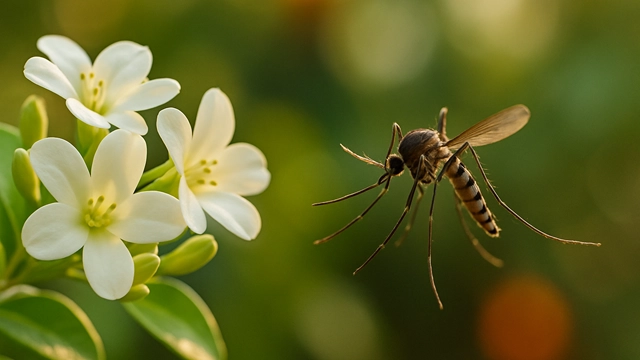
In a breakthrough from the University of Maryland, scientists have engineered a fungus to release the aroma of flowers—specifically the natural compound longifolene—to draw mosquitoes closer. Once they land, the fungus infects them, spreads through their tissues, and kills them. A simple fragrance becomes a deadly invitation.
This is not chemical warfare.
It is biological choreography.

A Fungus That Smells Like Flowers
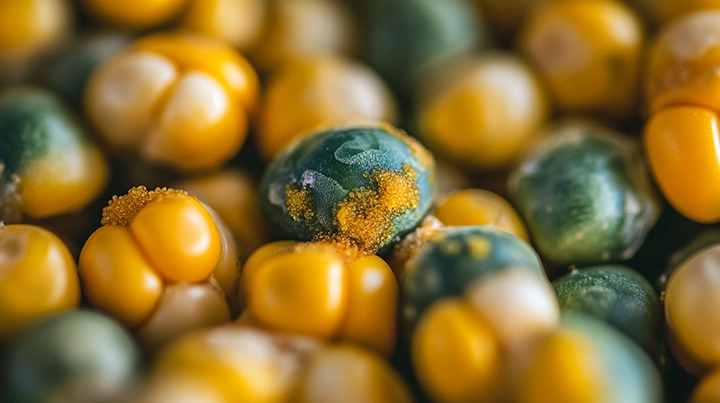
The research is built on Metarhizium, a soil fungus long known to attack insects. Normally, these fungi wait passively for an insect to touch their spores—a method effective in nature but too slow for modern mosquito-borne disease control.
The scientists asked a simple but disruptive question:
If insects love floral scents, why not teach the fungus to smell like flowers?
Using genetic engineering, the team rewired the fungus to produce longifolene, a terpene released by various flowers and trees. Mosquitoes are instinctively pulled toward it—they need nectar to survive, long before they go looking for blood.
The result is a fungus that acts like a natural perfume diffuser.
Only this perfume doesn’t attract admirers—it attracts victims.

A Kill Rate That Surprised Even the Researchers
In controlled laboratory settings, the engineered fungus achieved more than 90% mosquito kill rates within a matter of days. Even when the team introduced competing scents—human odor, plant volatiles, ambient lab smells—the insects still favored the longifolene-emitting fungus.
To a mosquito, it simply smelled like dinner.
Once a mosquito lands on the spore-coated surface, the fungus penetrates the exoskeleton, fills the body cavity, and eventually kills the insect. The mechanism isn’t new—but the efficiency is. Instead of waiting for chance contact, the fungus now calls the mosquitoes over.
The strategy flips traditional pest control on its head:
Don’t chase mosquitoes away—draw them toward their own destruction.

Safer, Cheaper, and Harder for Mosquitoes to Outsmart
The implications are significant, especially in regions struggling with dengue, Zika, and malaria.
Chemical insecticides come with a long list of problems:
- mosquitoes evolve resistance
- environmental toxicity builds up
- costs rise with each reformulated chemical
- beneficial insects often get caught in the crossfire
The engineered fungus dodges many of these pitfalls.
Because it relies on infection instead of poisoning, mosquitoes would need to evolve resistance to both the scent and the fungus. And altering metabolically essential scent pathways often comes with biological trade-offs that weaken the mosquito.
In other words:
Evolution might not be able to save them.
The material cost is also low. Fungal spores can be grown in bulk on cheap organic substrates—sawdust, grain waste, agricultural byproducts. In areas without strong infrastructure, an attract-and-infect system could offer a powerful, low-cost alternative to synthetic pesticides.
But Does It Work Outside the Lab?
This is where things get complicated.
Mosquitoes behave differently in the real world.
Wind, humidity, heat gradients, competing scents, vegetation, and local species traits can shift their movement patterns drastically.
A floral-scented fungus in a rainforest might perform very differently than in an urban alleyway.
There is also the ecological question:
What happens when modified fungi spread outdoors?
Although Metarhizium naturally infects insects, adding a scent-diffusion system means its ecological interactions may change. Regulatory agencies will want answers to questions about long-term stability, non-target effects, persistence in soil, and how far its fragrance plume can travel.
The researchers themselves acknowledge that field trials—not lab trials—will determine whether this approach becomes a revolution or a laboratory curiosity.
And then there’s the public perception problem.
People are famously uneasy about “genetically engineered” anything, especially when combined with the words “fungus” and “released into the environment.”
Still, history shows that many life-saving technologies begin exactly this way: bold, slightly uncomfortable, and scientifically sound.

The Future of Mosquito Control May Smell Like a Garden
If the technology scales, entire neighborhoods might one day deploy small, scent-emitting fungal stations—quiet, passive, low-energy devices that mosquitoes mistake for nectar sources. Gardens, forests, and wetlands would no longer be battlegrounds of chemicals, but carefully managed biological systems.
It represents a shift from fighting nature to outsmarting it.
Mosquitoes follow their noses.
And now, their noses may lead them to their end.
References
Academic
- Lovett, B., & St. Leger, R. J. (2017). “Genetically engineering Metarhizium fungi to enhance insect control.” Nature Biotechnology. DOI: 10.1038/nbt.3972
- Fang, W., & St Leger, R. J. (2012). “Enhanced insecticidal activity of fungal pathogens engineered to express scorpion toxins.” PLoS Pathogens. DOI: 10.1371/journal.ppat.1002645
Official Sources
- WHO — Malaria: https://www.who.int/news-room/fact-sheets/detail/malaria
- CDC — Dengue: https://www.cdc.gov/dengue
- CDC — Zika virus: https://www.cdc.gov/zika