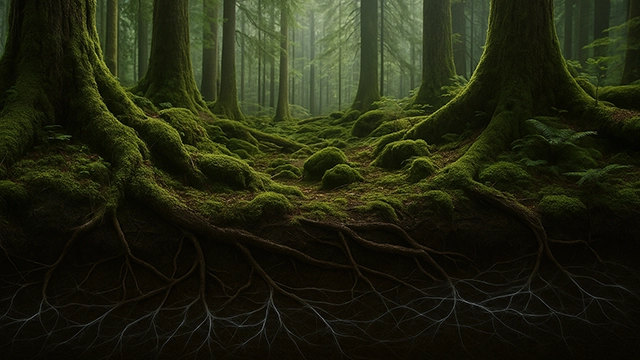
For years, the idea of trees sharing secrets through underground fungal networks—popularly dubbed the “Wood Wide Web”—captivated public imagination. Trees, it was thought, passed along nutrients and danger signals to neighboring kin via this mycorrhizal network. But a new wave of ecological research suggests we may have been giving too much credit to the plants. The true orchestrators of these underground exchanges might actually be the fungi themselves.
Fungi in Command
Emerging evidence reveals that mycorrhizal fungi aren’t simply acting as silent conduits. Instead, they appear to be active agents: detecting changes in their plant partners, interpreting those signals, and relaying biochemical alerts throughout their network. In this model, fungi become more than network cables—they’re more like central processors, managing ecosystem dynamics in real time.

A Self-Serving Underground Strategy
In a series of experiments simulating pest attacks on certain host plants, scientists observed nearby, uninjured plants connected by the same fungal network activating their defense responses—even without direct signaling from the afflicted plant. This suggests that the fungi themselves detected the stress and took it upon themselves to warn the rest. Why? Because their survival depends on the health of the community. Fungi draw carbon from photosynthesizing plants; if a host falls to disease or herbivory, the fungus risks losing its energy source.
Plants as Clients, Not Collaborators
While it may sound cooperative, the dynamic is transactional. From an evolutionary standpoint, plants gain little by warning competitors of danger. Fungi, on the other hand, benefit from maintaining as many viable partners as possible. This positions them more like brokers in an underground economy—investing energy and alerts in the parts of the network that keep their own system running.

A Paradigm Shift for Forest Ecology
This reframing of forest communication has broad implications. If fungi are the real decision-makers underground, then forest health, biodiversity, and resilience may depend more on fungal activity than previously thought. It encourages conservationists and land managers to consider fungal networks as keystone infrastructure—capable not only of sustaining but coordinating life aboveground.

Conclusion: The Forest Doesn’t Whisper—It Listens
The old metaphor of trees whispering in the dark now seems quaint. Instead, what we are beginning to understand is that forests function thanks to a fungal surveillance system, one that senses danger, calculates risk, and deploys protective strategies across plant communities. The forest doesn’t talk. The network listens—and then it acts.

References
- Simard, S. et al. (2012). Mycorrhizal networks: Mechanisms, ecology and modelling. Fungal Biology Reviews.DOI:10.1016/j.fbr.2012.07.001
- Karst J, Jones MD, Hoeksema JD. (2023). The “Wood Wide Web”: debunking a popular metaphor. Nature Ecology & Evolution. DOI:10.1038/s41559-023-01986-1
- USDA Forest Service. Mycorrhizal Fungi and Forest Health. USDA