I. Where Sweetness Meets Decay
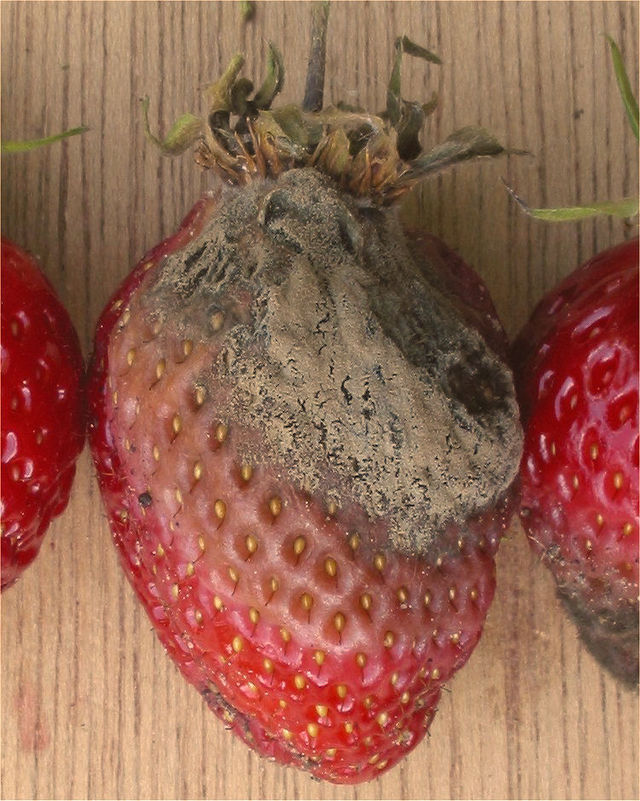
There’s a moment every grower dreads. A crate of perfect strawberries leaves the farm glowing red and alive — and by the time it reaches the shelf, gray fuzz blooms across their surface like ash after a quiet fire.
That’s Botrytis cinerea, the gray mold fungus. It doesn’t roar in; it whispers, colonizing fruit silently during transport, feeding on the softness that makes them so appealing in the first place.
For decades, the response has been chemical — layers of fungicides meant to stop decay before it starts. Yet the fungus adapts faster than the rules can change.
But in one of those small, poetic turns that science loves, researchers have found a potential answer in a familiar place: the world of flavor itself.
The molecule is called 3-methyl pentanoic acid (3MP). To food chemists, it’s a flavor enhancer. To fungi, it might be a molecular saboteur.
II. A Molecule with a Double Life
3MP isn’t exotic. It already exists in the toolkit of the food industry — a short-chain fatty acid known for its fruity, slightly cheesy aroma, found in everything from beverages to processed dairy.
But when scientists introduced it to cultures of B. cinerea, something remarkable happened: the fungus simply stopped growing.
In controlled trials, 3MP:
- Inhibited spore germination and mycelial expansion, halting gray mold at its earliest stage.
- Prevented germ tube elongation, blocking the physical invasion process that lets fungi penetrate plant tissue.
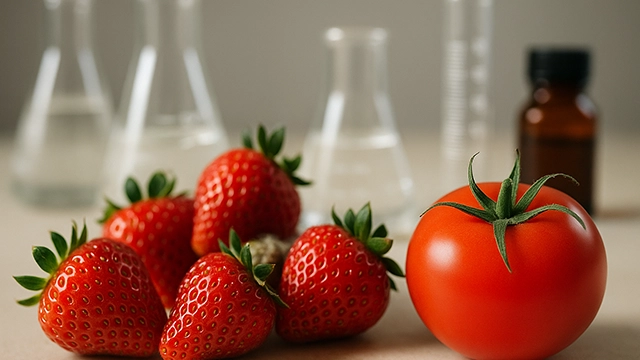
- Protected real fruit — strawberries and tomatoes — at concentrations as low as 12 μL/L, keeping them mold-free without any synthetic fungicide support.
These aren’t “preliminary” hints. These are controlled, measurable outcomes. For the first time, a compound designed for taste is proving itself as a postharvest shield.

III. The Science of Sabotage
3MP doesn’t kill in the crude sense. It disables.
At the cellular level, the compound disrupts membrane integrity, leaving fungal cells leaky and unable to regulate themselves. Under fluorescence microscopy, treated spores glow with the unmistakable signal of death — not explosive, but methodical.
Dig deeper, and the story becomes molecular. The study revealed two major systems inside B. cinerea that collapse under 3MP exposure:
- Cell Wall Integrity (CWI) pathway — a vital network maintaining fungal structure. The key gene Chs1, responsible for chitin synthesis, is sharply suppressed.
- MAPK signaling cascade — the fungus’s internal communication grid, managing stress and pathogenic behavior. Genes like Bmp1, Bmp3, and Sak1 go silent.
Think of MAPK as the fungal nervous system — a set of switches that help it sense, decide, and adapt. When 3MP turns off those switches, the organism doesn’t just weaken. It forgets how to survive.

IV. Smart Biofungicides: The Next Chapter
The term biofungicide often conjures images of vague natural extracts or essential oils whose activity depends on luck more than logic. 3MP changes that narrative.
It’s a defined molecule with a clear mechanism, measurable targets, and a regulatory head start thanks to its existing role in food systems.
This makes 3MP part of an emerging class of smart biofungicides — compounds that combine biological safety with pharmaceutical precision.
Real-world implications follow naturally:
- Cleaner labels: No synthetic residues or hidden chemicals.
- Reduced cold-chain dependence: Fruits can last longer at ambient temperatures.
- Lower resistance risk: By targeting both membranes and gene regulation, 3MP gives fungi no simple evolutionary escape route.
It’s not about adding another layer of protection — it’s about rewriting what “protection” means in a world where food waste and chemical overload can no longer coexist.
V. Between Flavor and Function
There’s something poetic about this molecule’s dual identity. For years, 3MP’s job was to make food taste alive; now it might also keep it literally alive.
It reminds us that the boundary between chemistry and biology — between pleasure and protection — is thinner than we imagine. A molecule doesn’t know whether it was designed for taste or defense. It only reacts, interacts, and reveals its character under the right microscope.
And maybe that’s the real lesson here: the solutions to our most persistent problems often hide in familiar compounds, waiting for us to ask a different question.
What if flavor could fight decay?
What if safety could be molecular, not mechanical?
Those questions aren’t just scientific curiosities. They’re cultural ones — the kind that reshape how we define “natural,” “safe,” and “sustainable.”

VI. Donna’s Reflection: A New Language of Freshness
I’ve spent enough time in labs to know that discovery rarely feels cinematic. It smells of agar plates and burnt electrodes, not victory. But this story — the flavor that turned fighter — feels different.
The researchers behind 3MP aren’t just finding another antifungal. They’re writing a new grammar of freshness — one where microbial intelligence meets molecular empathy.
Still, the questions ahead are real:
- Can 3MP remain stable across weeks of transport and fluctuating humidity?
- Can it work beyond strawberries — on apples, grapes, or ornamental plants?
- Can its activity be integrated into edible coatings or mist systems suited to large-scale logistics?
Those are challenges worth pursuing. Because if the molecule holds, it could redefine postharvest protection — from reactive chemistry to anticipatory design.
And if that happens, maybe one day we’ll look at a tray of strawberries and see not a race against decay, but a quiet alliance between nature’s sweetness and science’s restraint.
After all, the best defenses don’t always roar.
Sometimes, they taste faintly of fruit.
In a world tired of trade-offs between safety and shelf life, maybe this is what innovation looks like now:
a hint of acid, a little science, and a fruit that lasts just long enough to be remembered.