Beneath the Canopy: The Forest’s Hidden Marketplace
A walk through any temperate forest feels serene, even timeless. Yet, beneath your feet, an invisible network pulses with exchanges more intricate than any stock market. Here, trees are not solitary titans, but participants in a vast and ancient marketplace—a living economy in which the currency is carbon and the toll collectors are fungi.
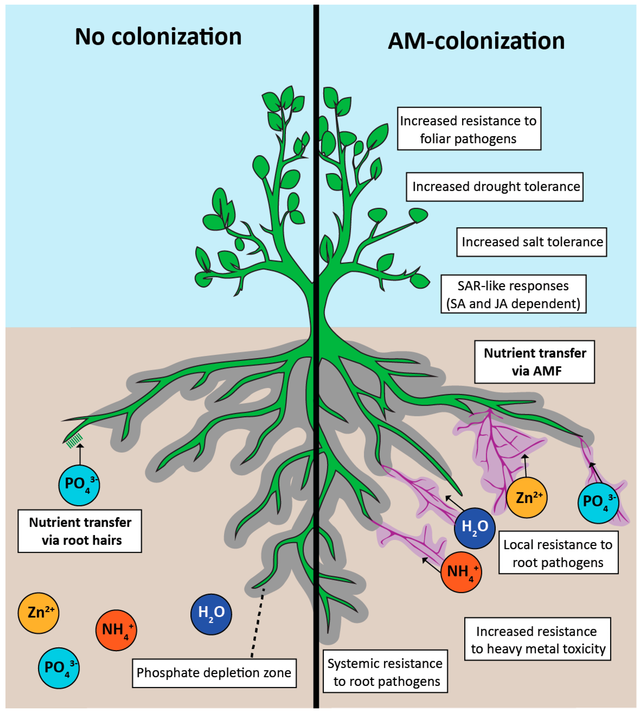
Through their roots, trees trade sugars and other photosynthates—precious carbon captured from sunlight—with mycorrhizal fungi. In return, these fungi extend their hyphae outward, exploring the soil for elusive nutrients and water, reaching places roots cannot go. But this partnership is far from free. New research by Siya Shao and colleagues (2025) finally quantifies the true cost—and reveals how the underground economy is shifting under the pressures of a changing planet.

The Cost of Cooperation: Quantifying the Fungal Tax
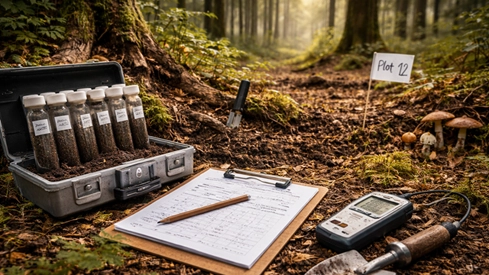
The team’s research employed the Myco-CORPSE model, which stands for Mycorrhizal Carbon, Organic matter, Rhizosphere Processes and Soil Ecology. Scientists tracked the carbon flows between trees and fungi across more than 1,800 forest plots in the eastern United States. The findings confirm what ecologists long suspected: feeding fungi is expensive, and the price tag is anything but trivial.
In ECM forests—those populated by oaks, beeches, and conifers—about sixteen percent of net primary production, the carbon available for growth and storage, goes to supporting fungal partners. This substantial “tax” underscores just how much trees depend on the extended reach and specialized skills of their underground allies. In contrast, AM forests, dominated by maples and many herbaceous plants, pay a smaller share of their productivity—just under six percent. Even more intriguing are mixed forests, where both ECM and AM fungi are present. Here, the costs are distributed more evenly, and the overall investment is lower, demonstrating the power of fungal diversity in balancing the ecological books.
This carbon tax isn’t just an ecological curiosity—it can influence how much carbon a forest can store, how quickly it grows, and even how well it weathers storms, droughts, and disease. In a world searching for ways to maximize carbon sequestration, understanding these transactions is critical.
Modeling the Root–Fungus Economy
What makes the Myco-CORPSE model unique is its ability to simulate both carbon and nitrogen cycling. Unlike simpler models that track only biomass, Myco-CORPSE includes the subtle interplay of nutrient flows, organic matter turnover, and root exudation. It’s as if researchers have built an underground economic simulator, where every nutrient pulse and fungal negotiation can be tracked, measured, and projected into the future.
Validation in the field—matching the model against real-world data from over 1,800 sites—confirms its accuracy. This rare congruence between simulation and observation marks a breakthrough for underground ecology, where so much remains hidden from direct view.
Global Change Rewrites the Underground Contract
So what happens when the world aboveground is thrown into flux? The Myco-CORPSE team modeled several “global change drivers,” including elevated nitrogen (from pollution or fertilizer), warmer temperatures, and rising atmospheric CO₂, and found the impacts to be profound and varied.
When nitrogen is abundant—whether through pollution or fertilization—trees can often bypass their fungal partners for nutrients, and the carbon tax drops, especially in ECM forests. AM fungi, already less expensive, become even more favored in these conditions. Warming soils speed up microbial activity and nutrient cycling, making nutrients more readily available, so trees can afford to pay less to fungi. Again, AM-dominated systems benefit from this shift.
The real twist comes with elevated CO₂. Rapid tree growth, fueled by abundant carbon, increases demand for nitrogen. Trees in this scenario are pushed to rely more heavily on ECM fungi, which are capable of unlocking organic nitrogen sources otherwise unavailable. As a result, the carbon cost to maintain these partnerships rises. Mixed forests, however, fare best in the face of these global changes, using their diversity of fungal strategies to buffer environmental swings and maintain greater resilience.

Winners, Losers, and the Future Forest
These findings suggest profound implications for the future of forests, climate resilience, and carbon storage. Forests that pay less to fungi might grow faster and absorb more carbon, but only if soil nutrients remain sufficient. If nutrient availability can’t keep up, growth will stagnate, regardless of the fungal partnership. The shift in fungal strategies also affects how forests cope with heat, drought, and other stressors. AM-dominated forests may expand in some regions, while ECM systems could decline as their higher “fee” becomes less competitive.
The composition of tomorrow’s forests—the species of trees, their growth rates, and the services they provide—may be shaped by these changing underground economics. Some trees, adapted to work with specific fungal partners, may thrive or decline depending on how well those partnerships fit the new environmental realities. These dynamics will shape not only forest productivity but also biodiversity, wildlife habitats, and even the stability of the global carbon budget.

From Mold to Mycorrhizae: Fungi as Carbon Gatekeepers
At MoldNewsHub, the fungal story often focuses on their roles as invaders—molds fouling air, crops, or buildings. But here, fungi are infrastructure, quietly governing the largest carbon sink on land. They don’t merely decompose old wood or colonize forgotten corners; they regulate how much carbon forests can keep locked away and how deeply nutrients flow into the biosphere.
This new lens reframes fungi as active agents in Earth’s climate system—a network of toll booths deciding just how fast carbon moves from atmosphere to soil and back again.
Teslo’s Final Reflection
Beneath every forest, the carbon economy is constantly renegotiated. Trees invest, fungi collect, and the terms change with every degree of warming, every pulse of nitrogen, every shift in atmospheric CO₂. In the 21st century, understanding these “root deals” is as important as any aboveground policy.
If the planet’s carbon future hinges on forests, then forests depend on their invisible fungal financiers. The question now is: in an age of climate volatility, can we manage or at least predict the ever-shifting price of this most ancient contract?
References
Academic sources
Shao, S., et al. (2025). Carbon allocation to mycorrhizal fungi under global change: Insights from the Myco-CORPSE model. Nature Climate Change.
Official / institutional sources
Intergovernmental Panel on Climate Change (IPCC). Climate Change and Land. https://www.ipcc.ch/srccl/
National Aeronautics and Space Administration (NASA). The carbon cycle. https://climate.nasa.gov/