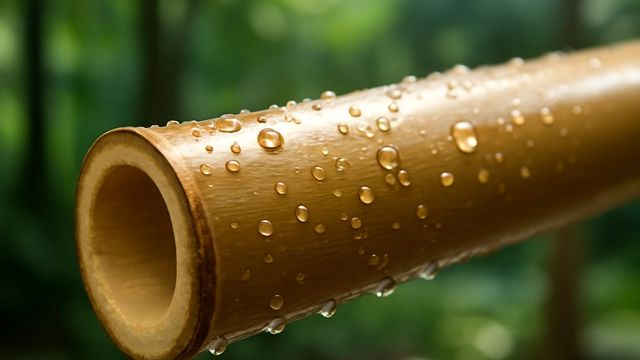
No more leaching chemicals or biodegradable dreams cut short—scientists have biohacked bamboo with enzyme-anchored essential oils, unlocking a new era of sustainable mold resistance.

From Green Beauty to Fungal Vulnerability
Bamboo is the darling of sustainable design. Fast-growing, self-regenerating, and elegantly simple, it promises an ecological alternative to timber in architecture, furniture, and infrastructure. But there’s a catch: nature’s most renewable stem is also one of the most mold-prone, particularly when used in the round—outer skin intact, structure untouched.
That outer layer, known as bamboo green, is paradoxically both its armor and its Achilles’ heel. Rich in silica and phenolic compounds, it’s exposed to moisture and fungi in every outdoor application—from garden fences to tropical eco-homes. And in humid climates, bamboo’s charm can rapidly decay into a biodegradable liability.
Traditionally, builders turned to synthetic biocides and heavy-metal treatments to fend off fungal decay. But as regulatory walls close in and the public demands cleaner, safer materials, the search for a bio-based antifungal strategy has reached a fever pitch. Now, a team of researchers has delivered one—by growing the solution directly into the material.
The Dual Enzyme Strategy That Changed Everything
The breakthrough? A two-step, bio-inspired treatment that transforms round bamboo into a mold-resistant champion—without compromising its natural aesthetic or ecological integrity.
Step 1: Open the Door
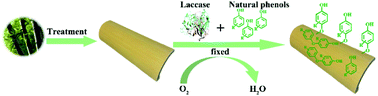
First, the bamboo is treated with dilute acid hydrothermal pretreatment—a gentle wash in 1% hydrochloric acid, followed by heat. This unlocks the bamboo’s tightly packed fibers, making the surface more chemically accessible. Think of it as loosening the zipper on a tightly closed jacket.
Step 2: Lock It In
Next comes the star of the show: laccase, a naturally occurring oxidative enzyme. When combined with thymol—an antifungal compound extracted from thyme essential oil—laccase catalyzes a reaction that grafts thymol molecules directly onto the bamboo’s phenolic sites.
The result is a molecular handshake. Thymol, which usually washes off with rain, now holds fast like a vine clinging to a trellis. And just like that, bamboo’s greatest vulnerability becomes its bio-shield.
Mold Resistance You Can Measure
In controlled lab tests, the newly modified bamboo—dubbed HPLT-Bamboo—was put to the test in high humidity environments for 30 days, simulating tropical exposure. The untreated samples quickly developed visible mold. HPLT-Bamboo? Zero growth. Not even a spore.
But that’s not all. The surface of treated bamboo became dramatically more hydrophobic, reaching a water contact angle of 101.01°. That means water beads up and rolls off, denying fungi the moisture they need to colonize.
In simpler terms: no wet surface, no fungal foothold.

Why Bamboo Green Is the Key
Here’s where it gets even more elegant. The very layer most vulnerable to mold—the bamboo green—also turned out to be the most reactive in the enzymatic bonding process. Rich in silica and natural phenols, it serves as a fertile ground for laccase-thymol polymerization.
That means we don’t have to strip the outer layer or process the bamboo into engineered panels. We can use the natural form—round, intact bamboo—and make it mold-resistant without sacrificing strength or character.
It’s not just a new treatment. It’s a new preservation philosophy.
What This Means for Green Building
In an industry increasingly judged by carbon footprints and health risks, this innovation answers a long list of unsolved challenges:
- No synthetic biocides or metal salts
- No toxic solvents or high-energy production
- No aesthetic compromise
- Yes to durability, bio-compatibility, and scale-up potential
This isn’t a lab curiosity. It’s a prototype for climate-conscious construction materials—especially for projects that embrace circular bioeconomy values.

Broader Implications: The Enzymatic Future of Materials
If laccase can anchor thymol to bamboo, what else can it do?
The study hints at a future where bio-sourced antifungal agents are grafted onto natural surfaces across a wide material spectrum—rattan, cork, palmwood, even mycelium composites.
Enzymes like laccase work under mild conditions, don’t require complex equipment, and come from fungi themselves—a poetic inversion, where the very kingdom that causes decay now prevents it.
This could pave the way for:
- Edible packaging with antifungal surfaces
- Biodegradable textiles resistant to mold
- Food-safe cutting boards with embedded plant-derived antimicrobials
It’s not just anti-mold. It’s post-mold thinking—rethinking how we collaborate with biology to build, protect, and regenerate.
The MoldNews Verdict
“This isn’t bamboo treated like plastic—it’s bamboo defended by biology.”
This innovation sits at the intersection of bio-inspired engineering, green chemistry, and material ethics. It acknowledges the vulnerability of organic materials—but doesn’t coat them in petrochemical armor. Instead, it enhances their defense systems using tools from the forest floor, not the refinery.
In an era of rising humidity, tighter regulations, and growing ecological urgency, the mold-proof building material of tomorrow won’t be synthetic—it will be symbiotic.
And if that material happens to be round, golden, and held together by thyme-scented molecular bonds? Even better.