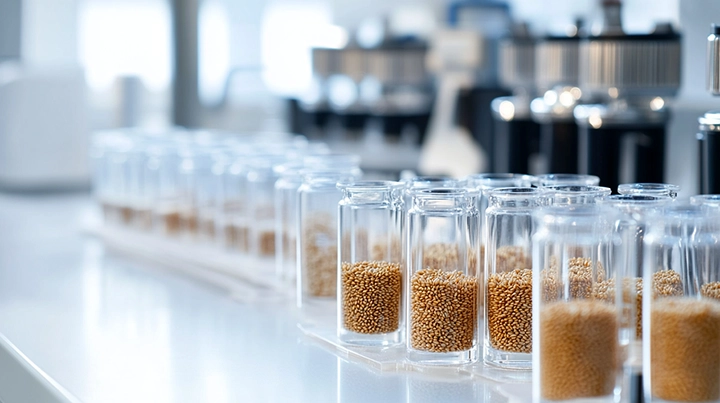
Invisible Risks in the Global Food Chain
Mycotoxins are an ongoing, invisible threat in food systems around the world. Produced by fungi such as Aspergillus, Fusarium, and Penicillium, these toxic compounds contaminate nearly 25% of the global food supply. They often remain undetected in grains, nuts, spices, and dairy products—resistant to heat and processing, and capable of causing a wide range of health effects, including liver cancer, immune suppression, and growth stunting in children.
Traditional detection methods, such as LC-MS/MS and HPLC, remain the gold standard in terms of accuracy. However, they require laboratory infrastructure, trained personnel, and hours or days to deliver results. In today’s fast-paced, international food trade environment, the need for rapid, portable, and reliable detection methods has never been greater.

Smaller Tools, Faster Results
Recent developments in biosensors, aptamer-based assays, and nanomaterial-enhanced devices are reshaping how and where mycotoxins are detected. These tools are designed to bring lab-grade detection to the point of need—whether that’s a farm gate, a shipping dock, or a food processing plant.
Immunoassays, like lateral flow strips and ELISA kits, have been widely adopted for their ease of use. They’re cost-effective, require minimal training, and can provide results within minutes. However, they can suffer from lower sensitivity and specificity, particularly when applied to complex food matrices.
Aptamer-based sensors offer a next-generation solution. Aptamers are short strands of DNA or RNA engineered to bind to specific mycotoxins with high precision. Unlike antibodies used in immunoassays, aptamers are more stable, easier to produce, and can be customized to target emerging toxins.
Biosensors integrate biological recognition elements with electronic or optical transducers. This combination allows them to convert molecular interactions into measurable signals. The result? Quick, portable detection platforms that deliver digital readouts, often in real time.

Nanomaterials: Amplifying the Signal
Nanotechnology plays a central role in improving detection sensitivity and accuracy. Materials like gold nanoparticles, carbon nanotubes, and magnetic beads are now commonly used in sensor platforms.
A standout technique is Surface-Enhanced Raman Scattering (SERS). By coating surfaces with metallic nanostructures, SERS can detect even trace levels of mycotoxins by amplifying their unique molecular signals. This method shows promise for high-sensitivity field tests, especially when paired with handheld devices.
Why This Matters Now
Global food supply chains are growing more complex, and climate change is expanding the geographical range of fungi that produce mycotoxins. Regions previously unaffected by certain toxins are now seeing increased contamination risks.
Portable biosensors and aptamer-based assays are already being tested in real-world conditions. For example, handheld mycotoxin detectors are under evaluation for use in grain silos, warehouses, and food markets across Asia and Africa. These tools can allow faster decision-making, reduce post-harvest losses, and help smallholder farmers meet export standards.

Practical Applications and Next Steps
The transition from lab to field isn’t just technical—it requires regulatory, industrial, and public health engagement. To scale up adoption:
- Regulatory bodies will need to evaluate and validate portable test kits against established standards.
- Food manufacturers can integrate these sensors at critical control points to enhance quality assurance.
- Exporters and traders may use on-site testing to prevent cross-border rejections.
- Governments and NGOs could support distribution of low-cost, easy-to-use kits in vulnerable regions.
Looking ahead, researchers are developing smart platforms that connect biosensors to cloud-based systems. This would enable real-time toxin surveillance across supply chains—from farm to table. Integration with blockchain and QR code-based labeling may also support consumer-facing transparency.
Conclusion: Toward a Safer, Smarter Food Future
Detecting mycotoxins no longer needs to be slow or inaccessible. With advances in aptamers, nanotech, and portable biosensors, food safety testing is becoming faster, smarter, and more responsive to global challenges. These tools won’t replace lab tests entirely, but they provide an essential frontline defense.
As technology continues to mature, the key challenge lies not just in innovation, but in implementation. Widespread access, affordable pricing, and public-private collaboration will determine how quickly we can close the gap between contamination and detection—and ultimately, protect global food security.

References
- Frontiers in Microbiology. (2019). Rapid immunoassays for mycotoxin detection. Frontiers