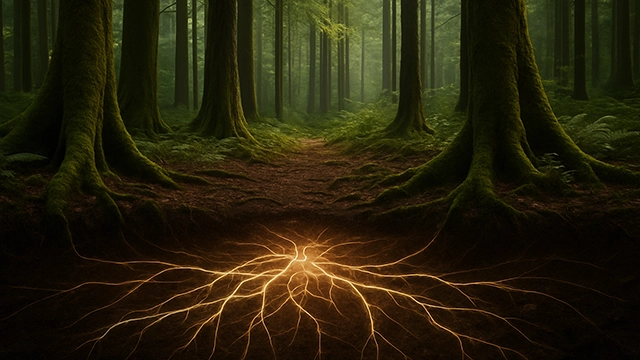
They don’t grow leaves. They don’t bask in sunlight. And unless you’re digging in the dirt, you’ll never lay eyes on them. But make no mistake—without these silent operators, Earth’s ecosystems would collapse like a ruined temple.
We’re talking about mycorrhizal fungi: microscopic powerhouses that form underground alliances with nearly every plant on Earth. And now, for the first time in history, scientists have mapped them across the globe. What they’ve found should shake the dust off every conservation plan on the planet.
A Fungal Treasure Map, 2.8 Billion Sequences Deep
In a scientific feat worthy of a fedora and whip, an international team trained machine learning algorithms on over 25,000 soil samples, decoding 2.8 billion fungal DNA sequences. Their mission: chart the strongholds of two major mycorrhizal groups—arbuscular mycorrhizal fungi and ectomycorrhizal fungi—that partner with roots to feed forests, grasslands, and crops.
The result? A first-of-its-kind global map showing exactly where these essential fungi thrive. Biodiversity hotspots. Functional strongholds. Hidden networks keeping ecosystems glued together from below.

And Here’s the Twist: We’re Not Protecting Them
The maps revealed a gut-punch of a fact: less than 10% of the world’s mycorrhizal hotspots are inside protected areas. That means the very fungal networks that regulate carbon, nitrogen, and phosphorus flows—those that keep plants fed, soils alive, and climate systems stable—are exposed. Vulnerable. Forgotten.
We’re guarding the canopy, but not the underground cathedral that holds it up.

Not Just Decomposers—These Are Ecological Engineers
Mycorrhizal fungi are more than soil sidekicks. They’re the biochemical diplomats of ecosystems—trading nutrients, shielding plants from drought, and potentially locking away carbon in the soil for centuries. In a warming, weather-whiplashed world, their services are priceless.
And yet, conservation efforts have overlooked them for decades. They weren’t pretty enough. Not visible enough. Not loud enough. Until now.

From Data to Boots-on-the-Ground Action
This isn’t just a pretty map to hang in a lab. It’s a toolkit. With these data, land managers and policymakers can:
- Target restoration zones where fungi still flourish
- Flag ecologically rich soil zones for immediate protection
- Detect shifts in fungal diversity as early warning signs of collapse
- Plan conservation like fungi matter—because they do
It’s time we updated our idea of biodiversity. The fungal frontier is open, mapped, and long overdue for a place in the spotlight.

Final Thought: This Is the Relic Worth Saving
We chase ancient bones and buried gold, but the real treasure has always been here—threaded through the soil, quietly holding life together. Mycorrhizal fungi aren’t just part of the story. They’re the root of it.
And now that we know where they are, we have no excuse not to act. Because ecosystems don’t begin above ground. They begin below it—with networks that, if protected, just might carry us into a livable future.
So here’s your map. The rest? That’s up to us.

References
- Tedersoo L. et al. (2014). Global diversity and geography of soil fungi. Science. DOI:10.1126/science.1256688
- IPCC. Climate Change and Ecosystems. IPCC