The Quietest Plants Hold the Loudest Secrets
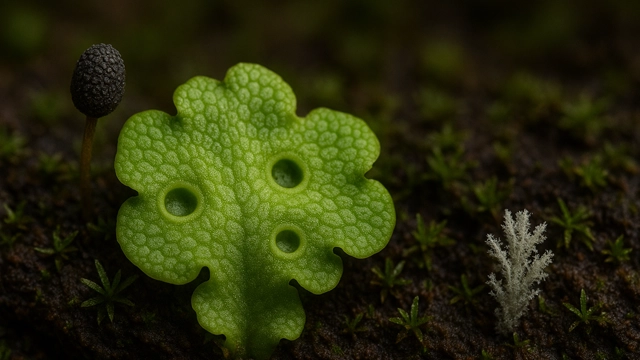
Walk through any forest and your eyes are drawn upward — to trunks, branches, the sway of leaves. But the real story, the intimate one, is happening much closer to the forest floor. That’s where the liverworts lie: thin, flat, and quietly ancient. And inside these humble bryophytes, researchers have now uncovered a microbiome so vibrant it feels like opening a treasure chest disguised as a houseplant.
In the tissues of Plagiochasma appendiculatum, a small liverwort native to India, scientists found 17 endophytic fungal species tucked away like secrets. One of them, astonishingly, has never before been recorded as an endophyte in any plant known to science.
Small plant.
Tiny leaves.
Huge microbial personality.

A Forest of Fungi Inside a Single Leaf
Endophytes — fungi that live inside plants without harming them — are like quiet houseguests who improve the home simply by being there.
In this study, some familiar fungal “regulars” appeared, including Aspergillus niger, Fusarium oxysporum, and Trichoderma asperellum. These are species well known for their skills in industry, agriculture, and environmental work.
But the most enchanting part wasn’t the familiar faces. It was the newcomer — a species that made its scientific debut as if stepping onto a stage with no warning, yet ready for the spotlight.

Meet the Unexpected Guest: Pyrenopolyporus tonngachangensis
This fungus, belonging to the order Xylariales, emerged as the liverwort’s dominant resident. But dominance wasn’t its only surprise.
When researchers tested its antibacterial potential, the results were nothing short of remarkable. This newcomer proved capable of stopping both Gram-positive and Gram-negative bacteria, suggesting chemical abilities as refined as any top-tier antibiotic candidate.
It’s rare for a fungus to make such a dramatic entrance into science — rarer still for its first impression to say, “Oh, by the way, I can fight pathogens better than some of your current drugs.”
That’s not just novelty. That’s a mic-drop moment.

Enzymes That Could Power Industries
The team didn’t stop at cataloging species. They evaluated what these fungi could do — and darling, that’s where the liverwort’s inner world began to glow.
Some endophytes, especially Aspergillus niger and Daldinia korfii, produced a sophisticated collection of extracellular enzymes. These included:
- amylases (break down starches)
- cellulases (digest plant fibers)
- lipases (break down fats)
- L-asparaginase (used in leukemia treatment)
- lignin-degrading enzymes important for biofuel production
In other words, inside a single moss-like plant, researchers found fungi that could revolutionize food processing, bioenergy, pharmaceutical development, and even environmental cleanup.
The liverwort wasn’t just hosting microbes — it was nurturing a miniature industrial ecosystem.

The Antibacterial Arsenal: Stronger Than Expected
What truly elevates this study into the realm of “remember this in 10 years” is the antibacterial testing.
When fungal extracts were placed against pathogens like Staphylococcus aureus, E. coli, Listeria monocytogenes, and Pseudomonas aeruginosa, the inhibition zones were wide, clean, and deeply impressive.
Some species, like T. koningiospis, produced zones reaching 34 millimeters — the kind of result that makes microbiologists raise their eyebrows and lean in closer.
Not to be overshadowed, P. tonngachangensis and Aspergillus piperis also demonstrated potent antimicrobial effects, often surpassing conventional antibiotics in laboratory conditions.
And many of these antibacterial properties had never been described before. Entirely new biochemical signatures, hiding inside a patch of moss.
It’s the scientific equivalent of discovering a jazz prodigy living in your basement.

The Moss Beneath Our Feet May Be a Biotech Frontier
There’s something tender about liverworts. They’re among the oldest land plants on Earth — small, shy, unassuming. And yet, inside their modest tissues lies a pharmacological universe humming with possibility.
These fungi aren’t freeloaders. They seem to offer their host protection, resilience, and biochemical resources in exchange for a home.
This partnership matters today more than ever:
- We’re searching for new antibiotics as resistance rises.
- We’re shifting toward greener, enzyme-based industrial processes.
- We’re hunting for new bioactive molecules.
And here, in the quiet corners of a forest, the answers may already be growing.
These liverwort-associated fungi hold promise not just as curiosities, but as future tools for medicine, agriculture, and biotechnology.
And that promise is rooted not in extravagance, but in subtlety — reminding us that innovation often sprouts in overlooked places.
Why This Matters: A Donna-Style Reality Check
Every time science digs into something small — a soil grain, a flea, a fern, a fungus — we discover how wildly we’ve underestimated the natural world.
Liverworts have been around for millions of years. They’ve lived through five mass extinctions. They’ve endured droughts, floods, shifts in atmosphere, shifts in light.
Is it any wonder they keep powerful allies close?
These fungi evolved alongside their liverwort hosts, refining enzymes, developing antibacterial strategies, and honing their biochemical toolkits generation after generation.
Their abilities aren’t accidents. They’re evolutionary poems, written slowly and intentionally across millennia.
And now we have the privilege of reading them.
“Mossy roots, mighty molecules.”
This study reminds us that we’re still in the opening chapters of understanding fungal diversity.
The next big breakthrough — the new antibiotic, the new enzyme, the new bioindustrial solution — may come not from far-off expeditions or futuristic labs, but from a green, slippery patch of liverwort sitting quietly on a stone.
Sometimes the smallest organisms don’t just survive. They innovate.
References
Academic
- Singh, H. et al. (2024). “Endophytic fungal diversity in Plagiochasma appendiculatum and bioactive potential.” Mycological Progress. DOI: 10.1007/s11557-024-01999
- Strobel, G. (2018). “Endophytic fungi: a source of novel antibiotics.” Journal of Industrial Microbiology & Biotechnology. DOI: 10.1007/s10295-018-2102
- Hyde, K. D. et al. (2020). “Xylariales: biodiversity, taxonomy, and bioprospecting value.” Fungal Diversity. DOI: 10.1007/s13225-020-00443
Official Sources
- CDC — Staphylococcus aureus: https://www.cdc.gov/staphylococcus
- CDC — E. coli: https://www.cdc.gov/ecoli
- CDC — Listeria: https://www.cdc.gov/listeria
- CDC — Pseudomonas: https://www.cdc.gov/pseudomonas