From Invader to Bodyguard: The Fungus Finds a New Role
When most people think of fungi, it’s the usual suspects: mold on your bread, mildew in the shower, or the infamous Cordyceps turning ants into tiny zombies. But sometimes, nature likes to flip the script—and this new study in Scienceis a prime example. Instead of fungi as ruthless invaders, here we have them as devoted defenders, working in partnership with their insect hosts. In the wild world of stinkbugs, evolution has written a whole new plot: the fungus is now the shield.

A Living Armor, Grown on Bug Legs
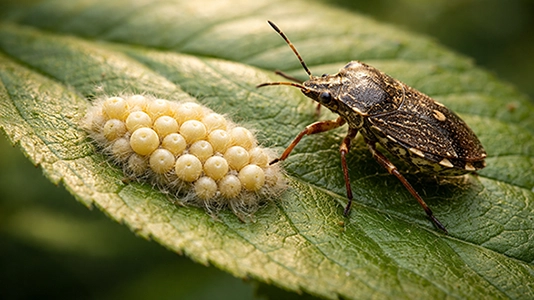
The stars of this show are female dinidorid stinkbugs, who have evolved a remarkable feature on their hindlegs: a special porous chamber, teeming with Cordycipitaceae fungi. What looks like a sound-sensing tympanum is actually a custom-built, living incubator for fungal symbionts. When it’s time to lay eggs, the female coats them with a soft brush of her leg—applying a layer of fungal hyphae directly onto the egg mass. It’s not just for show. Those growing fungal filaments create a dense barrier, stopping parasitoid wasps in their tracks and giving the next generation a fighting chance.
Most surprising of all? The fungi here are close relatives of the notorious Cordyceps, famed for their insect-killing ways. Yet in this relationship, the cordycipitaceous molds have flipped sides, trading destruction for defense.

Why This Matters: Symbiosis Gets Physical
Usually, when we talk about microbes helping their hosts, it’s all about chemistry—think toxins or antibiotics. But this is different: it’s a physical barricade. The wasp’s ovipositor can’t get through the living mat, turning the fungus into the equivalent of a high-tech security system. For the stinkbug, it’s protection; for the fungus, it’s transport, resources, and a front-row seat on the evolutionary arms race.
What’s more, the partnership isn’t exclusive. The study found multiple, low-pathogenic strains of Cordycipitaceae growing in the stinkbug’s leg chambers—demonstrating a rare flexibility in symbiosis that could help these insects adapt to changing threats and environments.

Insect–Fungus Partnerships: Nature’s Co-Evolutionary Masterpieces
This discovery is the latest in a growing trend: insects and fungi working together in creative ways. From leafcutter ants farming fungal crops, to beetles packing spores in specialized pouches, the natural world is filled with unlikely alliances. The stinkbug’s living armor is yet another reminder that evolution’s creativity knows no bounds—and that fungi can be both destroyer and defender, often in the same family tree.
For researchers, the implications go far beyond bug eggs. Understanding how insects cultivate, deploy, and even “farm” their own microbial shields could inspire new tools for agriculture, pest control, or bio-inspired materials. After all, why spray chemicals when you could have nature’s own living armor on your side?

From Field to Home: The Ubiquity of Fungal Friends (and Foes)
You might wonder—what does this have to do with indoor mold, crop disease, or the everyday fungi we track at MoldNewsHub? Plenty. The Cordycipitaceae found on stinkbug legs are close relatives of fungi that play starring roles in home air quality, food spoilage, and even medical innovation. Whether as pathogens, protectors, or producers, these molds remind us that the boundaries between “friend” and “foe” are often determined by context, not genetics.
Here’s a quick list of familiar faces and their dual roles:
Cordyceps – notorious insect pathogen, now found as a bodyguard
Beauveria – biocontrol agent in crops, related to Cordyceps
Aspergillus & Penicillium – household molds, sometimes defensive
Cladosporium & Alternaria – indoor/outdoor molds, environmental partners or problems

This story is more than a quirky headline. It’s a vivid reminder that the same molds you might scrub off a wall, or find fighting crop pests, are out there in the wild, evolving ingenious partnerships with the rest of the living world. Sometimes, they’re villains; sometimes, unexpected heroes.
So, the next time you see a stinkbug on the windowsill, imagine the microscopic world it carries on its legs—a world where fungi are both shield and sword, friend and former foe. In mycology, as in life, it pays to expect the unexpected.

References
Academic Sources
- Nishino, T., Moriyama, M., Mukai, H., Tanahashi, M., Hosokawa, T., Chang, H.-Y., Tachikawa, S., Nikoh, N., Koga, R., Kuo, C.-H., & Fukatsu, T. (2025). Defensive fungal symbiosis on insect hindlegs. Science, 390(6770), 279–283. https://doi.org/10.1126/science.adp6699
- Nishino, T., et al. (2024). Defensive fungal symbiosis on insect hindlegs (preprint). bioRxiv. https://doi.org/10.1101/2024.03.25.586038
Official Sources
- American Association for the Advancement of Science (AAAS) — Science article page: https://www.science.org/doi/10.1126/science.adp6699
- Dryad Dataset — Defensive fungal symbiosis on insect hindlegs (data repository): https://doi.org/10.5061/dryad.66t1g1kcp