The Quiet Work Behind Big Breakthroughs
Not all scientific progress arrives with headlines.
Some of the most important advances happen quietly—in controlled environments, through repeated experiments, careful measurements, and incremental understanding. A recent study represents exactly this kind of work. It does not attempt to redefine ecosystems or introduce a new technology overnight. Instead, it focuses on something more fundamental:
👉 understanding exactly how a microorganism performs under specific conditions
At first glance, this may seem narrow. But in reality, this is where biology begins to transform into engineering.

What Are Scientists Actually Measuring?
At the core of the study is a simple but powerful idea: performance.
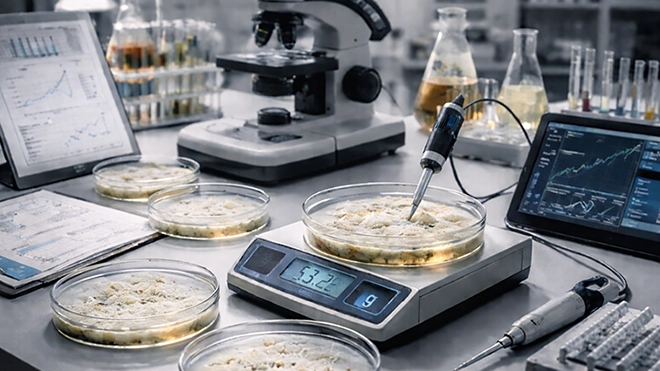
Researchers examine how a selected microorganism grows, how it processes a given substrate, and how its activity changes under controlled environmental conditions. These conditions—temperature, pH, nutrient availability, and exposure to certain compounds—are systematically adjusted to observe how the organism responds.
For example, a fungus tasked with breaking down organic material may perform efficiently at one pH level, but slow dramatically at another. By mapping these responses, scientists begin to build a detailed performance profile.
What emerges is not just observation.
It is quantification of behavior.
Why Does Measurement Matter So Much?
In microbiology, knowing that an organism can perform a function is only the beginning. What truly matters is:
how efficiently it performs
how stable the process is over time
how sensitive it is to environmental change
Without this level of detail, biological systems remain unpredictable.
With it, they become usable.
This is the critical transition:
👉 from possibility → to reliability
Measurement is what allows biology to move from curiosity to application.
Turning Growth Into Data
To achieve this, researchers rely on structured experimental designs.
They track growth curves to understand how populations expand over time. They measure activity rates to determine how quickly substances are transformed or degraded. They identify optimal conditions where performance peaks and variability is minimized.
Through this process, a living organism begins to resemble a functional system.
Not because it stops being alive—but because its behavior becomes consistent, measurable, and repeatable.
Can Fungal Behavior Be Predicted?
Prediction is the ultimate goal.
By understanding how fungi respond to controlled changes, scientists can anticipate how they will behave in different environments. This reduces uncertainty, improves reproducibility, and allows biological systems to be integrated into larger processes.
However, prediction does not mean perfect control.
Fungi remain adaptive, responsive organisms. But once their response patterns are understood, their behavior can be guided with increasing accuracy.
👉 we don’t eliminate variability
👉 we learn how to work within it
From Lab Data to Real-World Systems
While this study remains focused on laboratory conditions, its implications extend far beyond.
The data generated here becomes the foundation for:
environmental remediation systems
industrial bioprocesses
wastewater treatment technologies
sustainable manufacturing solutions
None of these applications can function reliably without first understanding how microorganisms behave under controlled conditions.
Before systems can scale, they must first be measured.
Why This Work Often Goes Unnoticed
This type of research rarely attracts attention.
It is precise, methodical, and incremental. It does not produce immediate applications or dramatic outcomes. But it plays a role that cannot be replaced.
It defines the boundaries of what is possible.
Without measurement:
systems fail unpredictably
processes lack consistency
results cannot be replicated
In other words, without this layer, biotechnology cannot function at scale.
The Transition: From Biology to Technology
What this study ultimately represents is a turning point.
Fungi are no longer just organisms to be observed. They are becoming components of designed systems—units of function within larger processes.
But that transformation depends on one critical step:
👉 turning behavior into data
Once measured, fungi can be optimized. Once optimized, they can be deployed. And once deployed, they can become part of industrial and environmental infrastructure.
❓ FAQ: Understanding Microbial Performance
What is the purpose of studying microbial growth and activity?
To understand how microorganisms behave under different conditions and how efficiently they perform specific functions.
Why are controlled conditions important?
They allow researchers to isolate variables and accurately measure how each factor affects performance.
What are growth curves?
They track how a microorganism grows over time, revealing patterns in activity and development.
Can these results be applied directly to real-world systems?
Not immediately. They provide foundational data that supports future applications.
Why is this research important?
Because it makes biological systems predictable, reliable, and usable in real-world technologies.
References
Academic Sources
Monod, J. (1949). The growth of bacterial cultures. Annual Review of Microbiology.
Madigan, M. T., et al. (2018). Brock Biology of Microorganisms. Pearson Education
Shuler, M. L., & Kargi, F. (2017). Bioprocess Engineering: Basic Concepts.
Official Sources
U.S. Environmental Protection Agency (EPA) – Bioremediation: https://www.epa.gov
World Health Organization (WHO) – Biotechnology overview: https://www.who.int