The experiment was straightforward enough. Researchers attached electrodes to a network of shiitake mycelium and passed electrical signals through it. Nothing unusual happened. Then they did it again. And again. And somewhere in the repetition, something changed.
The mycelium wasn’t responding the same way anymore. Its conductivity had shifted. The network had been altered by what had passed through it — and those alterations were shaping how it responded to what came next.
This wasn’t supposed to happen. Biological tissue isn’t meant to behave like a memory component. But that, according to recent research, is exactly what was observed.
What Mycelium Actually Is
The mushroom you see above ground is not the organism. It is the fruiting body — a temporary structure built for reproduction. The organism is beneath the surface: a vast, branching network of microscopic filaments called hyphae, collectively forming the mycelium.
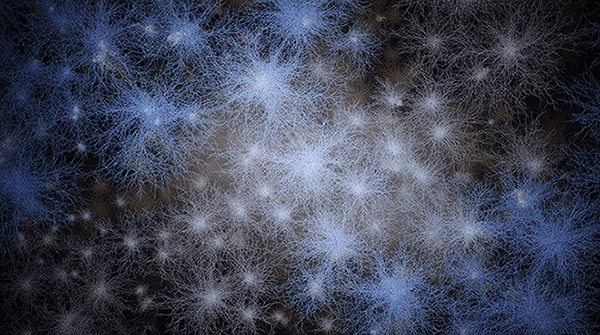
This network is not passive. It grows continuously, redirecting resources toward nutrients and away from obstacles. It responds to chemical gradients, physical contacts, and environmental shifts. It reorganizes itself. It is, in the most literal sense, a dynamic living material — one that has been doing its own form of information processing for hundreds of millions of years.
What researchers discovered is that this living material, when connected to electronic systems, can do something that no one had designed it to do.

The Memristor Comparison
In conventional electronics, there is a component called a memristor — short for memory resistor. Its defining property is simple: its resistance changes based on the history of current that has passed through it. It “remembers” what has happened to it electrically, and that memory influences how it behaves in the future.
Memristors are considered essential to neuromorphic computing — systems designed to process information the way biological brains do, through adaptive networks rather than fixed logic gates. They are difficult and expensive to manufacture at scale.
What the mycelium experiment revealed is that a cultivated biological network can exhibit behavior that closely resembles memristive function — not because it was engineered to, but because it grew that way. The electrical history of the network shapes its future responses. It retains influence from what has come before.
This is not digital memory. There are no bits, no addresses, no retrieval. But it is something: a material that changes through use, and whose changes persist.
Neither Electronics Nor Biology Alone
This places mycelium in a category that existing frameworks don’t quite capture. It is not a circuit. It is not simply a biological specimen. It exists at an interface — a living material that responds to electrical stimulation in ways that are functionally relevant to computing.
As a material, it offers properties that traditional electronics cannot easily replicate. It self-assembles. It grows with minimal energy input using organic substrates — agricultural waste, in many experimental setups. Its architecture is intrinsically networked, branching in ways that naturally resemble neural connectivity. And it adapts rather than maintaining a fixed state.
The challenges that come with these properties are equally real. Biological systems are variable. The responses of one mycelium network may not exactly match another. Temperature, moisture, age, and substrate composition all affect behavior. Precision control — the kind that electronics engineers depend on — is fundamentally harder when the component is alive.
What Sustainability Has to Do With It
The environmental dimension of this research is not incidental. It is part of why the field is attracting attention beyond pure computing science.
Conventional electronics manufacturing depends on rare earth elements, energy-intensive processing, and supply chains that carry significant environmental costs. The production of a single semiconductor chip involves dozens of chemical processes, vast amounts of water, and materials extracted from a small number of locations globally.
Mycelium can be grown on waste. It requires no mining. Its cultivation produces minimal toxic byproduct. And when a mycelium-based component reaches the end of its useful life, it is, in principle, biodegradable.
This is not yet a realized alternative — the research is too early for that. But it points toward a possible future in which some computing functions are handled by materials that grow rather than materials that are built.
What Neuromorphic Computing Needs
The field of neuromorphic computing is built on a core insight: the human brain processes information far more efficiently than any silicon system, using a fraction of the energy. Understanding and replicating that efficiency has been a central goal of computing research for decades.
The brain’s efficiency comes partly from its architecture — massively parallel, adaptive, fault-tolerant — and partly from the nature of its components, which change based on use. Synaptic connections strengthen or weaken depending on activity patterns. Memory and processing are not separated.
Mycelium reflects some of these properties without being engineered to. Its branching structure is inherently parallel. Its electrical behavior adapts with use. These are not the same as neural function, and no serious researcher is claiming otherwise. But they represent a biological analog that is worth studying — a proof of concept that adaptable, history-sensitive electrical behavior can emerge in living materials.

What This Is, and What It Isn’t
The research is at an early stage. There is no mycelium-based memory chip. There is no prototype device ready for deployment. What exists is a demonstration that the phenomenon is real — that a cultivated biological network can exhibit electrical behavior that has functional similarities to components used in advanced computing.
The path from that observation to practical technology is long and uncertain. Stability, scalability, and integration with existing systems are all open problems. It is entirely possible that mycelium will remain an experimental curiosity, useful for understanding biological computation but never integrated into actual devices.
It is also possible that it represents the beginning of something. The history of computing is full of materials and phenomena that seemed too strange or too variable to be useful — until they weren’t.
A Different Kind of Memory
There is something worth pausing on in what this research describes. Memory, in computing, has always meant precision — exact storage, exact retrieval, no drift. The mycelium offers something different: a record that is imprecise, adaptive, and shaped by accumulated experience.
That is not how computers work. But it is, in some respects, how organisms do.
The possibility being explored here is not that fungi can replace silicon. It is that there may be forms of memory and computation — adaptive, distributed, low-energy — that biological materials are better suited to than anything we have built so far.
FAQ
Can fungal mycelium really store memory like a computer? Not in the traditional digital sense. Mycelium doesn’t store fixed data like silicon-based systems. But it can exhibit history-dependent electrical behavior — its responses change based on past signals — which is functionally similar to memristive components used in neuromorphic computing.
Is mycelium currently used in computing devices? No. The research is at an early experimental stage. It demonstrates that the phenomenon is real, but practical applications have not been developed.
Why are fungi being studied for computing? Fungal mycelium forms adaptive, self-organizing networks with electrical properties that change based on stimulation history. These characteristics are relevant to neuromorphic computing, which seeks to replicate brain-like processing efficiency.
Is mycelium-based technology more sustainable? Potentially, yes. Mycelium can be grown on agricultural waste with low energy input, and it is biodegradable — a significant contrast with the resource-intensive production of conventional electronics.
Will biological materials replace silicon computers? Unlikely in the near future. The more plausible scenario is that they complement existing systems in specific applications where adaptability and low environmental impact matter more than raw precision.
References
- Science Alert — Scientists Built Working Computer Memory Out of Shiitake Mushrooms: https://www.sciencealert.com/scientists-built-a-working-computer-memory-out-of-shiitake-mushrooms
- Nature — Neuromorphic Computing and Engineering: https://www.nature.com/subjects/neuromorphic-computing
- Royal Society Open Science — Fungal Electrical Signalling: https://royalsocietypublishing.org/journal/rsos