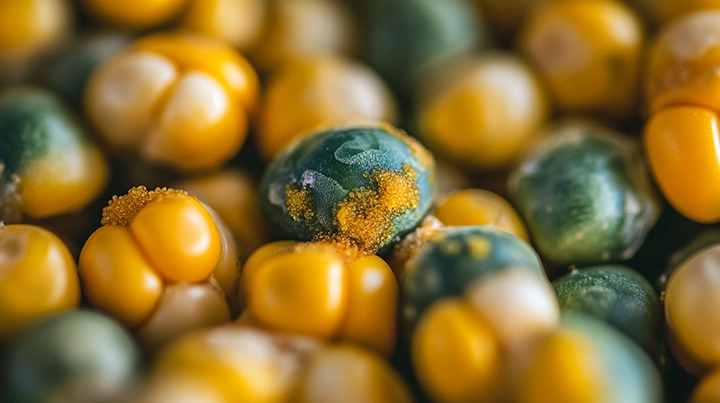
The assumption seems reasonable: mold and microbes are surface phenomena. They grow on walls, colonize food, appear on damp materials. They are problems you clean up, not forces that shape weather systems.
That assumption turns out to be incomplete.
Microscopic life does not stay where it starts. Fungal spores, bacterial cells, and soil microbes are continuously lifted off surfaces and carried upward — into air currents, into the upper atmosphere, and ultimately into clouds. What begins as a local phenomena becomes part of a planetary system. And once there, some of these particles do something unexpected: they influence how rain forms.
Why Rain Needs a Starting Point
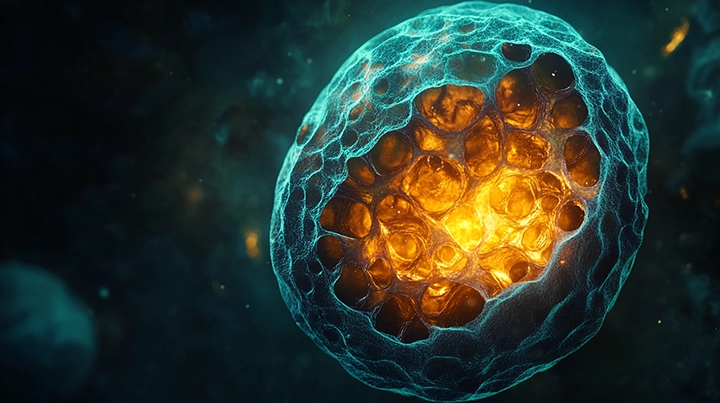
Water vapor alone does not produce rain. Clouds can hold enormous quantities of supercooled water — liquid droplets that remain unfrozen even well below 0°C — without precipitation occurring. For ice crystals to form, and for those crystals to grow heavy enough to fall, the water needs a surface to crystallize around.
This process is called ice nucleation. For decades, it was understood primarily through the lens of inorganic particles — dust, sea salt, mineral fragments carried aloft by wind. These particles provide surfaces where ice formation can begin. Without them, clouds remain suspended, their water content locked in an unstable liquid state.
What research over the past several decades has revealed is that biological particles — including microbes — can perform the same function. And in some cases, they perform it more efficiently than their inorganic counterparts.
The Bacteria That Freeze Water
Pseudomonas syringae is a plant pathogen. Its primary ecological role involves colonizing plant tissue and causing frost damage — a process it facilitates by producing specialized surface proteins that initiate ice formation at temperatures close to 0°C, far warmer than most inorganic particles require.
In agricultural contexts, this protein is a problem. It allows frost damage to occur at temperatures that would otherwise be harmless to crops. But in atmospheric contexts, the same protein becomes something more interesting: a highly efficient biological ice nucleator, capable of triggering ice crystal formation at conditions where inorganic particles would remain inactive.
Pseudomonas syringae has been recovered from rain, snow, and cloud water at altitudes far above the vegetation it normally inhabits. It travels. And when conditions align, it participates in the physics of precipitation in ways that scientists are still working to fully characterize.
Where Fungi Enter the Picture
Fungi contribute to this system through a different mechanism. Rather than producing ice-nucleating proteins directly, many fungal species release spores that can act as nucleation sites — surfaces around which water droplets can organize and freeze. The spores themselves become particles in the same process that dust and sea salt have always been known to participate in.
What distinguishes fungal spores is their abundance and their design. They are produced in quantities that dwarf most other biological particles. They are built to travel — lightweight, resilient, capable of surviving the UV exposure and temperature extremes of the upper atmosphere. And they are released continuously from soil, vegetation, and decomposing organic matter across the entire terrestrial surface of the planet.
The atmosphere, it turns out, is not empty between weather events. It is populated, invisibly, by biological material — and that material is not passive.

The Scale of the Journey
For a fungal spore or bacterial cell to influence cloud formation, it must first reach cloud altitude. This happens through aerosolization — the process by which surface disturbance, wind, and evaporation lift particles from soil and vegetation into moving air.
The distances involved are not trivial. Biological particles have been recovered from the upper troposphere, from ice cores in polar regions, and from rainfall thousands of kilometers from any plausible source. A spore released from forest soil in one continent may ultimately become part of a precipitation event on another.
This is not a theoretical possibility. It is a measured reality, documented across multiple studies using molecular identification techniques that can determine the biological origin of particles recovered from rain, snow, and high-altitude air samples.
The boundary between indoor and outdoor microbiology — already more permeable than most people assume — turns out to extend much further than the wall of a building.
What This Does and Doesn’t Mean
It is worth being precise about the limits of this influence. Microbes do not control weather. Precipitation depends on temperature gradients, atmospheric pressure, large-scale circulation patterns, and humidity at scales that dwarf the contribution of any biological particle.
What biological ice nucleators appear to do is participate in the efficiency and timing of ice formation under specific conditions. In a cloud where conditions are marginal — where inorganic nucleators alone might not be sufficient to trigger freezing at a given temperature — the presence of biological particles may shift the outcome. The precipitation that results is still governed by physics. The biology contributes a variable, not a determinant.
This distinction matters for how the research is interpreted. The finding is not that fungi make it rain. The finding is that fungi are part of a system that produces rain — one component in a network that scientists are only beginning to map with the resolution it requires.
A Different Way of Understanding Fungi
For mold in particular, this research creates a useful reframe. The dominant cultural understanding of mold is reactive: it appears somewhere it shouldn’t, it causes problems, it gets cleaned up. Even more scientifically informed perspectives tend to stop at the ecosystem level — mold as decomposer, mold as allergen, mold as structural problem.
The atmospheric research expands that picture considerably. Fungal spores are not simply the reproductive output of organisms living on surfaces. They are persistent components of the global atmosphere, contributing to processes that operate at continental scales.
This does not change how household mold should be managed. But it does change what fungi are understood to be — and what scale of system they participate in. An organism that seems confined to a damp corner of a building is, through its spores, connected to a planetary exchange between soil and sky that has been operating for longer than most of the ecosystems we recognize.

FAQ
- Can microbes really influence rain formation? They can contribute to ice nucleation within clouds — the process by which water droplets freeze around particles and begin to form precipitation. They are one component in a system that also includes temperature, humidity, and large-scale atmospheric dynamics.
- What is ice nucleation? The process by which supercooled water droplets freeze around a particle — biological or inorganic — forming ice crystals that can grow heavy enough to fall as precipitation.
- Are fungal spores found in the atmosphere? Yes, in significant quantities. Spores have been recovered from the upper troposphere, from polar ice cores, and from rainfall events thousands of kilometers from any terrestrial source.
- Do microbes control weather? No. Weather operates through large-scale physical systems. Biological particles contribute a variable to specific processes — particularly ice nucleation — but do not determine weather outcomes.
- Why does this matter beyond academic research? It suggests that ecosystem health — soil biology, vegetation, land use — may have indirect connections to atmospheric processes that are not captured by purely physical models of climate.
References
- Live Science — Some Fungi Can Influence the Weather: https://www.livescience.com/planet-earth/plants/some-fungi-can-influence-the-weather-and-now-we-know-how-they-do-it The Conversation — How Hidden Soil Fungi
- Steal Bacterial DNA to Control the Rain: https://theconversation.com/how-hidden-soil-fungi-steal-bacterial-dna-to-control-the-rain-279618 PMC / NIH — Biological Ice
- Nucleation: https://pmc.ncbi.nlm.nih.gov/articles/PMC4624964/