According to TECHNOLOGY NETWORKS
I. The Plastic Problem in Packaging
Single-use plastics, particularly in food packaging and paper coatings, such as those found inside coffee cups, represent a major environmental challenge. These synthetic materials, which provide essential resistance to liquids, grease, and oil, are slow to decompose, contributing significantly to global pollution and landfill waste.
The push for genuinely biodegradable, food-safe alternatives has driven researchers to explore the natural world, leading to a breakthrough using an unlikely source: an edible fungus.

Source: Wikimedia Commons, CC BY-SA 4.0
II. The Fungal Solution: The Turkey Tail Coating
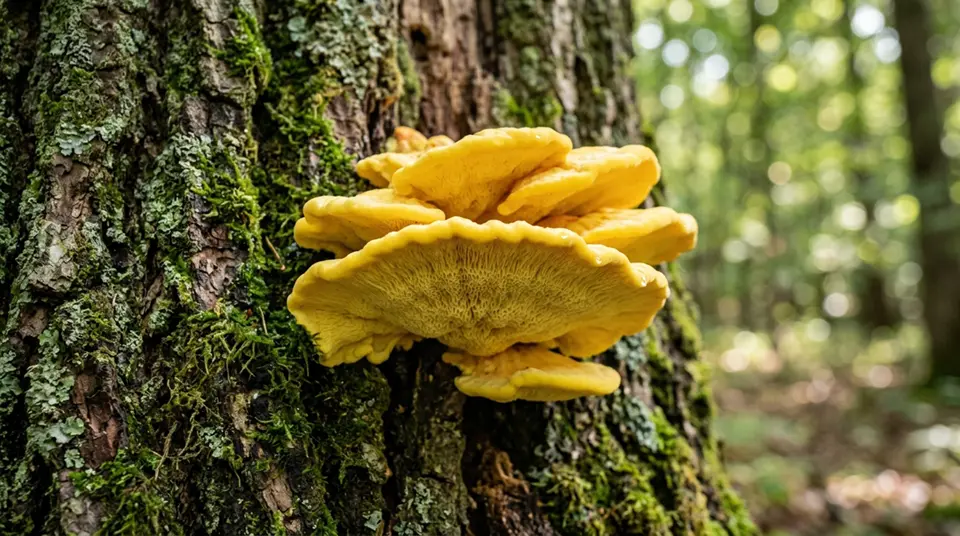
Researchers have successfully developed a thin, food-safe, and highly effective liquid-resistant coating derived from the mycelium—the root-like network—of an edible fungus commonly known as the “turkey tail” (Trametes versicolor).
This pioneering work, published in the journal Langmuir (American Chemical Society), outlines a method to harness the fungus’s natural properties to create a superior, sustainable barrier for common materials like paper, wood, and textiles.

Source: Wikimedia Commons, CC BY-SA 3.0
III. Bio-Fabrication and Barrier Properties
The process involves a form of bio-fabrication, combining the fungal network with plant fibers:
Composite Creation: Researchers blended the Trametes versicolor mycelia with a nutrient-rich solution of cellulose nanofibrils (tiny, fine fibers derived from wood pulp). The nanofibrils provide structural support and are already a common material in paper-making.
Fungal Growth: Thin layers of this mixture were applied to various materials, including paper, denim, polyester felt, and thin birch wood veneer. The samples were placed in a warm environment, allowing the fungus to grow an impervious film over a period of at least three days.
Inactivation: The process was completed by placing the samples in an oven, which inactivated the fungus and dried the coating, leaving behind a thin, protective layer.
The resulting fungal coating demonstrated remarkable hydrophobic (water-repelling) properties. Water droplets placed on the treated paper and textiles formed distinct, bead-like spheres, whereas water quickly soaked into the untreated materials.
IV. Resistance to Multiple Liquids
Crucially for commercial application, the fungal coating’s barrier function extends beyond water. The proof-of-concept study showed that the film effectively blocked the absorption of various organic liquids, including:
- Oil and Grease (e.g., castor oil)
- Organic Solvents (e.g., n-heptane and toluene)
This multi-liquid resistance suggests the coating’s significant potential in commercial applications where resistance to oil and grease is paramount—such as food packaging, disposable containers, and grease-proof papers.
V. Paving the Way for a Green Future
This fungal-based technology represents a major step toward a circular economy solution for packaging and textiles.
Sustainability: Unlike plastic coatings, the mycelium-based film is derived from natural, renewable resources and is completely biodegradable, leaving minimal environmental impact at the end of its life cycle.
Safety: The use of an edible fungus ensures the coating is food-safe — making it a viable alternative for direct-contact food packaging, such as single-use coffee cups and food wraps.
Scalability: Researchers suggest that this technology could be integrated into existing manufacturing processes with minimal changes, offering a practical and environmentally responsible replacement for plastic coatings in various industrial sectors.
Further work will focus on scaling the production and conducting long-term performance tests, but the initial findings demonstrate a clear path for fungi to help eliminate single-use plastics from the consumer market.

Source: Wikimedia Commons, CC BY-SA 4.0
References
- Javed, M. et al. (2024). Bio-derived Hydrophobic Mycelium Coatings for Paper and Textiles.
- Trametes versicolor – Wikipedia
- UNEP (2023). Single-use Plastics and Global Waste Impact.
According to TECHNOLOGY NETWORKS