According to MARCA
November in Michigan is a time of grey skies and biting winds, a season when nature typically goes dormant. But inside the federal courthouses and the quiet laboratories of Ann Arbor, a storm has just concluded—not of snow, but of spores.

Source: Wikimedia Commons, CC BY 2.0
The recent deportation of Yunqing Jian, a 33-year-old researcher formerly with the University of Michigan, marks the end of a legal saga that began with something as mundane as a backpack and as terrifying as the phrase “agroterrorism.” The headline is simple: Chinese scientists smuggled a crop-killing fungus. But as an observer who prefers the microscope to the megaphone, I find the truth is far more textured than a simple story of spies and crops.
The Fact Pattern: The contraband in the luggage
Let us strip away the geopolitical noise and look at the evidence. The timeline, as confirmed by court documents and federal filings, paints a picture of academic ambition colliding with federal law.
The central figure is Yunqing Jian and her partner, Zunyong Liu. The incident that triggered this domino effect occurred not in a high-tech spy facility, but at Detroit Metropolitan Airport. Liu was stopped with “red plant material” in his luggage—samples of Fusarium graminearum. He was turned away, but the investigation led agents to Jian’s lab at the University of Michigan.
The charge was smuggling. The outcome, finalized just days ago, was a guilty plea, time served, and immediate deportation for Jian.
Here, we must apply our principle of “truth over opinion.” Smuggling biological material is a crime. It violates the Plant Protection Act. The United States Department of Agriculture (USDA) requires strict permits (specifically the PPQ 526 permit) to move plant pests. This is not red tape; it is the firewall that protects American agriculture. Jian and Liu bypassed this firewall. That is the fact.
However, the context of that fact is where the story finds its human and scientific complexity.

Source: Wikimedia Commons, CC BY 2.0
The Antagonist: The “Scab” that costs Billions
To understand the panic, you must understand the fungus. Fusarium graminearum is not a rare, exotic poison from a spy novel. It is a biological sledgehammer that American farmers know intimately.
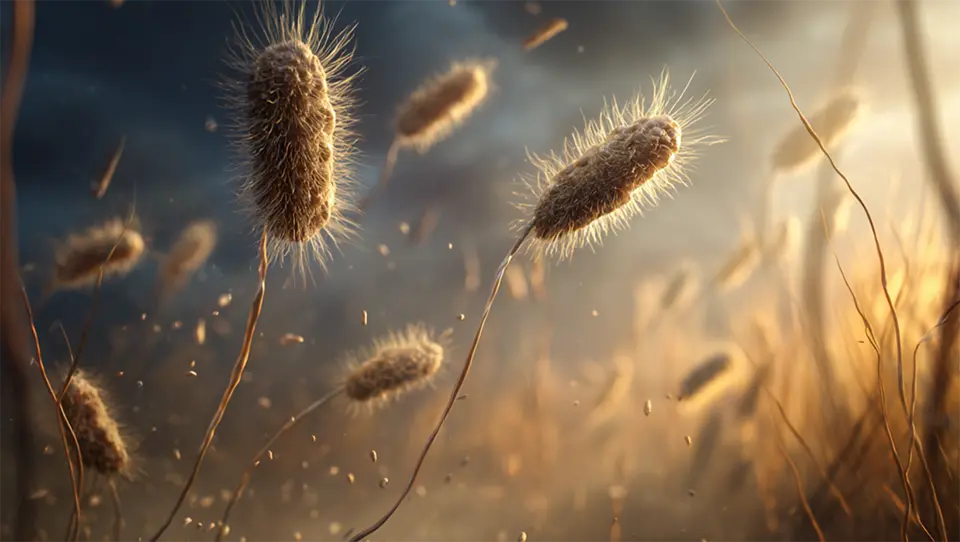
In the farming world, it is known as “Scab” or Fusarium Head Blight. It attacks wheat, barley, and corn. It doesn’t just kill the plant; it corrupts the harvest. The fungus produces a mycotoxin called deoxynivalenol (DON), colloquially and disgustingly known as “vomitoxin.” If grain has too much vomitoxin, it cannot be sold for food or feed. It must be destroyed.

Source: Wikimedia Commons, CC BY-SA 4.0
The economic devastation is real. As noted by experts like Tom Allen from Mississippi State University, this fungus costs the U.S. economy over $1 billion annually, and in bad years, it can slash yields by 45% in affected regions. Paired with global estimates that F. graminearum–driven Fusarium head blight has caused billions of dollars in losses worldwide, it turns golden fields into graveyards of shriveled, chalky kernels.

Source: Wikimedia Commons, CC BY 3.0
So, when federal prosecutors labeled the smuggled samples a “potential agroterrorism weapon,” they weren’t lying about the fungus’s destructive power. They were highlighting its resume.
The Paradox: Smuggling Coals to Newcastle?
This is where the story demands a double-take—a moment of rational skepticism.
Why smuggle a fungus that is already here?
Fusarium graminearum is ubiquitous in North American grain belts. Walk into a wheat field in Kansas or a cornfield in Iowa during a wet spring, and you will likely find it. It is as American as apple pie, albeit a rotten one.
Leading plant pathologists have pointed out this paradox. Why would a scientist risk prison to bring a common fungus into a country where it already thrives?
The answer likely lies in the nuances of research, not terrorism. Scientists often need specific strains or isolates to compare genetics. A strain from Jiangsu might have a slightly different gene for toxin production than a strain from Michigan. To study resistance—to build a better wheat plant—you need to test it against diverse enemies.
This does not excuse the crime. Bypassing the permit process is reckless. It assumes that you know better than the biosecurity protocols. But it changes the narrative from “malicious attack” to “arrogant negligence.” It suggests the motive was likely academic impatience rather than agricultural destruction.
he Human Core: The cost of a Backpack
Behind the legal briefs and the “agroterrorism” headlines, there is a human tragedy. Yunqing Jian was a scholar at a prestigious university. She had a career, a life in Ann Arbor, and a future in science.
That is all gone now.
The discovery of messages on her devices pledging loyalty to the Chinese Communist Party (CCP) added a layer of political intrigue that made this case impossible to treat as a simple regulatory error. It transformed a biosecurity breach into a national security incident.
But consider the atmosphere in labs across the country today. International collaboration is the lifeblood of science. Biology does not respect borders; a cure found in Beijing can save lives in Boston. Yet, this case casts a long shadow. Every international student, every shipped sample, is now viewed through a lens of suspicion. The “human core” here is the erosion of trust. When a scientist looks at a colleague, do they see a collaborator or a potential smuggler?
The Critical Perspective: Why Strictness Matters (YMYL)
From a “Your Money Your Life” (YMYL) perspective, the U.S. government’s hard line is justified. Agriculture is national security.
Even if Fusarium is already here, introducing a foreign strain is dangerous. What if the Chinese strain is hyper-virulent? What if it is resistant to the fungicides currently used by American farmers? What if it could mate with local strains to create a “super-scab”?
Ecology is fragile. We have seen what happens when we underestimate invasive or introduced threats—think of Chestnut blight or Dutch elm disease. The laws exist not to stop science, but to ensure that when we play with fire, we do it in a fireproof room.
Harborview Medical Center deals with fungal infections in people; the USDA deals with them in the food supply. Both require absolute rigor. A backpack is not a containment facility.
Conclusion: The Invisible Border
As Yunqing Jian returns to China, leaving behind a criminal record and a disrupted field of research, we are left with a sobering lesson.
We live in a world that is increasingly connected by travel but increasingly divided by suspicion. The “Red Dust” in the backpack was not just a biological contaminant; it was a symbol of this friction.
For the public, this is a reminder that food security is a constant, invisible battle fought by scientists and border agents. For the scientific community, it is a warning: The pursuit of knowledge is not a license to bypass the law.
The truth is, we don’t need new enemies. Nature, in the form of Fusarium graminearum, is formidable enough. We must fight it with science, yes, but science that respects the boundaries designed to keep us safe.
References
According to MARCA